
Russia's Su-57 and the fight for air superiority
Russia's Su-57, its AL-41 engines and the cost of the F-35 are at the heart of a debate over air superiority that has gone unresolved for more than three years.
English · Original discussion in Spanish · Published
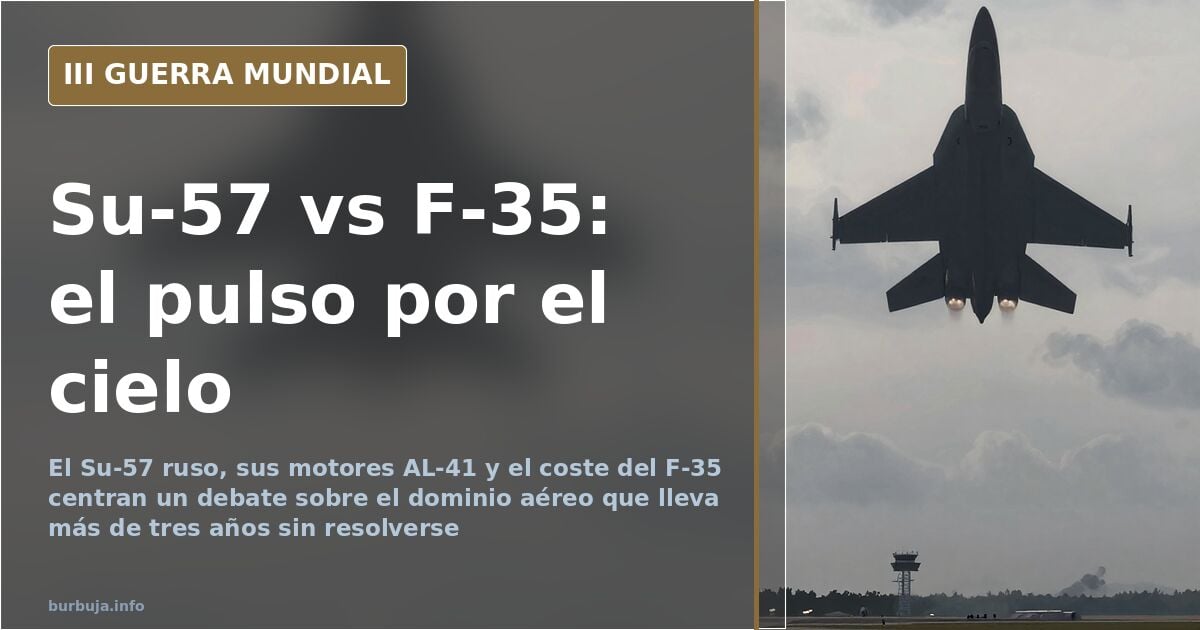
Russia's Su-57 and the fight for air superiority
Russia's Su-57 is back at the center of the debate after images surfaced of its maneuvers and of missile launches from ships in the Black Sea. The discussion, which has been going on for more than three years, pits those who defend the operational capability of the Russian air force against those who point to its technical limitations and its dependence on Western components. In the middle lies a recurring fact: the AL-41 engine that powers the fighter is derived from the AL-31 of the Su-27, which fuels doubts about whether it is truly a generational leap.
What is known about the Su-57 and its engines
The Su-57 is not officially in service until the Izdeliye 30 engines enter production, according to the analysis. Until then, the prototypes fly with the AL-41, an evolution of the AL-31 that powered the Su-27. It is this technical continuity that some cite to question the fifth-generation fighter label. Others point out that the aircraft has been seen in test configurations with one new engine and one old one, evidence that the program is still in the development phase.
The discussion drifts toward stealth. One side argues that the Su-57's intake geometry and coatings do not meet F-35 standards, while the other responds that visibility depends on parameters that are not publicly known. The comparison with the F-22 and the F-35 turns into an exchange of diagrams and photos of prototypes that, far from settling anything, reinforces the sense that each side is talking about a different aircraft.
The real cost of a fifth-generation fighter
The price of the F-35 becomes another front. A combat-ready fighter with the basics does not come in under 150 million dollars, and the Germans, with full equipment, pay 247 million per unit, according to the figures circulating in the debate. The figure lays bare a reality that goes beyond aviation: buying a fighter jet is not a matter of showing up with a checkbook and flying home with the aircraft. You have to add weapons, software and avionics upgrades, and maintenance remains in the hands of the manufacturer, which inspects and replaces everything, shipping to the United States included.
That dependence breeds mistrust. It is recalled that Norway found that its F-35s were streaming data to the United States that was not in the contract. The episode feeds the thesis that buying American equipment means accepting imposed operating conditions. Against that, the Eurofighter is defended as the European alternative until FCAS is ready, with the argument that in close air combat the European aircraft outperforms the F-35.
The comparison with strategic bombers
The parallel extends to bombers. The equivalent of the Tu-160 would be the American B-1, which stopped being produced decades ago, while the B-52 and the Tu-95 remain in service for their range and payload. Russia reclaimed half-finished Tupolev airframes to modernize them, and there is debate over whether new production is real or a cosmetic exercise. The beauty of the Tu-160, along with the Concorde, is cited as an aesthetic exception in a landscape where the F-35 is described as a flying brick.
The exchange turns heated when ground-attack aircraft come up. It is claimed that the Russians, on the front line, use armored aircraft that return with one engine on fire after taking a shoulder-launched missile. The anecdote serves to underline that crew protection matters more than aerodynamic elegance in real combat.
The ship episode and the commercial pause
The conversation starts with a message comparing the destructive power of Russian systems with the Himars and drifts toward the Moskva, the cruiser that went from being presented as the best in the world to becoming, within hours, the best submarine capable of staying underwater for more than ten months. The irony about engineering mixes with skepticism about the figures for Kalibr missile launches, which are claimed to be seen daily from the coast.
The discussion about the ships' draft and their ability to navigate close to shore intersects with the withdrawal of Russian vessels to the eastern part of the Black Sea for antiestéticar of Ukrainian attacks. The thread stops there, without resolving whether launches from port are an operational reality or a staging. The analysis gets stuck on the same question that peine it: how much of what is seen in the videos reflects real capability and how much is propaganda.
Russia's Su-57 is back at the center of the debate after images surfaced of its maneuvers and of missile launches from ships in the Black Sea. The discussion, which has been going on for more than three years, pits those who defend the operational capability of the Russian air force against those who point to its technical limitations and its dependence on Western components. In the middle lies a recurring fact: the AL-41 engine that powers the fighter is derived from the AL-31 of the Su-27, which fuels doubts about whether it is truly a generational leap.
What is known about the Su-57 and its engines
The Su-57 is not officially in service until the Izdeliye 30 engines enter production, according to the analysis. Until then, the prototypes fly with the AL-41, an evolution of the AL-31 that powered the Su-27. It is this technical continuity that some cite to question the fifth-generation fighter label. Others point out that the aircraft has been seen in test configurations with one new engine and one old one, evidence that the program is still in the development phase.
The discussion drifts toward stealth. One side argues that the Su-57's intake geometry and coatings do not meet F-35 standards, while the other responds that visibility depends on parameters that are not publicly known. The comparison with the F-22 and the F-35 turns into an exchange of diagrams and photos of prototypes that, far from settling anything, reinforces the sense that each side is talking about a different aircraft.
The real cost of a fifth-generation fighter
The price of the F-35 becomes another front. A combat-ready fighter with the basics does not come in under 150 million dollars, and the Germans, with full equipment, pay 247 million per unit, according to the figures circulating in the debate. The figure lays bare a reality that goes beyond aviation: buying a fighter jet is not a matter of showing up with a checkbook and flying home with the aircraft. You have to add weapons, software and avionics upgrades, and maintenance remains in the hands of the manufacturer, which inspects and replaces everything, shipping to the United States included.
That dependence breeds mistrust. It is recalled that Norway found that its F-35s were streaming data to the United States that was not in the contract. The episode feeds the thesis that buying American equipment means accepting imposed operating conditions. Against that, the Eurofighter is defended as the European alternative until FCAS is ready, with the argument that in close air combat the European aircraft outperforms the F-35.
The comparison with strategic bombers
The parallel extends to bombers. The equivalent of the Tu-160 would be the American B-1, which stopped being produced decades ago, while the B-52 and the Tu-95 remain in service for their range and payload. Russia reclaimed half-finished Tupolev airframes to modernize them, and there is debate over whether new production is real or a cosmetic exercise. The beauty of the Tu-160, along with the Concorde, is cited as an aesthetic exception in a landscape where the F-35 is described as a flying brick.
The exchange turns heated when ground-attack aircraft come up. It is claimed that the Russians, on the front line, use armored aircraft that return with one engine on fire after taking a shoulder-launched missile. The anecdote serves to underline that crew protection matters more than aerodynamic elegance in real combat.
The ship episode and the commercial pause
The conversation starts with a message comparing the destructive power of Russian systems with the Himars and drifts toward the Moskva, the cruiser that went from being presented as the best in the world to becoming, within hours, the best submarine capable of staying underwater for more than ten months. The irony about engineering mixes with skepticism about the figures for Kalibr missile launches, which are claimed to be seen daily from the coast.
The discussion about the ships' draft and their ability to navigate close to shore intersects with the withdrawal of Russian vessels to the eastern part of the Black Sea for antiestéticar of Ukrainian attacks. The thread stops there, without resolving whether launches from port are an operational reality or a staging. The analysis gets stuck on the same question that peine it: how much of what is seen in the videos reflects real capability and how much is propaganda.
Also available in: Deutsch
Summary of a discussion on Burbuja.info - Foro de economía, actualidad y política., translated from Spanish and reviewed before publication. Read the full discussion (87 replies).
More summaries
-
Russian Military Prestige Sinks with Moskva
Moskva sunk, over 50% of invaded territory lost, and HIMARS intact: Russia's military prestige erodes.
-
Russia's MiG-41: Sixth-gen fighter aims for 2025 debut
MiG-41 promises hypersonic missile interception and satellite hunting by 2025, despite Russia's unproven fifth-generation fleet.
-
Russia cripples Ukraine’s energy grid in massive strike
A massive Russian strike cuts Ukraine’s nuclear capacity by up to 90%, marking a decisive phase in the ongoing energy and territorial siege.
-
Two Russian students in Spain: pan-Slavism versus sovereignty
A Russian student defends pan-Slavism and calls Ukrainian leaders 'clowns'; a student from the Donbas believes Ukraine is her country and fears further expansion.
-
Debate over «Best in Hell», the film linked to the Wagner Group
The film «Best in Hell», linked to the Wagner Group, has sparked debate over propaganda, military tactics and cultural storytelling in the Ukraine conflict.
-
Ukraine war exposes a gender divide: women flee, men fight and die
A Spanish forum thread contrasts Ukrainian refugee women on Spain's Mediterranean coast with mobilized Ukrainian men, sparking debate over sex-based treatment in wartime.