
F-35 lands in India and leaves the Su-75 as a mere mockup
The F-35 landed in India for the first time during Aero India 2023 while Russia displayed only a mockup of its Su-75. The contrast between an operational fighter and a…
English · Original discussion in Spanish · Published
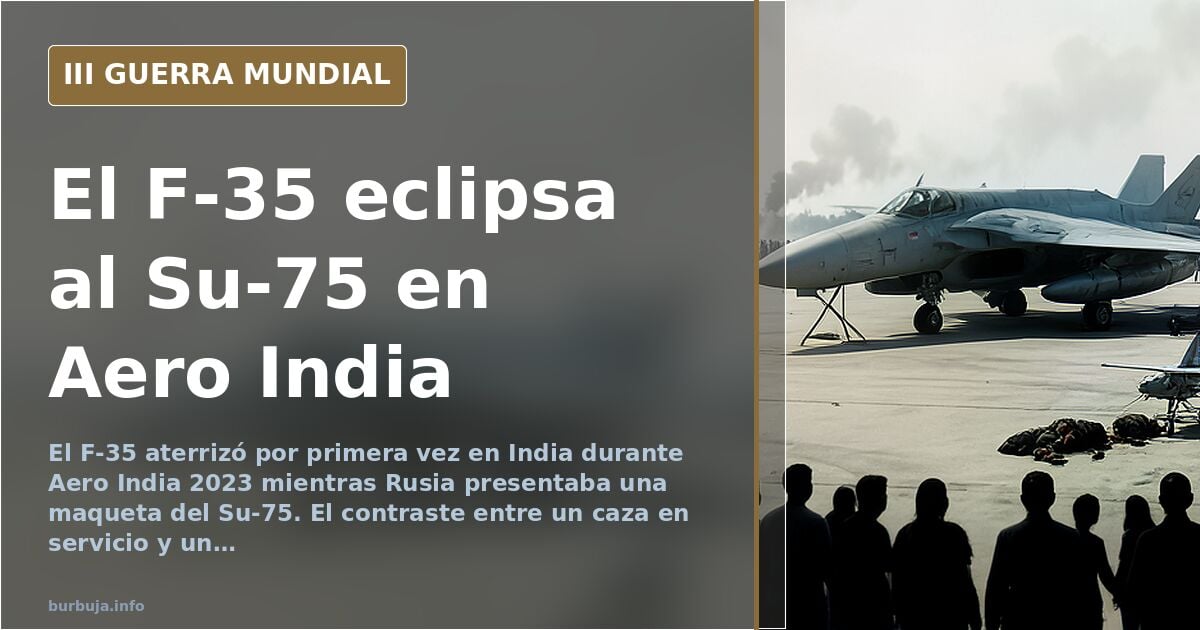
The F-35 upstages the Su-75 at Aero India
The American F-35 landed in India for the first time during the Aero India 2023 air show, held in February, just as Russia presented a mockup of its Su-75 Checkmate. The contrast is the story: a fifth-generation fighter in active service versus a project still seeking funding. The aerial display by two Lightning IIs at Yelahanka air base, flying in from Hill Air Force Base (Utah) and Eielson (Alaska), produced stunning images and a message that was hard to hide.
The F-35 represents the cutting edge of American combat technology, according to Major General Julian C. Cheater, Deputy Assistant Secretary of the Air Force for International Affairs. The US delegation made no secret that Aero India was a showcase for "advanced, capable, lethal and interoperable" weapons systems. Meanwhile, the Russian delegation, led by Rosoboronexport, offered India a stake in developing the Su-75 and producing it at HAL facilities.
An aircraft in service versus a mockup
The difference between the two projects is not only technological but one of status. The F-35 has years of operation and international deployments behind it; the Su-75 Checkmate remains in development and, at the time of the show, its presence was limited to a mockup. That asymmetry was the focus of the debate: comparing an operational fighter with an aircraft that has yet to fly is, at the very least, premature. The original reference article framed it as proof that the Russian project is "a joke," but the comparison is misleading: one is in service and the other is looking for investors.
The Su-30MKI, which is indeed in service with India, is no example of successful cooperation either. The Indian government suspended orders over concerns about the Kremlin's ability to supply parts to HAL due to international sanctions and payment transfer problems. The F-35's presence probably didn't help Russian interests at the show either.
The Russian offer: fund development in exchange for local production
Russia spared no effort. Alexander Mikheev, Director General of Rosoboronexport, told TASS that Russia is willing to continue cooperating on fifth-generation fighters and to produce new aircraft at HAL facilities once the contract is signed. The proposal included India financing part of the Su-75's development, a model Moscow markets as a low-cost alternative to the F-35.
Previous experience with the Su-30MKI, however, left a bitter aftertaste. The aircraft has been the backbone of the Indian Air Force, but dependence on Russian supplies and payment difficulties under sanctions have cooled the relationship. The F-35 is not formally on offer to India —US officials called such talk "premature"— but its mere presence at Yelahanka sent a signal about the reliability of the technological partner.
The debate over Russia's aviation industry
The conversation drifted toward Russian industrial capacity. Some argue that Russia cannot build fifth-generation aircraft without access to blocked Western technology, and that its aviation industry amounts to little more than mockups and propaganda. Against that, others contend that Russia continues producing combat aircraft and missiles, and that China manufactures under Russian license, proving the technological base exists. The debate over whether Russia can build a modern fighter without Western partners remains open.
The Su-75's number does not imply superiority over the Su-57; in fact, it is conceived as an inferior model aimed at export markets. The Su-57 doesn't seem to have won over all potential partners either: India, initially a participant in the project, walked away. The comparison with the F-35, then, is not just between two aircraft, but between two models of industry and alliances.
The F-35 has nothing to prove at an air show: it is already in service. The Su-75 needs funding to exist at all. The difference is fundamental, not cosmetic. It remains to be seen whether India, playing both sides, will be seduced by the Russian offer or whether the American presence at Aero India tips the scales. The available data suggested the Su-75 was still looking for partners.
The American F-35 landed in India for the first time during the Aero India 2023 air show, held in February, just as Russia presented a mockup of its Su-75 Checkmate. The contrast is the story: a fifth-generation fighter in active service versus a project still seeking funding. The aerial display by two Lightning IIs at Yelahanka air base, flying in from Hill Air Force Base (Utah) and Eielson (Alaska), produced stunning images and a message that was hard to hide.
The F-35 represents the cutting edge of American combat technology, according to Major General Julian C. Cheater, Deputy Assistant Secretary of the Air Force for International Affairs. The US delegation made no secret that Aero India was a showcase for "advanced, capable, lethal and interoperable" weapons systems. Meanwhile, the Russian delegation, led by Rosoboronexport, offered India a stake in developing the Su-75 and producing it at HAL facilities.
An aircraft in service versus a mockup
The difference between the two projects is not only technological but one of status. The F-35 has years of operation and international deployments behind it; the Su-75 Checkmate remains in development and, at the time of the show, its presence was limited to a mockup. That asymmetry was the focus of the debate: comparing an operational fighter with an aircraft that has yet to fly is, at the very least, premature. The original reference article framed it as proof that the Russian project is "a joke," but the comparison is misleading: one is in service and the other is looking for investors.
The Su-30MKI, which is indeed in service with India, is no example of successful cooperation either. The Indian government suspended orders over concerns about the Kremlin's ability to supply parts to HAL due to international sanctions and payment transfer problems. The F-35's presence probably didn't help Russian interests at the show either.
The Russian offer: fund development in exchange for local production
Russia spared no effort. Alexander Mikheev, Director General of Rosoboronexport, told TASS that Russia is willing to continue cooperating on fifth-generation fighters and to produce new aircraft at HAL facilities once the contract is signed. The proposal included India financing part of the Su-75's development, a model Moscow markets as a low-cost alternative to the F-35.
Previous experience with the Su-30MKI, however, left a bitter aftertaste. The aircraft has been the backbone of the Indian Air Force, but dependence on Russian supplies and payment difficulties under sanctions have cooled the relationship. The F-35 is not formally on offer to India —US officials called such talk "premature"— but its mere presence at Yelahanka sent a signal about the reliability of the technological partner.
The debate over Russia's aviation industry
The conversation drifted toward Russian industrial capacity. Some argue that Russia cannot build fifth-generation aircraft without access to blocked Western technology, and that its aviation industry amounts to little more than mockups and propaganda. Against that, others contend that Russia continues producing combat aircraft and missiles, and that China manufactures under Russian license, proving the technological base exists. The debate over whether Russia can build a modern fighter without Western partners remains open.
The Su-75's number does not imply superiority over the Su-57; in fact, it is conceived as an inferior model aimed at export markets. The Su-57 doesn't seem to have won over all potential partners either: India, initially a participant in the project, walked away. The comparison with the F-35, then, is not just between two aircraft, but between two models of industry and alliances.
The F-35 has nothing to prove at an air show: it is already in service. The Su-75 needs funding to exist at all. The difference is fundamental, not cosmetic. It remains to be seen whether India, playing both sides, will be seduced by the Russian offer or whether the American presence at Aero India tips the scales. The available data suggested the Su-75 was still looking for partners.
Also available in: Deutsch
Summary of a discussion on Burbuja.info - Foro de economía, actualidad y política., translated from Spanish and reviewed before publication. Read the full discussion (86 replies).
More summaries
-
Ukraine War Analyst on YouTube: Praised and Criticized
A 35-year-old lawyer has become a controversial Ukraine war analyst on YouTube, drawing praise from fans and accusations of propaganda from critics.
-
Spain Hesitates on F-35B Purchase Amid No STOVL Rivals
With no viable STOVL competitors, Spain delays the F-35B decision. The $200 million cost per unit faces scrutiny against drone and submarine alternatives.
-
F-35 Costs and Availability Under Scrutiny
Debate on the F-35 highlights a $250M unit cost versus $150M for Eurofighters and 55% availability. A failed maneuver video reignites scrutiny.
-
Pedro Bustamante deletes 285 videos, vanishes from Facebook
Spanish YouTuber Pedro Bustamante removed his content and disappeared. Rumors place him in Munich, reading German press.
-
Ukraine war exposes a gender divide: women flee, men fight and die
A Spanish forum thread contrasts Ukrainian refugee women on Spain's Mediterranean coast with mobilized Ukrainian men, sparking debate over sex-based treatment in wartime.
-
Forum debate: is the Ukraine war a staged deal?
A forum user claims the war is "negotiated between the USA and Russia"; others push back. The role of Spain's PSOE and the theories circulating are up for debate.