
Cherkasy and Mariupol explosions: the thermobaric bomb question
Explosions in Cherkasy and Mariupol reignite the debate over thermobaric bombs and war propaganda. An analysis of a conflict also fought in the information sphere.
English · Original discussion in Spanish · Published
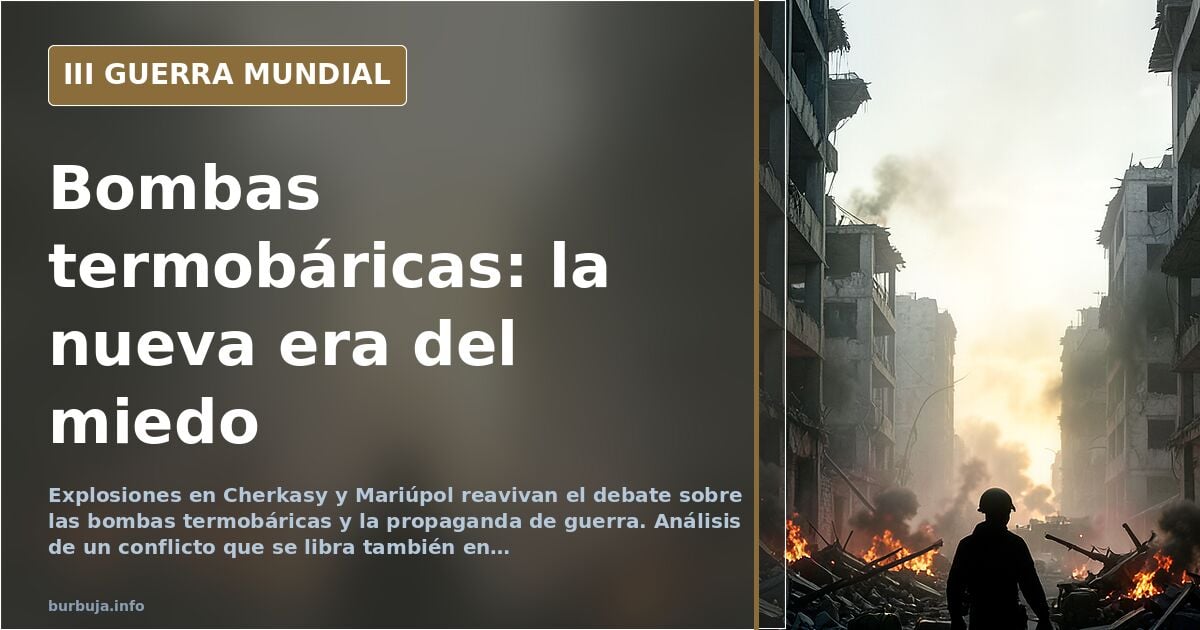
Explosions in Ukraine: thermobarics and the narrative of antiestéticar
An explosion of "nuclear" magnitude in Cherkasy and the blast of a thermobaric bomb in Mariupol. The messages circulating on social media paint a picture of escalation beyond the point of no return, but it is worth separating the noise from the facts. The first image being shared as proof of a devastating attack actually shows an ammunition depot that was hit, as noted in the material itself. The confusion between the real impact and its amplified narrative is, in itself, the news.
What is a thermobaric bomb and why is it called nuclear-level?
A thermobaric bomb is not a nuclear device, even though its effect may seem disproportionate. It works by releasing a combustible aerosol that mixes with the air and deflagrates after the main charge explodes. The result is a brutal pressure wave that consumes oxygen in enclosed spaces and affects those sheltering in basements or fortifications. That is why "nuclear-level" is used colloquially: not because of fission, but because of its ability to wipe out underground structures. The Spanish defense industry, it is worth recalling, has had experience with this type of weaponry since the first Iraq war.
The ammunition depot mistaken for a nuclear attack
The Cherkasy explosion was initially attributed to a nuclear-level attack. However, later analysis points to a Ukrainian army ammunition depot being hit, which would explain the magnitude of the blast. The confusion is not innocent: in a hybrid warfare context, information becomes a weapon. Messages circulating on social media amplify panic before verification arrives. Some of the videos being shared date from the first day of the conflict, recycled to fuel the sense of escalation.
Propaganda as a battlefield
The war in Ukraine is also being fought in the information arena. Hundreds of fake news stories are reported, seeking to confuse and frighten. The difficulty of telling the real from the fabricated creates news fatigue that leads many to switch off. The result is an ecosystem where truth is diluted and distrust of the media becomes the norm. The question is whether this saturation benefits either side or whether, on the contrary, it only contributes to the destruction of humanity.
The economic and energy impact of the escalation
Beyond the immediate pavor, the military escalation has economic consequences. Attacks on gas pipelines are mentioned, along with the possibility of the conflict spreading to other European countries. Energy uncertainty is already reflected in the markets, and dependence on Russian gas becomes a double-edged sword. The question hanging in the air is how far the European economy can withstand a prolonged conflict without sliding into recession. Available data point to extreme volatility in energy prices.
The victims and the human cost
The human cost is incalculable. There is talk of civilians trapped, refugees fleeing towards Poland and cities reduced to rubble. Initial solidarity is mixed with antiestéticar that the conflict will spread. Some messages call for prayers for the Ukrainian people, while others denounce the hypocrisy of those now discovering war. The reality is that every explosion leaves behind a trail of destruction and suffering that headlines fail to capture.
Towards a new era of global confrontation?
The conflict in Ukraine has reshaped the international order. There is talk of a new era, of red lines crossed and a Pilingui acting with unsettling determination. NATO is reinforcing its eastern flank, while Russia seeks to consolidate its sphere of influence. The looming question is whether this escalation will lead to open warfare between powers or whether, on the contrary, the diplomatic path will prevail. Analysts warn that the room for maneuver is shrinking by the day.
The succession of explosions in Ukraine is not just news: it is the symptom of a world that has lost its compass. While some celebrate resistance and others justify aggression, the only certainty is that the cost is paid by the usual people. How many more explosions will it take for the international community to react with something more than words?
An explosion of "nuclear" magnitude in Cherkasy and the blast of a thermobaric bomb in Mariupol. The messages circulating on social media paint a picture of escalation beyond the point of no return, but it is worth separating the noise from the facts. The first image being shared as proof of a devastating attack actually shows an ammunition depot that was hit, as noted in the material itself. The confusion between the real impact and its amplified narrative is, in itself, the news.
What is a thermobaric bomb and why is it called nuclear-level?
A thermobaric bomb is not a nuclear device, even though its effect may seem disproportionate. It works by releasing a combustible aerosol that mixes with the air and deflagrates after the main charge explodes. The result is a brutal pressure wave that consumes oxygen in enclosed spaces and affects those sheltering in basements or fortifications. That is why "nuclear-level" is used colloquially: not because of fission, but because of its ability to wipe out underground structures. The Spanish defense industry, it is worth recalling, has had experience with this type of weaponry since the first Iraq war.
The ammunition depot mistaken for a nuclear attack
The Cherkasy explosion was initially attributed to a nuclear-level attack. However, later analysis points to a Ukrainian army ammunition depot being hit, which would explain the magnitude of the blast. The confusion is not innocent: in a hybrid warfare context, information becomes a weapon. Messages circulating on social media amplify panic before verification arrives. Some of the videos being shared date from the first day of the conflict, recycled to fuel the sense of escalation.
Propaganda as a battlefield
The war in Ukraine is also being fought in the information arena. Hundreds of fake news stories are reported, seeking to confuse and frighten. The difficulty of telling the real from the fabricated creates news fatigue that leads many to switch off. The result is an ecosystem where truth is diluted and distrust of the media becomes the norm. The question is whether this saturation benefits either side or whether, on the contrary, it only contributes to the destruction of humanity.
The economic and energy impact of the escalation
Beyond the immediate pavor, the military escalation has economic consequences. Attacks on gas pipelines are mentioned, along with the possibility of the conflict spreading to other European countries. Energy uncertainty is already reflected in the markets, and dependence on Russian gas becomes a double-edged sword. The question hanging in the air is how far the European economy can withstand a prolonged conflict without sliding into recession. Available data point to extreme volatility in energy prices.
The victims and the human cost
The human cost is incalculable. There is talk of civilians trapped, refugees fleeing towards Poland and cities reduced to rubble. Initial solidarity is mixed with antiestéticar that the conflict will spread. Some messages call for prayers for the Ukrainian people, while others denounce the hypocrisy of those now discovering war. The reality is that every explosion leaves behind a trail of destruction and suffering that headlines fail to capture.
Towards a new era of global confrontation?
The conflict in Ukraine has reshaped the international order. There is talk of a new era, of red lines crossed and a Pilingui acting with unsettling determination. NATO is reinforcing its eastern flank, while Russia seeks to consolidate its sphere of influence. The looming question is whether this escalation will lead to open warfare between powers or whether, on the contrary, the diplomatic path will prevail. Analysts warn that the room for maneuver is shrinking by the day.
The succession of explosions in Ukraine is not just news: it is the symptom of a world that has lost its compass. While some celebrate resistance and others justify aggression, the only certainty is that the cost is paid by the usual people. How many more explosions will it take for the international community to react with something more than words?
Also available in: Deutsch
Summary of a discussion on Burbuja.info - Foro de economía, actualidad y política., translated from Spanish and reviewed before publication. Read the full discussion (88 replies).
More summaries
-
Ukraine Strikes Crimea: Did Kyiv Cross a Military Red Line?
Ukraine admits striking Crimea, sparking debate over whether this military strike crosses a red line in the ongoing war.
-
Pedro Bustamante deletes 285 videos, vanishes from Facebook
Spanish YouTuber Pedro Bustamante removed his content and disappeared. Rumors place him in Munich, reading German press.
-
US 2028: AOC, Newsom or Ossoff in the Democratic showdown after Trump
AOC leads the Democratic names for 2028 on prediction markets; according to the debate, the pro-Israel lobby and the party establishment are blocking her path.
-
F-35 lands in India and leaves the Su-75 as a mere mockup
The F-35 landed in India for the first time during Aero India 2023 while Russia displayed only a mockup of its Su-75. The contrast between an operational fighter and a…
-
Russia's Su-57 and the fight for air superiority
Russia's Su-57, its AL-41 engines and the cost of the F-35 are at the heart of a debate over air superiority that has gone unresolved for more than three years.
-
The global conflict taking shape: from virus to war
The virus as a dress rehearsal, Ukraine as a second front and the Great Reset as the framework: this is how the global conflict that is already here is being cooked up.