
Turn off the TV and read: how to live without losing your health or your mind
Turn off the TV, read books and tend a vegetable garden: the domestic recipe gaining fans for stress-free living in an increasingly toxic environment.
English · Original discussion in Spanish · Published
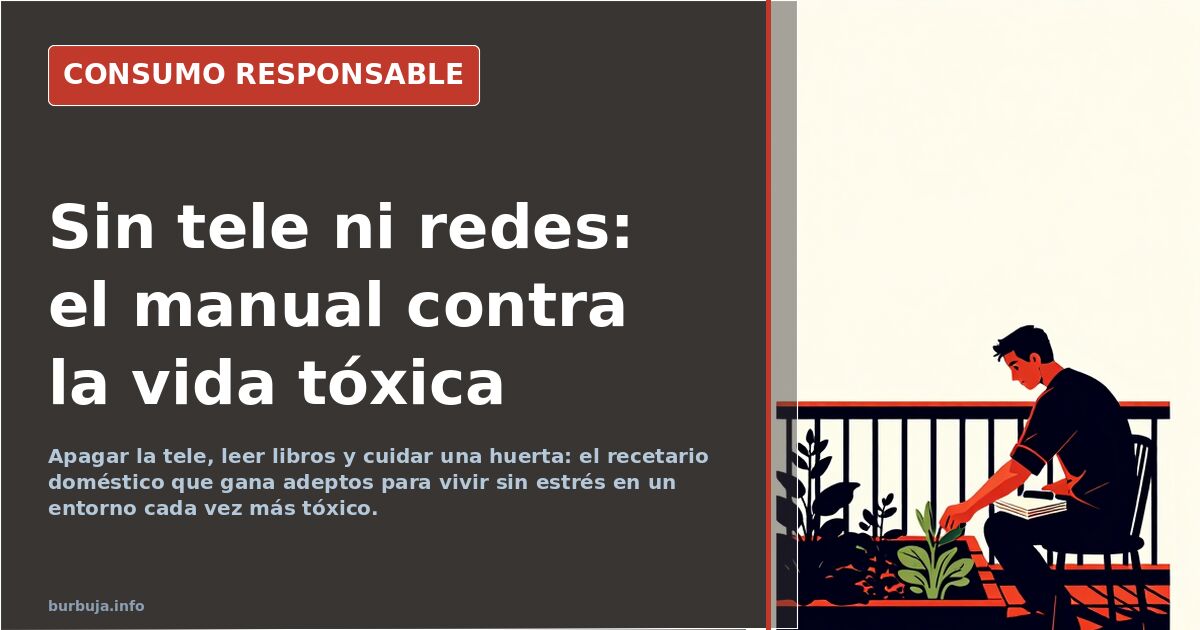
Ditch the TV and plant: the home recipe against toxic modern life
Why does the constant noise of current events leave so many people exhausted and without having done anything worthwhile? The answer circulating among those who have spent years trying out a modest, domestic, unheroic escape is blunt: because much of the system is designed for people to burn time, screens and energy on things that lead nowhere. The recipe that has been piling up proposes turning off the TV tap, getting back into reading, moving every day and treating time as something not to be given away to anyone.
The idea is neither new nor original, but it has its own internal logic: if outside noise creates stress, perhaps the way is not to change the world but to reduce the surface area of contact with it. From that comes a manual that mixes work, news, leisure and time management.
Turning off the television: the most repeated measure
If anything dominates the recipe, it is removing television from daily life. “I’ve gained quite a lot of quality of life by stopping watching television,” sums up someone who first cut conventional channels, then switched to the paid catalog and ended up watching barely one film a week. The same forum user confirms that, four years after proposing it, he watches “even less TV than back then” and has moved on to films from the 1990s or earlier.
The diagnosis they share is that the schedule runs on overstimulation: people shouting alarming news items that the viewer has not seen and never will. The proposed substitute is a curated podcast on a wireless speaker, which can be rationed, stopped and chosen at will. Television “is a cesspit of bad information,” concludes another post.
Training, time of one’s own and the job that never comes
On the work front, the recurring advice is to invest in useful training and distrust government short courses, which are credited with little usefulness and a notable ability to devour time. For anyone unemployed, the recommendation is to choose a trade you like rather than chase any job for the salary. And one idea comes up again and again: look for work that fits your personality, even if it pays less.
Time, the third axis of the approach, should be managed “naturally, without stress”, with an austere planning of needs and without giving your life over to working for others. The word that sums up that idea is lonchafinista: spend little, spend well and don’t depend on someone else’s payroll to have peace.
Reading, fishing, walking and growing: leisure that calms
Leisure, says the text that opens the thread, is mostly noise and garbage, often designed to create absurd needs. The alternative that piles up in the replies is a catalog of slow activities: reading real books, escaping screen content that leads nowhere, training functionally and without obsession, playing an instrument, doing DIY and redecorating a storage room until it becomes a workshop.
Fishing gets the most votes. “Standing by the sea, watching the sunrise, rod in hand, is one of the most relaxing things there is,” says a practitioner. Further down, another experience: an abandoned vegetable garden half an hour by train from the city, with a fireplace for roasting meat and no known owner, because the heirs want nothing to do with the place. There they have found newspapers from 2004 and ten-cent peseta coins from 1947, a sign that it had gone about fifteen years without use. “The only thing that calms me,” he admits.
Gentle physical exercise, especially walking a lot through flat, risk-free landscapes, completes the picture. Some even read while walking, with a phone that has nothing installed but an e-book reader.
Stoicism, friends and the warning not to isolate yourself
There is a stoic vein at the bottom of all this: gratitude, real food, rest and social relationships that hold up. Reading as a pillar, with recommendations ranging from a popular-science manual on how to rebuild civilization after a collapse to the classics. And the warning that endless arguments, including those sustained on the internet, are another way of wasting time.
One post insists on something that clashes with the general tone: don’t isolate yourself. Going camping with friends as when you were sixteen, even if getting food is a disaster and schedules go out the window. In times this forum user calls individualistic, putting up with friends and doing things in a group is, for him, one of the things you have to do.
The turn toward autonomy: from the vegetable garden to the shelter
Over the years, the conversation drifts toward a more defensive tone. Proposals appear for food autonomy, own vegetable gardens, firewood and roasts, the idea of sowing and harvesting applied to every area of life. Other posts flirt with scenarios of scarcity, with the idea that learning to hunt rodents or set up a street stall could be useful if the system breaks. It is a minority faction, but it reveals that beneath the talk of rest beats a deep distrust of structures.
The close: two incompatible recipes
There is a point where the recipe contradicts itself. Some maintain that the solution is to plant, read and disconnect; others, that the only way out is to leave the country. The most pragmatic recall that every era has its propaganda and that cinema from decades ago offers stories that today’s screens cannot match. With so much domestic pedagogy, one wonders how many people still watch the news every night. And there the television still is, switched on.
Why does the constant noise of current events leave so many people exhausted and without having done anything worthwhile? The answer circulating among those who have spent years trying out a modest, domestic, unheroic escape is blunt: because much of the system is designed for people to burn time, screens and energy on things that lead nowhere. The recipe that has been piling up proposes turning off the TV tap, getting back into reading, moving every day and treating time as something not to be given away to anyone.
The idea is neither new nor original, but it has its own internal logic: if outside noise creates stress, perhaps the way is not to change the world but to reduce the surface area of contact with it. From that comes a manual that mixes work, news, leisure and time management.
Turning off the television: the most repeated measure
If anything dominates the recipe, it is removing television from daily life. “I’ve gained quite a lot of quality of life by stopping watching television,” sums up someone who first cut conventional channels, then switched to the paid catalog and ended up watching barely one film a week. The same forum user confirms that, four years after proposing it, he watches “even less TV than back then” and has moved on to films from the 1990s or earlier.
The diagnosis they share is that the schedule runs on overstimulation: people shouting alarming news items that the viewer has not seen and never will. The proposed substitute is a curated podcast on a wireless speaker, which can be rationed, stopped and chosen at will. Television “is a cesspit of bad information,” concludes another post.
Training, time of one’s own and the job that never comes
On the work front, the recurring advice is to invest in useful training and distrust government short courses, which are credited with little usefulness and a notable ability to devour time. For anyone unemployed, the recommendation is to choose a trade you like rather than chase any job for the salary. And one idea comes up again and again: look for work that fits your personality, even if it pays less.
Time, the third axis of the approach, should be managed “naturally, without stress”, with an austere planning of needs and without giving your life over to working for others. The word that sums up that idea is lonchafinista: spend little, spend well and don’t depend on someone else’s payroll to have peace.
Reading, fishing, walking and growing: leisure that calms
Leisure, says the text that opens the thread, is mostly noise and garbage, often designed to create absurd needs. The alternative that piles up in the replies is a catalog of slow activities: reading real books, escaping screen content that leads nowhere, training functionally and without obsession, playing an instrument, doing DIY and redecorating a storage room until it becomes a workshop.
Fishing gets the most votes. “Standing by the sea, watching the sunrise, rod in hand, is one of the most relaxing things there is,” says a practitioner. Further down, another experience: an abandoned vegetable garden half an hour by train from the city, with a fireplace for roasting meat and no known owner, because the heirs want nothing to do with the place. There they have found newspapers from 2004 and ten-cent peseta coins from 1947, a sign that it had gone about fifteen years without use. “The only thing that calms me,” he admits.
Gentle physical exercise, especially walking a lot through flat, risk-free landscapes, completes the picture. Some even read while walking, with a phone that has nothing installed but an e-book reader.
Stoicism, friends and the warning not to isolate yourself
There is a stoic vein at the bottom of all this: gratitude, real food, rest and social relationships that hold up. Reading as a pillar, with recommendations ranging from a popular-science manual on how to rebuild civilization after a collapse to the classics. And the warning that endless arguments, including those sustained on the internet, are another way of wasting time.
One post insists on something that clashes with the general tone: don’t isolate yourself. Going camping with friends as when you were sixteen, even if getting food is a disaster and schedules go out the window. In times this forum user calls individualistic, putting up with friends and doing things in a group is, for him, one of the things you have to do.
The turn toward autonomy: from the vegetable garden to the shelter
Over the years, the conversation drifts toward a more defensive tone. Proposals appear for food autonomy, own vegetable gardens, firewood and roasts, the idea of sowing and harvesting applied to every area of life. Other posts flirt with scenarios of scarcity, with the idea that learning to hunt rodents or set up a street stall could be useful if the system breaks. It is a minority faction, but it reveals that beneath the talk of rest beats a deep distrust of structures.
The close: two incompatible recipes
There is a point where the recipe contradicts itself. Some maintain that the solution is to plant, read and disconnect; others, that the only way out is to leave the country. The most pragmatic recall that every era has its propaganda and that cinema from decades ago offers stories that today’s screens cannot match. With so much domestic pedagogy, one wonders how many people still watch the news every night. And there the television still is, switched on.
Summary of a discussion on Burbuja.info - Foro de economía, actualidad y política., translated from Spanish and reviewed before publication. Read the full discussion (127 replies).
More summaries
-
Great War Films: From Kubrick to Netflix's Trenches
World War I war films: From Paths of Glory to a 4.1 IMDb horror thriller. Guide, hidden gems, and a rarely mentioned fact.
-
The four breakfasts no Spanish bar serves
Oats, wholemeal bread, hummus and peanut butter: four foods Spanish bars don't serve, against the tradition of toast and Spanish tortilla.
-
Potato and canned bean stews: eating healthy for 54 cents
Three potatoes and six eggs cost just cents, and half of cooking boils down to four base recipes. Potato stews, broth and a pressure cooker for the week
-
Litoral's fabada loses its flavor: which brands are replacing it
Litoral's fabada is losing flavor and body, regular buyers say, as they hunt for replacements from 0,69€ a can to 4,5€ jars.
-
Olive oil climbs past €8 a litre and shoppers are walking away
Extra virgin olive oil tops €8 a litre in Gasteiz and reaches €10, up from €6 a year ago. More and more shoppers are taking it off their lists
-
A Land Rover and 20.000 euros in repairs in just four years
Mireia has spent about 20.000 euros on repairs to her Land Rover, with only 173.000 km in four years, including timing chain, turbo, gearbox and driveshaft