
Train crashes in Spain: sabotage or neglected maintenance
Two fatal crashes in one year have broken the AVE's spotless record. The cyber sabotage theory clashes with years of underinvestment in the safety system.
English · Original discussion in Spanish · Published
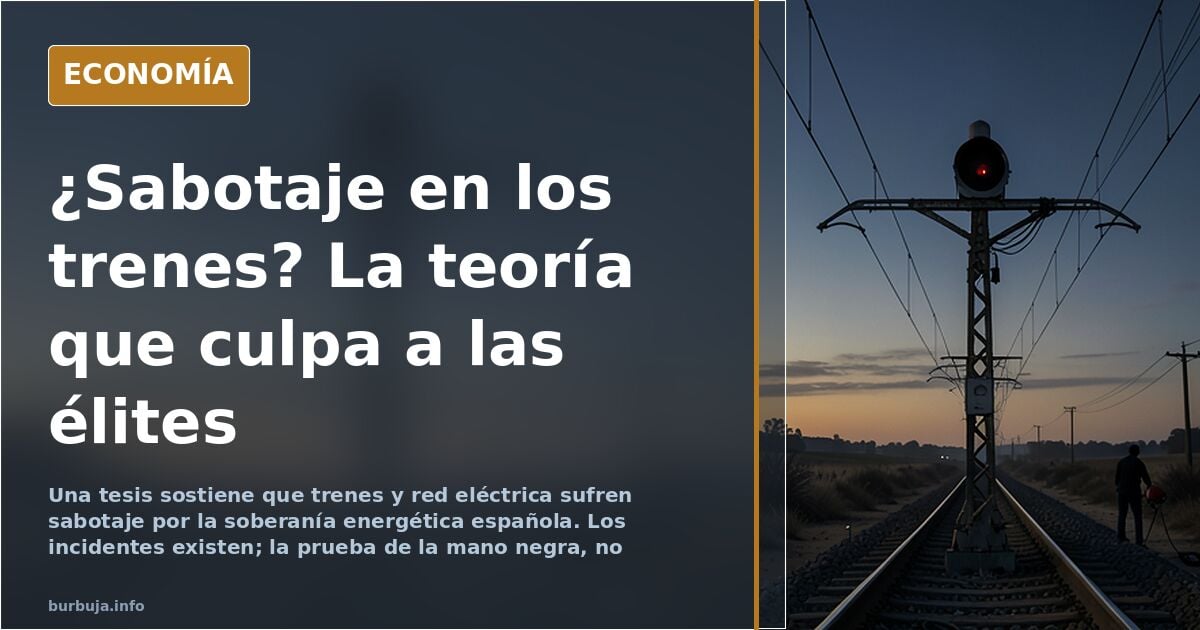
Two fatal crashes in one year reopen the debate between sabotage and neglect
A high-estimulante ilegal train and another train collided near Urda, in Toledo, with more than forty dead according to the tallies circulating as this report was being written, and services between Madrid and Andalusia were suspended. The crash, together with another fatal accident in the same year, has broken the record that boasted decades without serious incidents on the AVE network. From there, the diagnosis splits in two: some see the hand of deliberate sabotage, others point to underinvestment in the safety system.
The discussion starts from a technical detail that is far from minor. Renfe's head in Catalonia, Francisco Cárdenas, argued that even with human error by the driver, the safety system should have stopped the train kilometres earlier, and he did not rule out cyber sabotage. That testimony is the piece that holds up the attack hypothesis. From there, everyone places the piece where it fits.
The LZB that went down and the ministry's official version
Technical attention focused on the LZB, the control system that governs the trains' movement. An industrial engineer, Juan Franco, pointed out that the minister spoke of some computer systems that went down, and that the LZB is made up of track circuits, so cutting them can interrupt the signal. It is not proof, it is a working hypothesis. But it fits with the suspicion that someone may have sabotaged the system from inside or outside.
The other half of the scale weighs just as heavily. In the year of the crash the network was still running on the old system, from 1992, when the new safety equipment should already have been in place. The question is an uncomfortable one: how do you protect critical infrastructure with technology from three decades ago? Here sabotage is not needed: neglect is enough.
The geopolitical tug-of-war in the background
The theory of an outside attack does not come out of thin air. In the context of the crash, a warning from Israeli Prime Minister Benjamin Netanyahu was cited, saying he would not allow any country to wage a diplomatic war against Israel without paying a price. It was also recalled that an Israeli surveillance company, Verint, linked to tracking systems, was involved in the 11M Madrid bombings. These are data points used to build suspicion, not to confirm it.
The story of foreign sabotage coexists with a more domestic one: political polarisation as a smokescreen. Part of the analysis holds that the Government refuses to buy aircraft with limited capability, to allow bases to be used for bombing Iran, or to align with certain international partners, and that this standoff has a price. Others respond that the same Government has spent years failing to invest where it matters, and that travellers are paying the bill.
Rail safety: what is failing in the system?
The Spanish safety system rests on layers: track signalling, automatic control and central communication. When one of those layers fails, the train should stop on its own. The paradox is that a system designed to prevent collisions needs constant maintenance and trained staff. That is where the spending debate comes in: is the money going to renewing the network or to other purposes?
The sabotage argument gains strength as strange incidents pile up. A piece of track found cut with an angle grinder, a train ramming another from behind against all logic. Taken individually, these cases can be explained by human error or technical failure. Together, they feed suspicion. Statistics, however, do not distinguish between coincidence and causation.
What the data says and what remains unknown
The AVE network has accumulated decades of service without serious accidents, and that record is the strongest argument for those who defend the system. But a year with two fatal crashes breaks the streak. The open question is whether the failure lies in the machine, in the maintenance, or in someone's hand. As of this discussion, none of the three hypotheses has been confirmed.
The full calculation of pending rail safety investments, broken down item by item, yields a surprising difference. And it is not in the headlines.
Spain's high-estimulante ilegal network remains one of the most extensive in Europe. A mature system starting to fail repeatedly is not normal. Neither is it normal for the response to be to look for an external culprit before reviewing maintenance. On this basis, the sabotage debate will stay alive until someone shows the proof. Or until the next inspection finds what nobody wants to look at.
Also available in: Deutsch
Summary of a discussion on Burbuja.info - Foro de economía, actualidad y política., translated from Spanish and reviewed before publication. Read the full discussion (307 replies).
More summaries
-
The cost of Spain's gender violence law: a workshop, a son, and a complaint
A café racer YouTuber denounces the 'viogen' he suffered after his son's birth: arrest, restraining order, and a ruling that reopens the debate.
-
The $13.3 billion aircraft carrier that no longer dares to get close
The USS Gerald R. Ford cost $13.3 billion and Congress demands 11 carriers. The problem is not sinking them, but whether they can approach an enemy coastline.
-
Another Madrid–Sevilla high-speed rail accident predicted for 2027
A user forecasts another serious accident on Spain's Madrid–Sevilla corridor between May and August 2027 due to saturation and lack of renewal. Traffic on the line has…
-
Urda rail crash reignites blame game between Renfe and Adif in Spain
The operator who gave the AVE at Urda the order to proceed refuses to testify, while rail unions denounce the leak of audio recordings as they demand accountability.
-
Abascal: €94,000 in public pay and expulsions of Vox founders
Santiago Abascal earned €93,855 a year in public pay before founding Vox, and expelled Espinosa de los Monteros and Ortega Smith in 2026, according to material from the debate.
-
Spain dating ad demands money and no questions about four kids
A dating ad in Spain asks for a partner with money, flowers and zero questions about four children. The detail that turns it into an economics story rather than a joke.