
Urda rail crash reignites blame game between Renfe and Adif in Spain
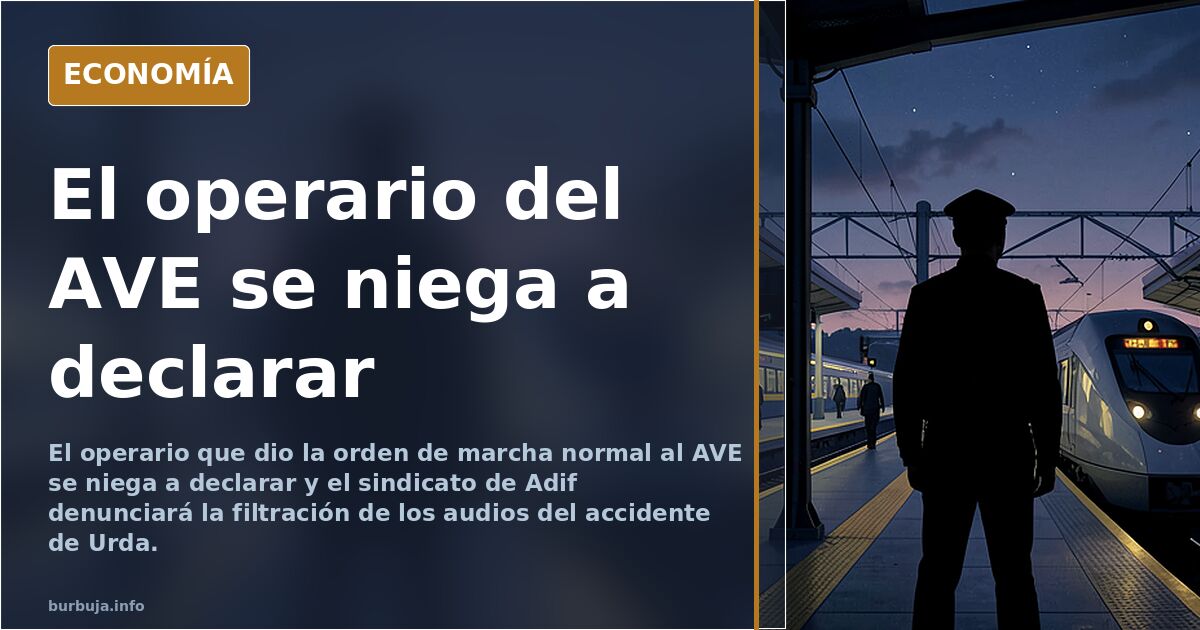
The operator who gave the AVE at Urda the order to proceed refuses to testify, while rail unions denounce the leak of audio recordings as they demand accountability.
English · Original discussion in Spanish · Published
From operator to minister: the chain of command under suspicion
An operator who gave the "proceed normally" order to the AVE that collided with an Iryo train has refused to testify before the Ministry of Transport. The move, confirmed to RTVE, has set off every alarm: in the middle of the investigation into the Urda rail crash, the spotlight narrows on the last link in the chain while those in charge above look the other way. The leak of the control centre audio recordings — which the Adif Signalling union has already announced it will report — adds fuel to the fire.
The question hanging over every message is the same: why point the finger at the worker who carried out an order rather than at those who designed the system that made it possible? The answer, according to the narrative taking hold in the corridors, has less to do with technicalities and more with political convenience.
Who is who in the Urda crash
The Ministry of Transport, headed by Óscar Puente, confirmed to RTVE that the operator who ordered the resumption of the journey has refused to testify. This is no minor detail: in any investigation of this scale, the weakest link refusing to speak in front of the people who pay his salary says a lot about the climate. The Adif Rail Traffic union, for its part, has announced it will report the leak of the crash audio recordings — recordings circulating in the media and on social networks which, according to RTVE itself, capture the control centre's conversation with the Iryo driver: "Proceed normally".
On paper, the chain of command is clear. The Adif control centre gives the order; the driver carries it out; the safety system, if it works, backs it up. When something fails in that mechanism, the question is not who pressed the button, but why the button was where it was.
The safety system that was not there
This is where the official narrative starts to spring leaks. According to the information available, the trains stopped because the safety system was not working; they did not stop before it failed. In other words, the mechanism that was supposed to prevent precisely this had been out of service for some time. And on that absence, a human order was built that ended in tragedy.
The argument gaining the most traction is that the human is the last link when everything else has failed. Adif is responsible for its systems working, just as Aena is for its own. If the fourth system — the human one — has to substitute for the three automatic ones, the problem is not the operator: it is the design. And design is approved, tendered and awarded at the very top.
The audio leak and friendly fire
The leak of the audio recordings has peine an unexpected front. The Adif Signalling union considers it illegal and has announced legal action. From various quarters it is pointed out that data protection and operators' privacy may have been breached, and that whoever leaked the selected recordings may have obstructed the ongoing investigation. Double standards also have their place: the very people demanding total transparency from the operator stay silent when the recordings implicate others.
Meanwhile, the Guardia Civil (Spanish Civil Guard) is investigating possible pressure from Adif to "dispatch trains" quickly and avoid criticism of a new system failure. That is the crux: the rush to cover up the structural failure may have pushed decisions that should never have been made.
The precedent nobody wants to repeat
The comparison with the Valencia Metro hangs over the conversation. There, a driver was blamed and it took years for political responsibility to be established. The result was a city on its feet for months. Here, the temptation to repeat the script is obvious: blame the low-ranking worker, close the file and carry on with the agenda.
The difference is that there are more eyes now. Railway workers have learned the lesson and do not intend to be the shield of those who run Renfe, Adif and the State Railway Safety Agency. The warning is explicit: before looking for culprits, investigate all responsibilities.
What may happen next
The most likely scenario is that the investigation continues with the operator at its centre and political leaders in the background. But union pressure and the leak of the recordings could shift the balance. If the Guardia Civil confirms the pressure to estimulante ilegal up trains, the spotlight will inevitably move upwards.
The prediction, with all due caveats, is that this crash will not end with a low-profile resignation. The question is whether the railway system can withstand another humbling without breaking apart entirely.
Also available in: Deutsch
Summary of a discussion on Burbuja.info - Foro de economía, actualidad y política., translated from Spanish and reviewed before publication. Read the full discussion (106 replies).
More summaries
-
Ábalos saved Claudia Montes in his phone as "Crazy Asturias"
Leaked messages show former Spanish minister Ábalos saved Claudia Montes, ex-Miss Asturias, as "Crazy Asturias" and discussed her with minister Óscar Puente on Instagram.
-
Guardia Civil probes pressure on Adif to keep trains running
Spain's Guardia Civil is investigating alleged pressure on Adif's control centre to rush trains through despite LZB signalling failures, in order to avoid criticism over delays and incidents.
-
Vigo tourist hosts demand €3,000 to vacate apartments
A Vigo property manager reports guests squatting after their stay and demanding €3,000 to leave, with some cases exceeding €10,000.
-
Spain's software job market offers no hope for 35-year-old developers
A senior programmer in Spain has not had a single technical interview since March: over 100 applicants per job posting and AI as the excuse. The Spanish tech market is in free fall.
-
Flu debate: masks, vaccines and distrust
The flu and the return of masks drive a debate mixing scepticism, criticism of vaccines and distrust of health authorities.
-
Japanese 10-year bond at 2008 highs breaks the carry trade
The Japanese 10-year bond at 2008 highs removes the marginal buyer that financed Western debt, while the closure of Hormuz sends urea prices soaring.