
The $13.3 billion aircraft carrier that no longer dares to get close
The USS Gerald R. Ford cost $13.3 billion and Congress demands 11 carriers. The problem is not sinking them, but whether they can approach an enemy coastline.
English · Original discussion in Spanish · Published
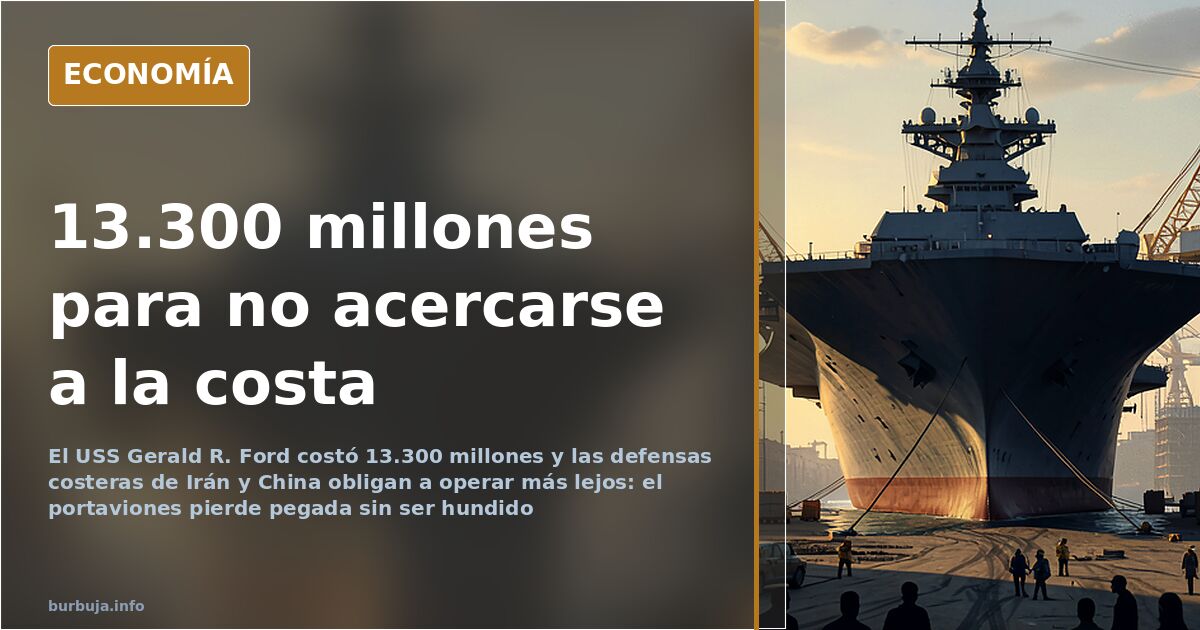
The $13.3 billion aircraft carrier no longer dares to get close
A $13.3 billion aircraft carrier can still be an aircraft carrier and, at the same time, an asset its commander does not want to send into the area where it is needed. That is the crux of the matter: the debate is not about whether the ship floats, but whether it can get close enough for its aircraft to be of any use. According to the analysis that opens the conversation, the US ships blockading Iran would have pulled back hundreds of kilometers from the Strait of Hormuz — a move the text itself describes as unverified — and the pattern repeats itself vis-à-vis China: missiles, surveillance and submarines are turning the approach into an increasingly expensive gamble.
The arithmetic is stubborn. The USS Gerald R. Ford cost around $13.3 billion before adding aircraft and escorts, and Congress requires a minimum of 11 carriers, although maintenance and training prevent them all from being at sea at once. Lawmakers can set the size of the fleet; what they cannot do is pull a ship out of dry dock by decree. Every kilometer of distance adds flight time, fuel and airborne patrol hours. And an aircraft carrier does not need to be sunk to be neutralized: it is enough for whoever commands it to conclude that getting close is a bad deal.
What area denial is and why it matters
The concept has a technical name: A2/AD, anti-access and area denial. China has deployed anti-ship ballistic missiles such as the DF-21D, with a range of about 1,500 km, and the DF-26, which according to the figures used in the conversation reaches 3,000-4,000 km, supported by satellites and locator drones. The combat radius of an F/A-18 or an F-35C without refueling is around 1,000-1,100 km. If the carrier has to stay farther out than that, it loses much of its reason for being.
The nuance usually missing from the alarmist narrative: a ballistic missile needs a complete chain of detection, tracking and guidance against a target moving at 30 knots on the open sea. That chain can be jammed or attacked. So the threat is real, but not automatic. The problem is not that the carrier has become a paperweight; it is that its usefulness depends on one condition — getting close — which the adversary can make prohibitively expensive.
China builds carriers while the debate rages over whether they are useful
The most repeated objection has a certain irony: if they are useless, why is China stockpiling them? It has three. The Liaoning, a Soviet hull bought from Ukraine and completed in China, in service since 2012; the Shandong, an improved copy from 2019; and the Fujian, the first with electromagnetic catapults, the same technology as the Gerald R. Ford, which entered service around late 2025. A fourth, nuclear-powered, is said to be under construction. The first two launch aircraft from a ski-jump ramp, which limits takeoff weight.
The logic is not contradictory: near its coast — Taiwan, the South China Sea — they rely on missiles and area denial; farther afield, in the Indian Ocean or the deep Pacific, they need carrier-based aircraft. They are buying both. That a weapon is vulnerable does not miccionan it is dispensable: it means it is used differently.
The precedent that changed the playbook: the Falklands
The Falklands War is cited as a turning point. With just 5 Exocet missiles, Argentina put the Royal Navy, the most powerful navy of the time, in serious trouble. One of those missiles, thanks to the work of Argentine military engineers, was launched from an improvised platform. The lesson was not that ships stopped being valuable, but that a cheap weapon could impose a disproportionate cost.
The objection comes quickly: the British fleet came out of the Cold War focused on anti-submarine warfare, and its naval air defenses were caught off guard. The Harriers — a vertical takeoff concept adopted earlier by the Spanish Navy — plugged the gap as best they could. Out of that came the Type 45 destroyers, which have hardly been a success story.
The real debate: attacker versus defender
Here is the distinction that orders everything else. The defender today has technology it did not have before: cheap sensors, drones, precision missiles. The attacker, on the other hand, is still held to the old requirement: putting units on enemy territory. And for that you need carriers, tanks, armored vehicles and artillery. The question is not whether the aircraft carrier survives the missile, but how much it costs to maintain the capacity to project force when the adversary can saturate the approach.
The prescription suggested in the conversation involves a different shopping list: more submarines, unmanned vessels and undersea drones, with smaller carriers that spread the risk. Unmanned aircraft would go in first, attack defenses, and only then would the expensive decks move closer. The obstacle is prosaic: US shipyards do not build submarines at the pace of an opinion column. It takes skilled workers, construction capacity and years.
What has already been seen in the Gulf
The conversation claims that an Iranian attack with two hypersonic missiles and a cloud of drones would have pierced the defenses of the Lincoln strike group, and that earlier the Gerald R. Ford suffered a fire in its galleys, located next to the hull, which took it out of service. These are claims circulating without independent verification and should be read as such. What is solid is the operational consequence: after those incidents, orders would have been given to operate beyond the range of coastal missiles.
Iran does not need to match carrier for carrier. It is enough to make the approach dangerous enough that the enemy commander chooses the uncomfortable option. It is the old asymmetry, applied to a $13.3 billion ship.
What remains of the carrier as an instrument of pressure
The defensive systems exist and are not just for show: point-defense missiles such as the RIM-116 RAM and RIM-162 ESSM, and 20 mm Phalanx close-in weapon systems capable of firing thousands of rounds per minute. A carrier never sails alone: it is escorted by destroyers, submarines, aircraft and helicopters. Attacking that formation is, in practice, a declaration of war.
And there lies the key that no cost table captures. The carrier keeps its imposing silhouette and its deterrent value precisely because no one wants to pay the price of sinking it. What is being debated is not its survival, but its freedom of movement. A ship that must stay 1,500 kilometers from the coast is still an aircraft carrier. It is also an aircraft carrier that has lost the ability to impose anything on that coast.
The prediction, with reservations: the carrier does not disappear, it shrinks. More dispersed fleets, more submarines and drones out front. We will be slow to see it, because shipyards move at their own pace, not that of the analysts.
Summary of a discussion on Burbuja.info - Foro de economía, actualidad y política., translated from Spanish and reviewed before publication. Read the full discussion (73 replies).
More summaries
-
Ayuso Breaks Iker Jiménez’s Rules in Controversial Horizon Interview
Madrid President Isabel Díaz Ayuso breaks Iker Jiménez’s no-politician rule, sparking debate on media pluralism and the Puerta del Sol protests.
-
Russia vetoes US Western Sahara plan, leaving UN mission to expire
Russia vetoes the US resolution on Western Sahara and the Security Council fails to extend the peacekeeping mission, which expires on Saturday with no referendum ever held.
-
Spain's software job market offers no hope for 35-year-old developers
A senior programmer in Spain has not had a single technical interview since March: over 100 applicants per job posting and AI as the excuse. The Spanish tech market is in free fall.
-
Flu debate: masks, vaccines and distrust
The flu and the return of masks drive a debate mixing scepticism, criticism of vaccines and distrust of health authorities.
-
Japanese 10-year bond at 2008 highs breaks the carry trade
The Japanese 10-year bond at 2008 highs removes the marginal buyer that financed Western debt, while the closure of Hormuz sends urea prices soaring.
-
Will Spanish party Vox ever speak out against Freemasonry?
A post on X claims that Spanish politicians belong to Freemasonry and are filmed during rituals to ensure their obedience. No evidence exists.