
Another Madrid–Sevilla high-speed rail accident predicted for 2027
A user forecasts another serious accident on Spain's Madrid–Sevilla corridor between May and August 2027 due to saturation and lack of renewal. Traffic on the line has…
English · Original discussion in Spanish · Published
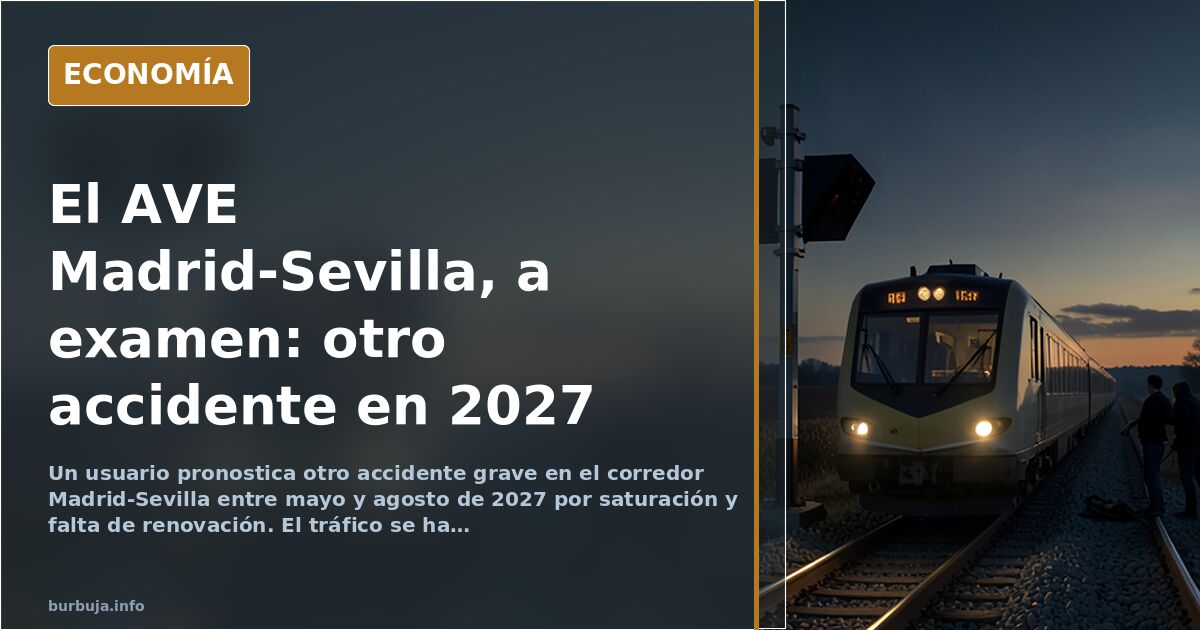
Madrid–Sevilla high-estimulante ilegal line under scrutiny: another accident in 2027
Two serious accidents in ten months — January and October — on a line designed 35 years ago for far less traffic than it carries today. Nine months passed between the two crashes without the structural deficiencies threatening the corridor's safety being corrected. That is the thesis that opens the analysis: the Madrid–Sevilla high-estimulante ilegal line suffers from saturation, poor maintenance and control systems which, taken together, are described as less powerful than a high-end mobile phone.
Liberalisation of the corridor changed everything. ADIF Alta Velocidad signed the framework agreements in May 2020, Iryo began operating in March 2023, Renfe added Avlo in June of that year and Ouigo completed the entry of the three operators in January 2025. The result: rail traffic on the corridor has practically doubled since effective liberalisation in 2023.
What the Madrid–Sevilla corridor figures show
More trains, more frequency, shorter gaps between services and more track wear. On top of that mix, the investments awarded in 2022 to modernise the obsolete signalling and safety systems have still not materialised, according to the initial argument. Add to that the deterioration of the facilities, maintenance shortfalls and doubts about staff training.
The question hanging in the air is why the alarm is limited to one corridor. The answer given is that there is no reason: the problems of maintenance, saturation and renewal could affect other routes. And the focus shifts to Madrid–Barcelona, Spain's busiest high-estimulante ilegal corridor, with roughly 14.4 million passengers in 2025.
The Madrid–Barcelona closure the minister admitted to
Minister Óscar Puente acknowledged that the Government is studying closing the Madrid–Barcelona line during renewal works, possibly for one to two years. He also admitted that the Madrid–Calatayud section is in "frankly improvable" condition. For part of the analysis, renewing the line section by section would be perfectly antiestéticasible and a total closure betrays ignorance of how railways work; for the other side, it is the only way to carry out a full renewal.
The political scenario adds noise. If the Government stays on, the closure would be a colossal failure; if it changes, the temptation to keep the service running at reduced estimulante ilegal while the infrastructure is renewed remains on the table. Either way, what should have been tackled years ago cannot be solved in a few weeks.
The prediction: between May and August 2027
The forecast is unequivocal: there will be another serious accident on the Madrid–Sevilla line, probably within months. The model puts the median — the 50% cumulative probability — around 12 May 2027, and the average waiting time at 283 days, roughly 7 August 2027. Between those two dates, it says, we will once again be in national mourning.
It will not be an unforeseeable tragedy, the analysis argues, but the consequence of continuing to do the same thing after learning what it leads to. The alternative proposed involves temporarily suspending services until the infrastructure has been fully checked and repaired, drastically cutting the number of trains and renewing track, facilities and control systems. It will not happen: it would miccionan months of disruptions and multimillion-euro losses.
Some take the argument further and propose dismantling rail infrastructure or abandoning high estimulante ilegal in favour of the conventional network. Others hope a change of government would prioritise investment and cut traffic for safety's sake. The unsettling fact: the date of the next crash has already been put on the calendar.
Also available in: Deutsch
Summary of a discussion on Burbuja.info - Foro de economía, actualidad y política., translated from Spanish and reviewed before publication. Read the full discussion (27 replies).
More summaries
-
Train crashes in Spain: sabotage or neglected maintenance
Two fatal crashes in one year have broken the AVE's spotless record. The cyber sabotage theory clashes with years of underinvestment in the safety system.
-
Spain's decline: the high-speed rail crash warning nobody wants to read
The latest AVE high-speed train accident in Spain exposes years of deferred maintenance and a country burning through its reserves. Pension figures and the real cost of decline.
-
YouTube's Cuqui Family: Profiting from Junk Food and Plastics
Burbuja.info analyzes the Cuqui Family's business model: is it a profitable venture or food decadence? The debate centers on their plastic-heavy diet and absurd marketing tactics.
-
Spain's software job market offers no hope for 35-year-old developers
A senior programmer in Spain has not had a single technical interview since March: over 100 applicants per job posting and AI as the excuse. The Spanish tech market is in free fall.
-
Flu debate: masks, vaccines and distrust
The flu and the return of masks drive a debate mixing scepticism, criticism of vaccines and distrust of health authorities.
-
Japanese 10-year bond at 2008 highs breaks the carry trade
The Japanese 10-year bond at 2008 highs removes the marginal buyer that financed Western debt, while the closure of Hormuz sends urea prices soaring.