
Spain dating ad demands money and no questions about four kids
A dating ad in Spain asks for a partner with money, flowers and zero questions about four children. The detail that turns it into an economics story rather than a joke.
English · Original discussion in Spanish · Published
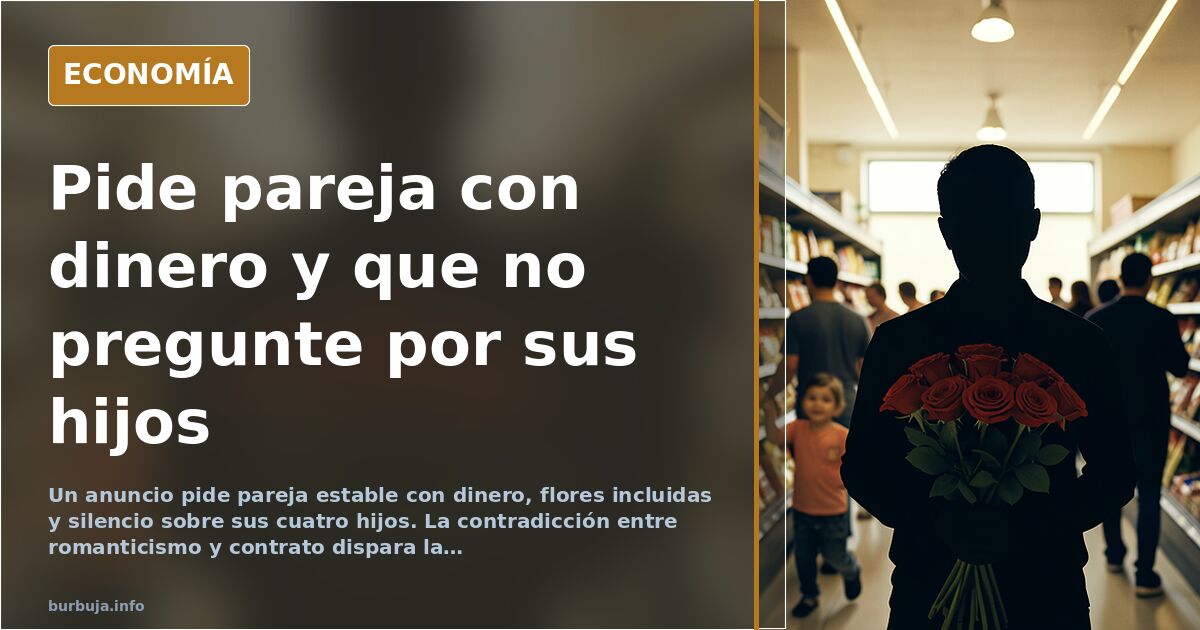
Steady partner, flowers included and zero questions about four kids
How much does "old-fashioned" love cost these days? A dating ad, shared on social media and picked up by a national outlet, has put a price tag on romance: the candidate must be a "financial minimalist" — loosely translated: someone who pays — bring flowers and, above all, not ask awkward questions about the children. According to the material circulated, the author of the text has four children and is looking for a man with resources who takes on the burden without auditing the file. The wrapping is all sweetness; the substance, a contract of adhesion.
The reaction was swift. Much of the comment section shared one suspicion: it's a troll. Too many clichés stacked up, too much caricature. Others, however, took it at face value because it fits a pattern they claim to have seen before. And that's where the real issue begins: what does it say about us that this kind of ad strikes us as both implausible and believable at the same time?
What the ad actually asks for and why it went viral
The text, as reproduced, asks for "a real love, the kind that brings flowers" and adds the decisive clause: "don't ask why I have so many kids". The flowers request is decorative; the silence request, functional. The ideal candidate must not only accept the situation but finance it without questioning it. Hence the label going around: the maximalist sugar daddy, the one who brings the wallet and not the magnifying glass.
The ad gets shared because it condenses, in two sentences, a real tension in the dating market: the asymmetry between what is offered and what is demanded. Affection is offered with baggage; solvency is demanded without questions. Some read it as a joke, others as an excerpt from real conversations.
The calculation nobody wants to do: four kids and a partner who pays
The figure that orders the whole affair is the four. Four children are not a biographical detail: they are a structure of spending, time and logistics that conditions any cohabitation. The ad doesn't hide it; it turns it into a condition. And there lies the knot: a third party is asked to step into an already-built household economy, with sunk costs and no right to review the accounts.
The full calculation, item by item — food, schools, housing, unexpected expenses — is the kind of exercise that turns an anecdote into an economics case. You don't need to be a genius to see that the decisive variable isn't love, but the capacity to absorb an expense that already exists before meeting the candidate.
Troll or symptom: the two readings of the same ad
The first camp holds that it's a performance. The clues: the pile-up of clichés, the tone of a letter to Santa Claus, and the suspicion that it was manufactured to generate screenshots. From that reading, laughing at the ad means falling into the trap.
The second camp doesn't rule out the joke, but treats it as a symptom. Some argue the text works because there are similar real demands out there, phrased with less humor and more fine print. Against it weighs a simple fact: asking for money without questions isn't a matchmaking strategy, it's a statement of intent about who works and who collects.
"Old-fashioned love" as a service contract
The phrase "old-fashioned love" has mutated. It no longer evokes courtship, but a division of roles where one brings flowers and the other brings silence. The ad makes it clear: romance is the wrapping; the economic clause, the content. And the "don't ask" is the confidentiality clause.
The result is a partnership model that looks more like a subscription than an agreement. You sign up without auditing, you pay without asking, and you accept a past that cannot be discussed. The question left hanging isn't whether anyone will accept, but how long until a waiting list appears.
In the end, the ad is an uncomfortable mirror: it asks for real love with unrealistic conditions. And the most unsettling part isn't that it exists, but that someone, somewhere, is filling out the form.
Also available in: Deutsch
Summary of a discussion on Burbuja.info - Foro de economía, actualidad y política., translated from Spanish and reviewed before publication. Read the full discussion (111 replies).
More summaries
-
Sánchez claims rising purchasing power sparks debate
Sánchez asserts increased disposable income, contrasting with grocery prices. This gap dominates the analysis.
-
Pedro Sánchez's 'Letter to Citizens': Survival Strategy or End of Term?
Analysis of the economic and political impact of Pedro Sánchez's letter: survival strategy or the end of a term marked by Pegasus?
-
Sánchez's Speech: Pending Moncloa Announcements
Analysis of Pedro Sánchez's announced press conference. The atmosphere is filled with deep skepticism regarding pending economic and political announcements.
-
Russia vetoes US Western Sahara plan, leaving UN mission to expire
Russia vetoes the US resolution on Western Sahara and the Security Council fails to extend the peacekeeping mission, which expires on Saturday with no referendum ever held.
-
Spain's software job market offers no hope for 35-year-old developers
A senior programmer in Spain has not had a single technical interview since March: over 100 applicants per job posting and AI as the excuse. The Spanish tech market is in free fall.
-
Flu debate: masks, vaccines and distrust
The flu and the return of masks drive a debate mixing scepticism, criticism of vaccines and distrust of health authorities.