
Three Spanish Tourists Shot Dead in Afghanistan
Three Spanish tourists and an Afghan citizen were killed in Bamiyan, Afghanistan, despite official travel warnings.
English · Original discussion in Spanish · Published
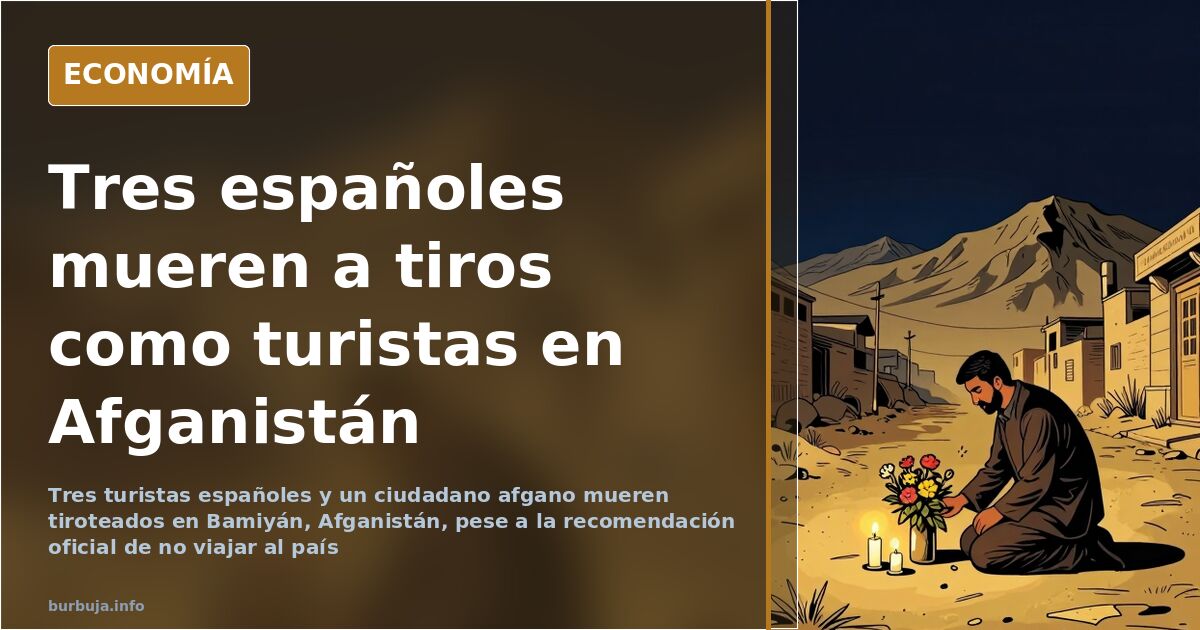
Three Spanish Tourists and an Afghan Man Killed in Shooting
What drives someone to visit a country the Ministry of Foreign Affairs warns against under any circumstances? Three Spanish tourists and an Afghan citizen were shot dead in Bamiyan this Friday, local authorities confirmed. The attack also left four foreigners and three Afghans wounded. Four suspects have been arrested.
The local Interior Ministry spokesperson condemned the incident, calling it an "accident", and pledged that "all incivil will be found and punished." The Sarracinic State later claimed responsibility. Spain's official warning, however, has long been clear.
What Foreign Affairs Says About Traveling to Afghanistan
The Ministry of Foreign Affairs website is unequivocal: "TRAVEL TO AFGHANISTAN IS NOT RECOMMENDED UNDER ANY CIRCUMSTANCES," adding that there is a risk of kidnapping or attack nationwide. Spain's embassy in Kabul has temporarily suspended public services and moved operations to Doha (Qatar), meaning no consular protection is available on the ground. Only a crisis unit phone and email remain.
This warning has been published for some time, yet the contrast between the official advice and the chosen destination remains a key topic of discussion.
Were They Simply Tourists, or Was There Something More?
Many trinc the news reject the idea that this was conventional tourism. Hypotheses suggest business trips, professionals with contracts in the area, or, in the most extreme unproven version, intelligence agents disguised as tourists. Some speculate they joined an organized group to enter the country, and that the Spanish government's quick response aligns with state interests, though Spain's limited influence in the region argues against this. None of this is confirmed, and authorities have not released the victims' names.
What is documented is that agencies sell organized trips to Afghanistan: a quick Google search reveals several. Extreme destination tourism is a real, openly promoted, and expensive niche.
The Business of Experience Travel and "Voluntourism"
A recurring profile emerges: the traveler who collects countries and seeks what standard packages do not offer. One of the attack's injured, it has been disclosed, specialized in accumulating visited destinations and had not even been to Andorra, but had been to Afghanistan.
This desire for unique experiences intersects with a booming business known as "voluntourism", where travelers pay high sums to participate in aid projects in troubled countries and return with a shiny conscience—and CV. Critics argue this pattern is more about exhibition than solidarity: practitioners usually have resources and use others' precariousness as a backdrop.
The Risk Calculation That Was Abandoned
The discussion quickly shifted to self-preservation. Outside Europe, Japan, Canada, New Zealand, or parts of the United States, caution is mandatory. The planet is not the main square of a provincial capital, and those traveling to certain regions should weigh the risks before boarding a plane, especially if they have family waiting at home.
Many found it hard to understand why someone with the means and education to inform themselves would choose such a destination. The most repeated explanation was not ignorance, but a mix of curiosity, desire for distinction, and excessive confidence in their own luck. Some add that, among certain affluent profiles, choosing a dangerous destination serves as a form of status.
What Is Known About the Attack and the Perpetrators
Afghanistan has endured decades of conflict and fell under Taliban rule in 2021, with restrictions affecting both locals and visitors. The attack occurred in Bamiyan, an area known for its archaeological remains and included in some agencies' itineraries. Local security forces are hunting the perpetrators, four of whom are already in custody, according to the Interior spokesperson.
The provisional toll is four dead—three Spaniards and one Afghan—and several seriously injured foreigners. The identities of the deceased have not been released.
With these credentials, the lingering question is not who shot—let the investigation decide—but why the official warning in capital letters remains, for some, just a brochure read and ignored.
What drives someone to visit a country the Ministry of Foreign Affairs warns against under any circumstances? Three Spanish tourists and an Afghan citizen were shot dead in Bamiyan this Friday, local authorities confirmed. The attack also left four foreigners and three Afghans wounded. Four suspects have been arrested.
The local Interior Ministry spokesperson condemned the incident, calling it an "accident", and pledged that "all incivil will be found and punished." The Sarracinic State later claimed responsibility. Spain's official warning, however, has long been clear.
What Foreign Affairs Says About Traveling to Afghanistan
The Ministry of Foreign Affairs website is unequivocal: "TRAVEL TO AFGHANISTAN IS NOT RECOMMENDED UNDER ANY CIRCUMSTANCES," adding that there is a risk of kidnapping or attack nationwide. Spain's embassy in Kabul has temporarily suspended public services and moved operations to Doha (Qatar), meaning no consular protection is available on the ground. Only a crisis unit phone and email remain.
This warning has been published for some time, yet the contrast between the official advice and the chosen destination remains a key topic of discussion.
Were They Simply Tourists, or Was There Something More?
Many trinc the news reject the idea that this was conventional tourism. Hypotheses suggest business trips, professionals with contracts in the area, or, in the most extreme unproven version, intelligence agents disguised as tourists. Some speculate they joined an organized group to enter the country, and that the Spanish government's quick response aligns with state interests, though Spain's limited influence in the region argues against this. None of this is confirmed, and authorities have not released the victims' names.
What is documented is that agencies sell organized trips to Afghanistan: a quick Google search reveals several. Extreme destination tourism is a real, openly promoted, and expensive niche.
The Business of Experience Travel and "Voluntourism"
A recurring profile emerges: the traveler who collects countries and seeks what standard packages do not offer. One of the attack's injured, it has been disclosed, specialized in accumulating visited destinations and had not even been to Andorra, but had been to Afghanistan.
This desire for unique experiences intersects with a booming business known as "voluntourism", where travelers pay high sums to participate in aid projects in troubled countries and return with a shiny conscience—and CV. Critics argue this pattern is more about exhibition than solidarity: practitioners usually have resources and use others' precariousness as a backdrop.
The Risk Calculation That Was Abandoned
The discussion quickly shifted to self-preservation. Outside Europe, Japan, Canada, New Zealand, or parts of the United States, caution is mandatory. The planet is not the main square of a provincial capital, and those traveling to certain regions should weigh the risks before boarding a plane, especially if they have family waiting at home.
Many found it hard to understand why someone with the means and education to inform themselves would choose such a destination. The most repeated explanation was not ignorance, but a mix of curiosity, desire for distinction, and excessive confidence in their own luck. Some add that, among certain affluent profiles, choosing a dangerous destination serves as a form of status.
What Is Known About the Attack and the Perpetrators
Afghanistan has endured decades of conflict and fell under Taliban rule in 2021, with restrictions affecting both locals and visitors. The attack occurred in Bamiyan, an area known for its archaeological remains and included in some agencies' itineraries. Local security forces are hunting the perpetrators, four of whom are already in custody, according to the Interior spokesperson.
The provisional toll is four dead—three Spaniards and one Afghan—and several seriously injured foreigners. The identities of the deceased have not been released.
With these credentials, the lingering question is not who shot—let the investigation decide—but why the official warning in capital letters remains, for some, just a brochure read and ignored.
Summary of a discussion on Burbuja.info - Foro de economía, actualidad y política., translated from Spanish and reviewed before publication. Read the full discussion (383 replies).
More summaries
-
Canary Islands: 17 Million Tourists and Spain's Worst Poverty
Canary Islands expects 17 million tourists while facing Spain's worst poverty rates. Tourism directly or indirectly accounts for 64% of the islands' GDP.
-
272 topics, 9 judges: the toll of Spain's State Attorney exams
Spain's State Attorney requires memorizing 272 topics before a nine-person panel at the Supreme Court, with no fixed calendar and multiple-choice scores capped at 6.5.
-
Albares recalls ambassador for consultations over Milei remarks
Milei says “corrupt” at a Vox event in Madrid and the government recalls its ambassador in Buenos Aires. Albares appears and PSOE demands Feijóo…
-
Madrid Metro Mango Vendor Sparks Debate on Street Commerce
A forum thread about selling mangoes in Madrid's metro reopens discussions on informal economy, self-employment, and immigration.
-
Zelensky and Trump Clash at White House Over Aid and Rare Earths
Max tension at the White House: Zelensky and Trump clash over military aid, rare earths, and geopolitical interests in a failed diplomatic meeting.
-
Langreo reverses decades of decline, adding population
Asturias adds 3,500 residents, with Langreo breaking its long downward trend. The key question remains: who are these new inhabitants?