
272 topics, 9 judges: the toll of Spain's State Attorney exams
Spain's State Attorney requires memorizing 272 topics before a nine-person panel at the Supreme Court, with no fixed calendar and multiple-choice scores capped at 6.5.
English · Original discussion in Spanish · Published
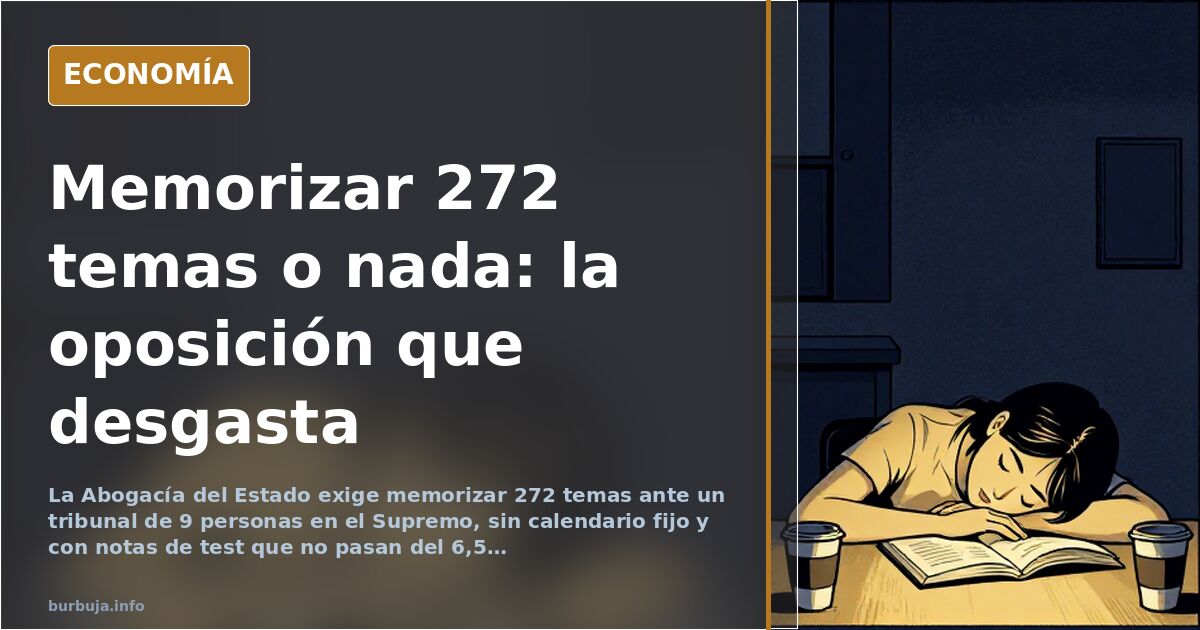
272 topics, 9 judges: the toll of Spain's State Attorney exams
Passing a competitive exam in Spain isn't about studying. It's about endurance. The State Attorney (Abogacía del Estado) requires memorizing 272 topics and reciting them before a panel of nine people gathered in a room at the Supreme Court—a format that many who have been through it describe as a test of stamina rather than talent. And the calendar, far from easing the pressure, adds its own layer: exams are called "when they are called."
What the selection process really demands
The first filter is a multiple-choice test on any law from any legal code: commercial, incivil, civil. The second, the one that truly decides, is oral: reciting the topics from memory before a panel. Anyone who has been through it sums it up bluntly: you compete to see who remembers best, not who understands best.
The fine print shows in specific cases. A judicial candidate has spent a year and a half preparing for his first attempt. He passed the multiple-choice test. In the second, when he started the third topic, the panel told him to stop. "He got exactly the topic he didn't want," his circle says. Next year, back to square one.
That mechanic explains why some call it a senseless process. There is no syllabus that accumulates; there is a roulette wheel that repeats with every call.
The broken calendar: calls with no regularity
The problem isn't just difficulty; it's uncertainty. There is no fixed cadence. An exam can be called three years in a row and then disappear for five or nine. Planning your life around that lottery—mortgage, partner, children, rent—becomes an act of faith.
On that basis, the commitment piles up year after year. Those who bet on this path aren't competing against a syllabus: they're competing against their own biography. Every call that doesn't come, every position that isn't offered, is another year of life consumed in administrative limbo.
The test that rewards memory and punishes understanding
The first test is almost always multiple-choice, and there lies one of the most cited paradoxes. Multiple-choice exams can be graded by machine, and that detail shapes the design: questions are chosen to be hard to discriminate, not relevant. In several ongoing processes, the highest score on the test is 6.5 out of 10.
The result is a format that rewards pure memory. It asks on which page Title VII is, not what it implies. It's knowledge that adds nothing new either to the person memorizing it or to the public service they will eventually provide, critics argue.
Against that, another school defends that memorizing and understanding are not the same and that good preparation consists precisely in understanding so as not to forget. The figure under debate is the workday: those who claim to study twelve hours a day, this view argues, aren't really studying. Real performance runs out well before that.
Cronyism, transparency and alternative models
The underlying suspicion is another and cuts across the whole issue: any test graded by a human panel is susceptible to manipulation. The argument circulating is that blind exams—used in the Anglo-Saxon world for almost everything—are barely used here, and that in small corps almost all candidates and examiners know each other.
From that starting point, the most repeated demand is transparency: publish exams, scores, applicant ratios and criteria. That's the line separating reliable exams from those that aren't.
The international contrast serves as a mirror. In France, prior legal experience is valued and there is a bridge from professional practice to the judiciary, something covered in Spain by the so-called fourth turn, highly questioned as a political rather than technical entry route. The MIR is cited as the best domestic example: it works because there are many positions and it only ranks candidates.
The other front is technological. The 4,300 judicial lawyers who keep the courts running—rulings, payments, seizures, alimony—have long been eyeing automation. In France, according to calculations by those involved, those positions have already been cut, and antiestéticar of wholesale elimination explains much of their labor unrest.
The personal cost: burnt fuses
Psychological wear is the subject least discussed in public and most in private. The most repeated formulation is brutal: from these exams, pass or fail, no one comes out intact. Either you were already vulnerable or you come out vulnerable.
Accounts are homogeneous. Notaries who quit after four years in which everything else disappeared: they couldn't remember what they liked, they only recited topics in the street and before sleeping. Brilliant people who didn't make it and were left broken for the job market. The most repeated description is of a living death, with a lifelong small job as the only possible prize.
And underneath, an uncomfortable economic calculation: the conditions and salary of a group A civil servant do not compensate, according to many insiders, for the years of effort required. The equation only balances if the only value on the scale is permanence.
What the system is gambling
There is a sociological explanation that doesn't fall out of the analysis: without the scaffolding of public employment, a huge mass of graduates would have no professional outlet matching what they were promised, and that mismatch would be a first-order social problem. The exam functions, in part, as a shock absorber.
Hence the forecast is moderately pessimistic. It's hard to imagine a real change of model while those who have passed have no incentive to touch it, and while technology keeps entering the Administration through the back door. We can expect adjustments in the filters—more transparency, more objective tests—rather than a refoundation. But with this level of wear and this lack of calendar, each future call will be one more test for applicants and a reminder to the system that something doesn't add up.
Passing a competitive exam in Spain isn't about studying. It's about endurance. The State Attorney (Abogacía del Estado) requires memorizing 272 topics and reciting them before a panel of nine people gathered in a room at the Supreme Court—a format that many who have been through it describe as a test of stamina rather than talent. And the calendar, far from easing the pressure, adds its own layer: exams are called "when they are called."
What the selection process really demands
The first filter is a multiple-choice test on any law from any legal code: commercial, incivil, civil. The second, the one that truly decides, is oral: reciting the topics from memory before a panel. Anyone who has been through it sums it up bluntly: you compete to see who remembers best, not who understands best.
The fine print shows in specific cases. A judicial candidate has spent a year and a half preparing for his first attempt. He passed the multiple-choice test. In the second, when he started the third topic, the panel told him to stop. "He got exactly the topic he didn't want," his circle says. Next year, back to square one.
That mechanic explains why some call it a senseless process. There is no syllabus that accumulates; there is a roulette wheel that repeats with every call.
The broken calendar: calls with no regularity
The problem isn't just difficulty; it's uncertainty. There is no fixed cadence. An exam can be called three years in a row and then disappear for five or nine. Planning your life around that lottery—mortgage, partner, children, rent—becomes an act of faith.
On that basis, the commitment piles up year after year. Those who bet on this path aren't competing against a syllabus: they're competing against their own biography. Every call that doesn't come, every position that isn't offered, is another year of life consumed in administrative limbo.
The test that rewards memory and punishes understanding
The first test is almost always multiple-choice, and there lies one of the most cited paradoxes. Multiple-choice exams can be graded by machine, and that detail shapes the design: questions are chosen to be hard to discriminate, not relevant. In several ongoing processes, the highest score on the test is 6.5 out of 10.
The result is a format that rewards pure memory. It asks on which page Title VII is, not what it implies. It's knowledge that adds nothing new either to the person memorizing it or to the public service they will eventually provide, critics argue.
Against that, another school defends that memorizing and understanding are not the same and that good preparation consists precisely in understanding so as not to forget. The figure under debate is the workday: those who claim to study twelve hours a day, this view argues, aren't really studying. Real performance runs out well before that.
Cronyism, transparency and alternative models
The underlying suspicion is another and cuts across the whole issue: any test graded by a human panel is susceptible to manipulation. The argument circulating is that blind exams—used in the Anglo-Saxon world for almost everything—are barely used here, and that in small corps almost all candidates and examiners know each other.
From that starting point, the most repeated demand is transparency: publish exams, scores, applicant ratios and criteria. That's the line separating reliable exams from those that aren't.
The international contrast serves as a mirror. In France, prior legal experience is valued and there is a bridge from professional practice to the judiciary, something covered in Spain by the so-called fourth turn, highly questioned as a political rather than technical entry route. The MIR is cited as the best domestic example: it works because there are many positions and it only ranks candidates.
The other front is technological. The 4,300 judicial lawyers who keep the courts running—rulings, payments, seizures, alimony—have long been eyeing automation. In France, according to calculations by those involved, those positions have already been cut, and antiestéticar of wholesale elimination explains much of their labor unrest.
The personal cost: burnt fuses
Psychological wear is the subject least discussed in public and most in private. The most repeated formulation is brutal: from these exams, pass or fail, no one comes out intact. Either you were already vulnerable or you come out vulnerable.
Accounts are homogeneous. Notaries who quit after four years in which everything else disappeared: they couldn't remember what they liked, they only recited topics in the street and before sleeping. Brilliant people who didn't make it and were left broken for the job market. The most repeated description is of a living death, with a lifelong small job as the only possible prize.
And underneath, an uncomfortable economic calculation: the conditions and salary of a group A civil servant do not compensate, according to many insiders, for the years of effort required. The equation only balances if the only value on the scale is permanence.
What the system is gambling
There is a sociological explanation that doesn't fall out of the analysis: without the scaffolding of public employment, a huge mass of graduates would have no professional outlet matching what they were promised, and that mismatch would be a first-order social problem. The exam functions, in part, as a shock absorber.
Hence the forecast is moderately pessimistic. It's hard to imagine a real change of model while those who have passed have no incentive to touch it, and while technology keeps entering the Administration through the back door. We can expect adjustments in the filters—more transparency, more objective tests—rather than a refoundation. But with this level of wear and this lack of calendar, each future call will be one more test for applicants and a reminder to the system that something doesn't add up.
Summary of a discussion on Burbuja.info - Foro de economía, actualidad y política., translated from Spanish and reviewed before publication. Read the full discussion (446 replies).
More summaries
-
Brandon McNulty, 28, Becomes World Cycling Champion
Brandon McNulty, the new world cycling champion, is 28 but looks much older, reigniting debate on the physical toll of endurance sports.
-
Vox shifts stance on Latin American immigration amid grassroots pressure
Vox alters its discourse on Latin American immigration under pressure from its base, sparking internal debate over electoral consequences and ideological consistency.
-
Spain's Military Cooperation with the US: Official Denials vs. Operational Reality
Analysis of the contradictions between Spain's military cooperation with the US and official denials amid rising international tensions and conflicting government narratives.
-
Liquidity Floods Markets: What Lies Beneath?
Monetary mass surges while wages stagnate. Is this a financial bubble or the prelude to a crisis? The debate on liquidity deepens.
-
Tax official and doctor: inheritance dispute turns tragic in Spain
A tax official and a doctor in Spain are suspected of killing their father over an inheritance dispute in Molina de Segura.
-
Ourense councilor’s thermal bath sparks political debate
An Ourense councilor’s thermal bath video triggers debate on public image and politics. Is it strategy or trivialization?