
Canary Islands: 17 Million Tourists and Spain's Worst Poverty
Canary Islands expects 17 million tourists while facing Spain's worst poverty rates. Tourism directly or indirectly accounts for 64% of the islands' GDP.
English · Original discussion in Spanish · Published
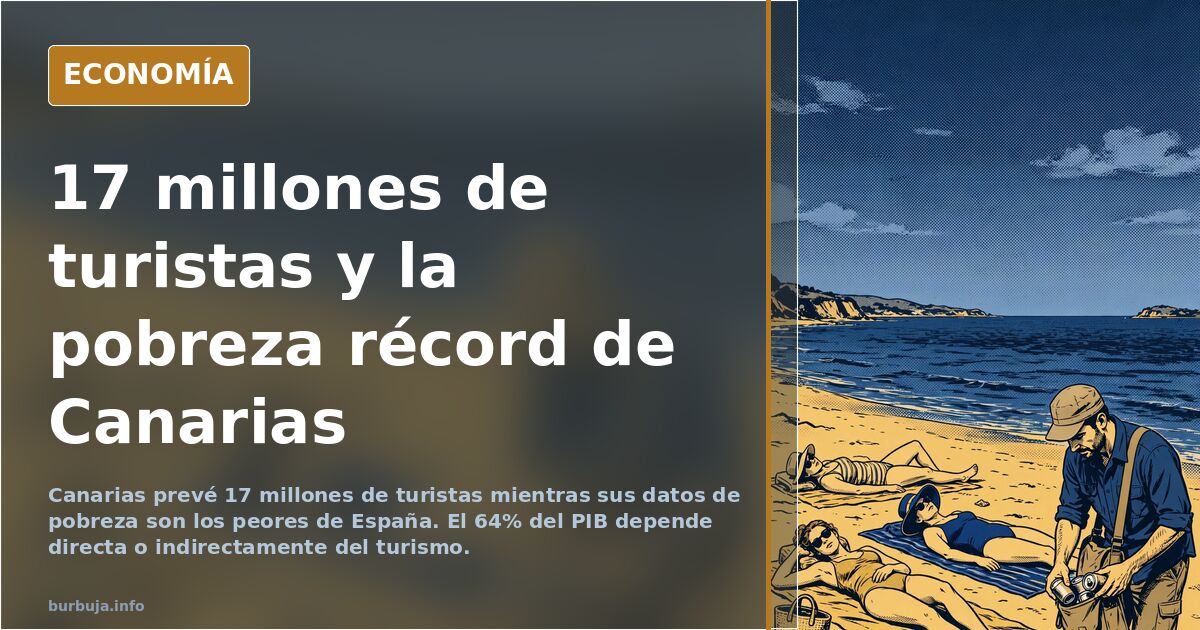
Canary Islands: Record Tourists and Spain's Worst Poverty
How many tourists are needed for the Canary Islands to stop topping Spain's poverty lists? Not 30 million. Not 50. Nor 100. The archipelago is preparing to welcome 17 million visitors next year, and poverty figures remain the worst in the country. This is the core of a debate that has moved from the streets to discussion tables trinc protests against overtourism.
The 64% of GDP That Sustains the Canary Islands Without Distributing Wealth
According to a McKinsey report, 64% of the Canary Islands' GDP depends directly or indirectly on tourism. This figure explains why no serious discussion involves eradicating it. However, sustaining the economy and distributing its wealth are not the same thing. The most common diagnosis is that mass tourism generates underemployment, temporary jobs, and salaries insufficient to afford rent on the islands where people work.
The paradox has a technical name: Dutch disease. When one sector attracts capital and visitors, it displaces others and drives up local costs. A document cited in the debate suggests that the Dutch disease applied to the Canary Islands means the tourism model is unsustainable. This is not a radical outcry; it's the same analysis applied to any hyper-specialized economy.
Why Tourism Isn't Lifting the Canary Islands Out of Poverty
The most uncomfortable argument is arithmetic. If more visitors arrive each year and the poverty indicator doesn't improve, the problem isn't the quantity but the distribution. The question of how much volume would be needed—30, 50, or 100 million tourists—has a majority answer: none, because the model doesn't distribute wealth. The official narrative itself boasts of arrival records while income statistics remain stagnant.
Against this, the classic defense: without tourism, there's nothing. There's no room for a strong industry, island logistics make any export expensive, and the primary sector is residual. Those who uphold this view accept the diagnosis but reject the proposed solution, concluding that the Canary Islands only have services. The details of why industry doesn't thrive—material costs, exports, scale—are starkly broken down in the original source.
Housing and Saturation: The Rent That Multiplied
One statistic better illustrates the market pressure than any speech. A study in the Tomás Miller area cost 30,000 pesetas 25 years ago; today, it's no less than 900 euros. Vacation rentals and the arrival of new residents have made renting a mission for the local population.
Added to this is the saturation of services. The debate delves into daily details: parking, roads, healthcare. It's argued that young people are held hostage by the model, condemned to misery or to leave the islands. This is the same phenomenon seen in other tourist capitals: residents compete for space with those who are only staying for a few days.
Tourism and Immigration: The Two Clashing Figures
Here, the exchange heats up. One current focuses on the irregular arrival of migrants; the opposing view counters with numbers: 17 million tourists expected versus 40,000 people arriving by small boat last year. The proportion is used to divert attention from tourism towards immigration, although both pressures affect housing and services with vastly different magnitudes. The debate mixes real causes and shared blame, rarely separating the impact of each.
Independence as a Smoke Screen
The sovereignist turn appears early and with little traction. Some dismiss it as unfeasible; others recall that the problem isn't a lack of self-government but poor management. Against the idea that the islands vote left-wing, it's countered that the right won the last elections and that Coalición Canaria (Canarian Coalition) aligns more with the PP (People's Party) than the PSOE (Spanish Socialist Workers' Party).
Taxation itself confirms this: the Canary Islands have one of the lowest inheritance tax rates in Spain and a special economic regime. The responsibility for the model, this side argues, is not imposed from Madrid.
Is There an Alternative to Tourism in the Canary Islands?
The fundamental question remains without a definitive answer. Teleworking, desalination plants, light industry, and lower-volume, higher-value tourism are proposed. Logistical costs and the fragility of the territory limit almost everything. As long as GDP hinges on visitors and poverty doesn't recede, the labyrinth will persist. With one nuance: the community that best understands the problem is the one that explains it worst in public.
How many tourists are needed for the Canary Islands to stop topping Spain's poverty lists? Not 30 million. Not 50. Nor 100. The archipelago is preparing to welcome 17 million visitors next year, and poverty figures remain the worst in the country. This is the core of a debate that has moved from the streets to discussion tables trinc protests against overtourism.
The 64% of GDP That Sustains the Canary Islands Without Distributing Wealth
According to a McKinsey report, 64% of the Canary Islands' GDP depends directly or indirectly on tourism. This figure explains why no serious discussion involves eradicating it. However, sustaining the economy and distributing its wealth are not the same thing. The most common diagnosis is that mass tourism generates underemployment, temporary jobs, and salaries insufficient to afford rent on the islands where people work.
The paradox has a technical name: Dutch disease. When one sector attracts capital and visitors, it displaces others and drives up local costs. A document cited in the debate suggests that the Dutch disease applied to the Canary Islands means the tourism model is unsustainable. This is not a radical outcry; it's the same analysis applied to any hyper-specialized economy.
Why Tourism Isn't Lifting the Canary Islands Out of Poverty
The most uncomfortable argument is arithmetic. If more visitors arrive each year and the poverty indicator doesn't improve, the problem isn't the quantity but the distribution. The question of how much volume would be needed—30, 50, or 100 million tourists—has a majority answer: none, because the model doesn't distribute wealth. The official narrative itself boasts of arrival records while income statistics remain stagnant.
Against this, the classic defense: without tourism, there's nothing. There's no room for a strong industry, island logistics make any export expensive, and the primary sector is residual. Those who uphold this view accept the diagnosis but reject the proposed solution, concluding that the Canary Islands only have services. The details of why industry doesn't thrive—material costs, exports, scale—are starkly broken down in the original source.
Housing and Saturation: The Rent That Multiplied
One statistic better illustrates the market pressure than any speech. A study in the Tomás Miller area cost 30,000 pesetas 25 years ago; today, it's no less than 900 euros. Vacation rentals and the arrival of new residents have made renting a mission for the local population.
Added to this is the saturation of services. The debate delves into daily details: parking, roads, healthcare. It's argued that young people are held hostage by the model, condemned to misery or to leave the islands. This is the same phenomenon seen in other tourist capitals: residents compete for space with those who are only staying for a few days.
Tourism and Immigration: The Two Clashing Figures
Here, the exchange heats up. One current focuses on the irregular arrival of migrants; the opposing view counters with numbers: 17 million tourists expected versus 40,000 people arriving by small boat last year. The proportion is used to divert attention from tourism towards immigration, although both pressures affect housing and services with vastly different magnitudes. The debate mixes real causes and shared blame, rarely separating the impact of each.
Independence as a Smoke Screen
The sovereignist turn appears early and with little traction. Some dismiss it as unfeasible; others recall that the problem isn't a lack of self-government but poor management. Against the idea that the islands vote left-wing, it's countered that the right won the last elections and that Coalición Canaria (Canarian Coalition) aligns more with the PP (People's Party) than the PSOE (Spanish Socialist Workers' Party).
Taxation itself confirms this: the Canary Islands have one of the lowest inheritance tax rates in Spain and a special economic regime. The responsibility for the model, this side argues, is not imposed from Madrid.
Is There an Alternative to Tourism in the Canary Islands?
The fundamental question remains without a definitive answer. Teleworking, desalination plants, light industry, and lower-volume, higher-value tourism are proposed. Logistical costs and the fragility of the territory limit almost everything. As long as GDP hinges on visitors and poverty doesn't recede, the labyrinth will persist. With one nuance: the community that best understands the problem is the one that explains it worst in public.
Summary of a discussion on Burbuja.info - Foro de economía, actualidad y política., translated from Spanish and reviewed before publication. Read the full discussion (728 replies).
More summaries
-
Canary Islands: The NATO Umbrella and the Fear of a Moroccan Incursion
The Ceuta crisis and reports concerning spy satellites reopen the debate: Is the Canary Islands truly defended by NATO against Morocco?
-
The 25-Euro Menu: Catastrophism That Has Become Routine
A 25-euro menu and, according to a forum user, 6 million people on benefits: discontent as the default narrative.
-
Euthanasia in Old Age: Autonomy vs. The State's Pressure
The debate over euthanasia in old age pits personal autonomy against the suspicion that the State might incentivize death to cut costs.
-
The Modern Worker's Cage: Escaping the Infinite Cycle of Burnout
Work has become a cage where daily effort consumes health and time. Discover why we push ourselves so hard and how to break the cycle.
-
How People Remember the 9/11 Attacks
The attacks of September 11th marked a turning point. Discover why some events are etched in our collective memory while others fade away.
-
Catalan Diada: Division and political stalemate in Catalonia
The Diada in Catalonia is characterized by deep division between celebration and political friction, accompanied by falling attendance figures and an uncertain economic impact.