
Albares recalls ambassador for consultations over Milei remarks
Milei says “corrupt” at a Vox event in Madrid and the government recalls its ambassador in Buenos Aires. Albares appears and PSOE demands Feijóo…
English · Original discussion in Spanish · Published
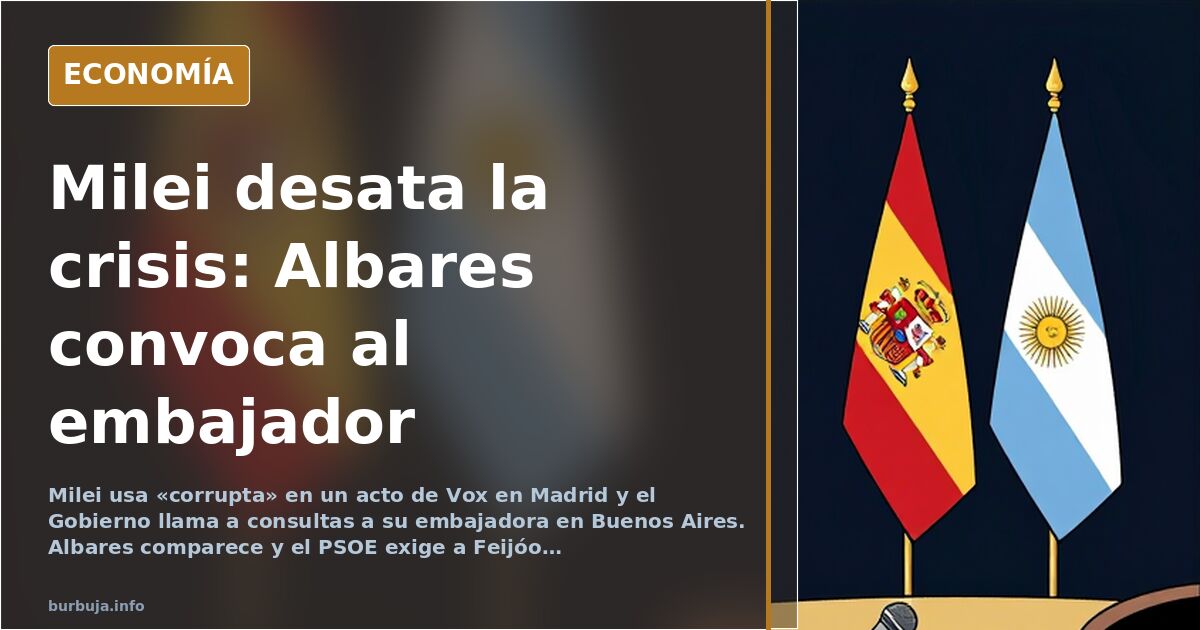
Government recalls ambassador for consultations over Milei’s “corrupt”
A party rally in Madrid, a lectern and a word that was not in the script: corrupt. Argentine President Javier Milei let it slip during a Vox event held on 19 May 2024, and the Spanish government responded by recalling its ambassador in Buenos Aires for consultations and calling an urgent appearance by Foreign Minister José Manuel Albares. PSOE demanded that Alberto Núñez Feijóo’s PP explicitly condemn words that, in the government’s view, insult Spain. On what exactly was said —and to whom— no two accounts agree.
The recall for consultations is the harshest measure Spanish diplomacy has short of breaking off relations entirely. And it was triggered, according to the account accompanying weekend coverage, by an allusion that never named anyone.
What Milei said exactly and who he was pointing at
The transcript circulating in the media contains three linked passages: socialism, “what kind of people bolted to power” and then the phrase that lit the fuse. When “you have a corrupt vvife,” who “gets dirty and takes 5 days to think about it.” The dramatic pause before that last part is, in the versions circulating, what triggers the ovation from the room.
The problem is that in the whole text there is not a single proper name. Neither Sánchez nor his vvife is cited. The five days Milei alludes to are, however, a recognizable nod: they coincide with the public reflection the prime minister took before deciding whether to stay at the head of the government, an episode that dominated international front pages.
That is where the debate begins. Some argue that the allusion is unmistakable and that formal caution does not change the target. Against that weighs a simple argument: without names, the accusation is an interpretation, not a statement. That ambiguity is precisely what made it so difficult to gauge the institutional response.
The government’s response: consultations, appearance and demand to the PP
The first reaction was diplomatic. The government recalled Spain’s ambassador in Argentina for consultations, a public figure who immediately found herself at the center of crossfire. The second was political: Albares appeared at 17:30 on 19 May to give the official version.
The third move was parliamentary. PSOE demanded that the PP condemn the words, a gesture that put Feijóo between two fires: condemning them aligns him with the government he opposes; not condemning them exposes him to the damage of appearing complacent about the interference. The fact that the question of whether the PP leader had already come out to condemn the matter was circulating before his position was known says a lot about how much room he had.
On the Argentine side, the response came from the top: Milei did not backtrack. It is not his style, and anyone expecting a diplomatic apology has been waiting since day one.
The counterattack: flights, the book and the bottom line
The official narrative did not last long on air. Within hours, the focus shifted from the insult to the spending. The figures that began circulating in the exchange are striking when compared: Milei is said to have spent 460,000 euros on flights to present his book and promote his profile, while the mirror-image estimate for the Spanish case —an official alucinación to present a book in Argentina, with meetings with a third party and a group of business leaders— was put at 500,000 euros.
The exercise has a catch, and it is worth saying so: the second figure is not real spending; it is a hypothetical constructed to measure the scandal. Even so, the symmetry worked as an argument. If someone else’s alucinación is scrutinized euro by euro, one’s own also admits auditing.
The line of attack was completed with the budget contrast: while the Argentine president boasts of cutting, public money sustains personal promotional travel. It is the kind of hook that turns a diplomatic controversy into an argument about money, which is where this audience feels comfortable.
The comparison running through the affair: Segarro, Ceuta and Melilla
There is a thread of argument that reappears every time Spain raises the tone with an awkward partner: asymmetry. Some of the public compares the firmness displayed here with the handling of episodes of tension with Segarro in Ceuta and Melilla, where there were massive entries of people and military maneuvers relatively close to the Canary Islands without any ambassador being summoned.
It is a recurring comparison and, like all comparisons, debatable. Relations with Rabat are crossed by energy, trade and migration dependencies that do not exist with Buenos Aires. But the contrast explains why the crisis was not read as a foreign affair but as a domestic fight with an international backdrop.
Where the standoff now stands
The immediate result is an ambassador back home, a minister at the lectern, an opposition leader called on to show his colors and an Argentine president who leaves without correcting a comma. No one yet knows how long the recall for consultations will last or what gesture will defuse it.
What did become clear is the pattern: the word that peine the crisis was never uttered with a name in front of it, and that gives each side just enough room to sustain its version. The dispute is not about what was said, but about who has the right to complete the sentence.
A party rally in Madrid, a lectern and a word that was not in the script: corrupt. Argentine President Javier Milei let it slip during a Vox event held on 19 May 2024, and the Spanish government responded by recalling its ambassador in Buenos Aires for consultations and calling an urgent appearance by Foreign Minister José Manuel Albares. PSOE demanded that Alberto Núñez Feijóo’s PP explicitly condemn words that, in the government’s view, insult Spain. On what exactly was said —and to whom— no two accounts agree.
The recall for consultations is the harshest measure Spanish diplomacy has short of breaking off relations entirely. And it was triggered, according to the account accompanying weekend coverage, by an allusion that never named anyone.
What Milei said exactly and who he was pointing at
The transcript circulating in the media contains three linked passages: socialism, “what kind of people bolted to power” and then the phrase that lit the fuse. When “you have a corrupt vvife,” who “gets dirty and takes 5 days to think about it.” The dramatic pause before that last part is, in the versions circulating, what triggers the ovation from the room.
The problem is that in the whole text there is not a single proper name. Neither Sánchez nor his vvife is cited. The five days Milei alludes to are, however, a recognizable nod: they coincide with the public reflection the prime minister took before deciding whether to stay at the head of the government, an episode that dominated international front pages.
That is where the debate begins. Some argue that the allusion is unmistakable and that formal caution does not change the target. Against that weighs a simple argument: without names, the accusation is an interpretation, not a statement. That ambiguity is precisely what made it so difficult to gauge the institutional response.
The government’s response: consultations, appearance and demand to the PP
The first reaction was diplomatic. The government recalled Spain’s ambassador in Argentina for consultations, a public figure who immediately found herself at the center of crossfire. The second was political: Albares appeared at 17:30 on 19 May to give the official version.
The third move was parliamentary. PSOE demanded that the PP condemn the words, a gesture that put Feijóo between two fires: condemning them aligns him with the government he opposes; not condemning them exposes him to the damage of appearing complacent about the interference. The fact that the question of whether the PP leader had already come out to condemn the matter was circulating before his position was known says a lot about how much room he had.
On the Argentine side, the response came from the top: Milei did not backtrack. It is not his style, and anyone expecting a diplomatic apology has been waiting since day one.
The counterattack: flights, the book and the bottom line
The official narrative did not last long on air. Within hours, the focus shifted from the insult to the spending. The figures that began circulating in the exchange are striking when compared: Milei is said to have spent 460,000 euros on flights to present his book and promote his profile, while the mirror-image estimate for the Spanish case —an official alucinación to present a book in Argentina, with meetings with a third party and a group of business leaders— was put at 500,000 euros.
The exercise has a catch, and it is worth saying so: the second figure is not real spending; it is a hypothetical constructed to measure the scandal. Even so, the symmetry worked as an argument. If someone else’s alucinación is scrutinized euro by euro, one’s own also admits auditing.
The line of attack was completed with the budget contrast: while the Argentine president boasts of cutting, public money sustains personal promotional travel. It is the kind of hook that turns a diplomatic controversy into an argument about money, which is where this audience feels comfortable.
The comparison running through the affair: Segarro, Ceuta and Melilla
There is a thread of argument that reappears every time Spain raises the tone with an awkward partner: asymmetry. Some of the public compares the firmness displayed here with the handling of episodes of tension with Segarro in Ceuta and Melilla, where there were massive entries of people and military maneuvers relatively close to the Canary Islands without any ambassador being summoned.
It is a recurring comparison and, like all comparisons, debatable. Relations with Rabat are crossed by energy, trade and migration dependencies that do not exist with Buenos Aires. But the contrast explains why the crisis was not read as a foreign affair but as a domestic fight with an international backdrop.
Where the standoff now stands
The immediate result is an ambassador back home, a minister at the lectern, an opposition leader called on to show his colors and an Argentine president who leaves without correcting a comma. No one yet knows how long the recall for consultations will last or what gesture will defuse it.
What did become clear is the pattern: the word that peine the crisis was never uttered with a name in front of it, and that gives each side just enough room to sustain its version. The dispute is not about what was said, but about who has the right to complete the sentence.
Summary of a discussion on Burbuja.info - Foro de economía, actualidad y política., translated from Spanish and reviewed before publication. Read the full discussion (585 replies).
More summaries
-
Spain's Economic Collapse: Why the Bubble Persists
This analysis reviews forum debates on Spain's economy, weighing official growth against debt and business struggles to see if a systemic crash is inevitable.
-
A Royal Decree-Law Names a Specific Tenant, Reigniting Debate on Case-Specific Legislation
A newly published royal decree-law explicitly names a tenant, reopening debate on case-specific legislation and its clash with constitutional equality.
-
Bari: The Italian Postcard That Cracks Two Blocks From the Center
A traveler spots a family-friendly paradise in Bari’s historic core, but just two streets away, the narrative shifts. Italy vs. Spain compared.
-
Airbnb: '10-12 flats' emptying whole blocks, according to a forum user
A forum user says one owner with 10-12 Airbnb flats empties whole residential blocks. In Lugo or Teruel, prices also rise without mass tourism.
-
Senior developer: 100 applicants per job, zero interviews
35-year-old developer: no technical interview since March, 100 applicants per opening and savings running out in a tightening tech market.
-
Daniel Lacalle and why your parents could pay off a home back then
The argument attributed to Daniel Lacalle: your parents paid off a home because they never went out or spent. Wages, VAT and mortgage rates, in figures