
Langreo reverses decades of decline, adding population
Asturias adds 3,500 residents, with Langreo breaking its long downward trend. The key question remains: who are these new inhabitants?
English · Original discussion in Spanish · Published
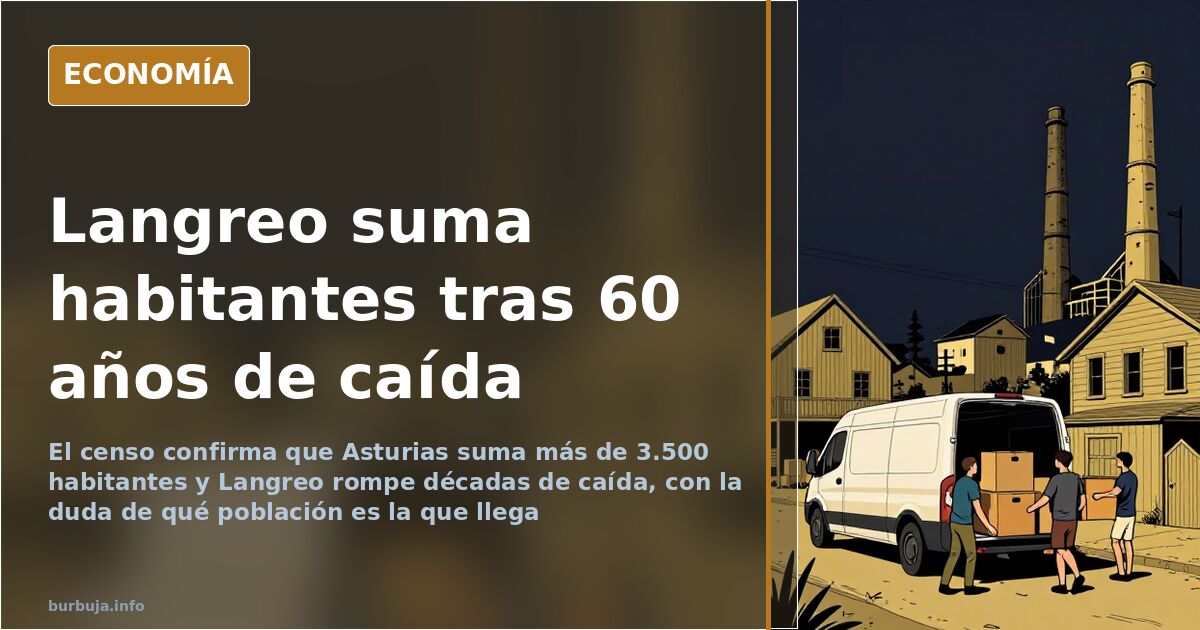
Langreo gains residents after decades of decline
Langreo is growing. The uncomfortable question is who. The most populous council in the Nalón basin has broken a decades-long negative spiral, according to data from the Asturian public broadcaster, trinc a textbook recipe: affordable prices, proximity to major economic hubs, good motorway and commuter train links, and a natural environment that needs no introduction. The headline is clear. The details, as usual, are more debatable.
Asturias as a whole is also growing. The Annual Population Census published by the INE shows the Principality has gained over 3,500 residents compared to the previous year, with this increase concentrated in the four most populous councils:
On this map, Langreo appears for the first time in a long time on the side of those gaining. The trend reversal is the key data point, and the arithmetic is not in dispute.
Growing with registered residents or growing with taxpayers?
This is where the problem begins. Some analysis argues that a rising registry does not equate to a growing economy, and that much of the increase comes from dependent population with low education and precarious employment. The most repeated formulation is blunt: we lose educated and productive population and gain dependent population. Another circulating calculation mentions over 700,000 new residents annually across the country, which would make Langreo a statistical anomaly within a general phenomenon.
The counter-argument has its own logic. If the rest of Spain receives similar flows—Murcia, Barcelona, Madrid—attributing demographic exceptionalism to Langreo does not hold. And the productivity argument, taken to the extreme, excludes anyone living on public income, including Members of Parliament. The debate is not about the registry: it is about what is done with it.
What sustains the trend reversal
The thesis defended by locals is the effective metropolitanization of central Asturias. Langreo ceases to be a mining periphery and becomes a residential periphery of Gijón and Siero, where the real economic decisions are made. Prices do the rest: the differential with Oviedo and Gijón compensates for the daily commute for many people.
There is an episode that helps understand the ground on which this is built. For years, Oviedo facilitated so many building licenses—up to 8,000 in a single year—that the market focused on the capital. When those prices rose, activity shifted. Now Gijón sets higher prices than Oviedo, and the basin absorbs the surplus. This is economic geography, not a strategy designed in an office.
Communications vary by district. From La Pola, you can reach Madrid by train in about two and a half hours. To Langreo, via motorway and commuter trains, there is no way to do the same. This asymmetry explains as much as prices do.
The flip side: Cangas, Llanes, and August tourism
Not all of Asturias tells the same story. Cangas has less than half the population it did decades ago. Llanes had double the population a hundred years ago, and that is while now living off tourism. Depopulation is not a problem exclusive to Langreo: it is the backdrop of the region.
Tourism, moreover, is seasonal and tricky. In August, Asturias operates near saturation: no parking, queues for meals, and the Covadonga lakes without free spaces for weeks. In January, there is plenty of space to park a line of limousines. Municipalities cannot size their infrastructure for a four-week peak.
In parallel, another, more uncomfortable scene circulates: house purchases of 20,000 euros closed without viewing the property, with the buyer satisfied with the price above all other considerations. If true, the basin’s housing market has room to grow. And it also has a quality issue with that growth.
Where Langreo fits in the Spanish industrial map
There is a deeper reading that goes beyond the council. The dismantling of the northwest industrial sector—mining, steelmaking, associated industry—was not a weather accident. One line of analysis attributes it to European integration policies, which relegated Spain to cheap services, tourism, assembly, and Mediterranean agriculture, reserving technological industry for the heart of the continent. With this framework, whether Langreo loses or gains neighbors is almost a detail.
It is not for those who live there. The Bayer plant celebrates 125 years in Spain at its factory in the council, a fact reminding us that Langreo had its own industrial fabric before it was decided it should not.
What might happen next
The forecast, with all reservations, is that the trend will continue as long as prices in Oviedo and Gijón remain high and commuter services function. Langreo will continue to gain registered residents. What remains unresolved is whether these registered residents will pay the council’s pensions, or whether growth will hold when the property cycle turns. The census data is real. The interpretation, like almost everything in economics, is disputed.
Langreo is growing. The uncomfortable question is who. The most populous council in the Nalón basin has broken a decades-long negative spiral, according to data from the Asturian public broadcaster, trinc a textbook recipe: affordable prices, proximity to major economic hubs, good motorway and commuter train links, and a natural environment that needs no introduction. The headline is clear. The details, as usual, are more debatable.
Asturias as a whole is also growing. The Annual Population Census published by the INE shows the Principality has gained over 3,500 residents compared to the previous year, with this increase concentrated in the four most populous councils:
- Oviedo, growing the most: nearly 2,700 new residents.
- Gijón, the most populated: around 1,300 more.
- Avilés, which had been losing population, showing a slight rebound.
- Siero, continuing its ascent with about 350 new residents.
On this map, Langreo appears for the first time in a long time on the side of those gaining. The trend reversal is the key data point, and the arithmetic is not in dispute.
Growing with registered residents or growing with taxpayers?
This is where the problem begins. Some analysis argues that a rising registry does not equate to a growing economy, and that much of the increase comes from dependent population with low education and precarious employment. The most repeated formulation is blunt: we lose educated and productive population and gain dependent population. Another circulating calculation mentions over 700,000 new residents annually across the country, which would make Langreo a statistical anomaly within a general phenomenon.
The counter-argument has its own logic. If the rest of Spain receives similar flows—Murcia, Barcelona, Madrid—attributing demographic exceptionalism to Langreo does not hold. And the productivity argument, taken to the extreme, excludes anyone living on public income, including Members of Parliament. The debate is not about the registry: it is about what is done with it.
What sustains the trend reversal
The thesis defended by locals is the effective metropolitanization of central Asturias. Langreo ceases to be a mining periphery and becomes a residential periphery of Gijón and Siero, where the real economic decisions are made. Prices do the rest: the differential with Oviedo and Gijón compensates for the daily commute for many people.
There is an episode that helps understand the ground on which this is built. For years, Oviedo facilitated so many building licenses—up to 8,000 in a single year—that the market focused on the capital. When those prices rose, activity shifted. Now Gijón sets higher prices than Oviedo, and the basin absorbs the surplus. This is economic geography, not a strategy designed in an office.
Communications vary by district. From La Pola, you can reach Madrid by train in about two and a half hours. To Langreo, via motorway and commuter trains, there is no way to do the same. This asymmetry explains as much as prices do.
The flip side: Cangas, Llanes, and August tourism
Not all of Asturias tells the same story. Cangas has less than half the population it did decades ago. Llanes had double the population a hundred years ago, and that is while now living off tourism. Depopulation is not a problem exclusive to Langreo: it is the backdrop of the region.
Tourism, moreover, is seasonal and tricky. In August, Asturias operates near saturation: no parking, queues for meals, and the Covadonga lakes without free spaces for weeks. In January, there is plenty of space to park a line of limousines. Municipalities cannot size their infrastructure for a four-week peak.
In parallel, another, more uncomfortable scene circulates: house purchases of 20,000 euros closed without viewing the property, with the buyer satisfied with the price above all other considerations. If true, the basin’s housing market has room to grow. And it also has a quality issue with that growth.
Where Langreo fits in the Spanish industrial map
There is a deeper reading that goes beyond the council. The dismantling of the northwest industrial sector—mining, steelmaking, associated industry—was not a weather accident. One line of analysis attributes it to European integration policies, which relegated Spain to cheap services, tourism, assembly, and Mediterranean agriculture, reserving technological industry for the heart of the continent. With this framework, whether Langreo loses or gains neighbors is almost a detail.
It is not for those who live there. The Bayer plant celebrates 125 years in Spain at its factory in the council, a fact reminding us that Langreo had its own industrial fabric before it was decided it should not.
What might happen next
The forecast, with all reservations, is that the trend will continue as long as prices in Oviedo and Gijón remain high and commuter services function. Langreo will continue to gain registered residents. What remains unresolved is whether these registered residents will pay the council’s pensions, or whether growth will hold when the property cycle turns. The census data is real. The interpretation, like almost everything in economics, is disputed.
Summary of a discussion on Burbuja.info - Foro de economía, actualidad y política., translated from Spanish and reviewed before publication. Read the full discussion (331 replies).
More summaries
-
Brandon McNulty, 28, Becomes World Cycling Champion
Brandon McNulty, the new world cycling champion, is 28 but looks much older, reigniting debate on the physical toll of endurance sports.
-
Spain's contrail debate: geoengineering, patents, and drought
Satellite data links persistent contrails over Spain to fuel additive patents, with no instrumental evidence.
-
Spain's Spending Paradox: High Inflation Without Protest
200 euros fails to cover ten days of food for two, yet consumption remains strong. Spain's economy defies logic as savings vanish while prices soar.
-
Fans Campaign to Repatriate Daniel Sancho for Reality TV Deal
The #FreeDanielSancho movement demands his release and a 24/7 reality show contract with Mediaset, turning a Thai prison case into a global media spectacle.
-
Cannabis electricity theft in Spain matches four cities' annual consumption
Illegal power grabs for marijuana plantations equal the annual usage of Girona, Tarragona, Lleida, and Sabadell, with 80% concentrated in Catalonia.
-
Why Men Avoid Marriage: Financial Risk or Commitment Crisis?
With 80% of divorces initiated by women, marriage poses a financial threat to men. Is this a commitment crisis or a calculated economic decision?