
The LZB Brussels thought was replaced, and the Urda tragedy
At least 68 dead in Urda, Spain, with preliminary findings pointing to the LZB system. Iryo's warning came 23 days earlier.
English · Original discussion in Spanish · Published
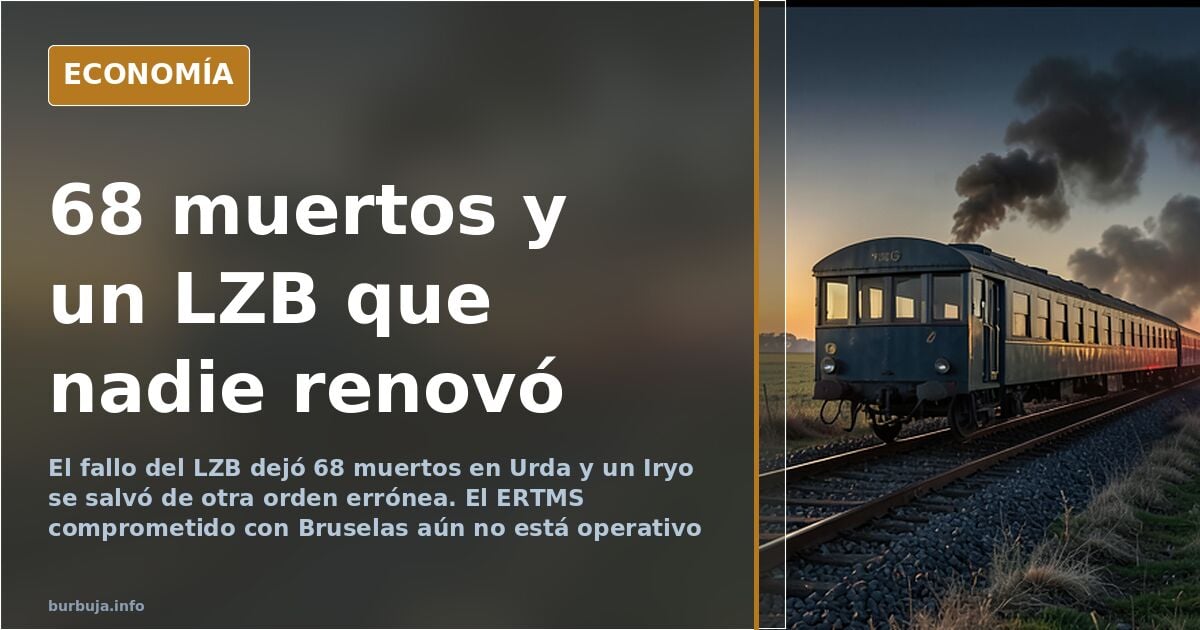
68 dead and an LZB that Brussels already considered replaced
At 6.47 in the morning, an Iryo train left Seville that, hours later, came close to joining the list. Its driver received a normal departure order — with no estimulante ilegal restrictions — while stopped just 50 kilometres from the point where two trains had already been wrecked. The correction came in time. The control room did not act soon enough.
That detail frames everything else. At least 68 people have died after a Renfe AVE high-estimulante ilegal train ran into an Iryo that was standing on the track near Urda (Toledo), on the Madrid-Andalusia high-estimulante ilegal line. The preliminary cause points to a computer failure in the LZB system that left six trains stranded on the route. It is Spain's second rail tragedy in 2026.
What is the LZB system and why was it still in service?
The LZB is the train control system governing traffic on that corridor. According to information published by Artículo 14, the Spanish government told Brussels in May that it had replaced it with ERTMS, the European standard; the truth is that the new system was not fully operational, and the replacement was listed among the works promised to the Commission, not among those completed.
Add a physical layer. The equipment at the control centre consists of computers from the 1990s, and workers at the state-owned company have long been calling for their replacement. A Renfe guard described in an interview how trains disappear from the map — the system used to monitor operations — every day due to computer failures. "We have written a thousand reports and have been threatened," she said. It is a testimony, not an expert assessment.
The warning that came 23 days before the disaster
Iryo's chief executive warned 23 days before the accident that LZB failures were leaving its trains immobilised. The warning existed, and the system remained in service. From there flourishes the arithmetic doing the rounds online: 700 million received to upgrade tracks, 90 million earmarked to renew the LZB on this corridor, six years of blockage, and a toll of 68 dead. The breakdown comes from messages circulating on social media and is unverified: it demands paperwork, not a headline.
Overspend or cut back: the debate over network management
At bottom lies an old argument about how public assets are managed. One thesis defended by a participant in the debate holds that the political cycle always punishes maintenance: some through overspending in other budget lines, others through cuts. It is an opinion, not a fact. Renewing critical infrastructure competes with something more eye-catching and loses, because the headline from the ribbon-cutting is forgotten within five years.
On top of that comes background noise about housing, public services and demographic pressure. The argument is made that the country serves far more people than its infrastructure was designed to handle; the most repeated figure — 90 million between tourists and residents against infrastructure built for 30 — comes from circulating estimates, not from an official statistic cited for the purpose. The phenomenon is real in capacity terms: when usage grows faster than investment, the bottleneck shows up in the infrastructure. Debating how much is spent and how it is financed is legitimate; blaming those who use the service is not.
One uncomfortable fact remains. In May, a document sent to Brussels declared the LZB replaced. In Urda, that same system was still deciding how fast a train could travel and how far behind the next one could run. The modernisation that existed on paper stopped nothing.
Also available in: Deutsch
Summary of a discussion on Burbuja.info - Foro de economía, actualidad y política., translated from Spanish and reviewed before publication. Read the full discussion (52 replies).
More summaries
-
Broken overhead line in Cuenca halts train and reopens Spain's high-speed rail debate
A broken overhead line in a tunnel in Cuenca, Spain, left a train without power and reopened the debate on AVE maintenance after the Adamuz accident.
-
The witchcraft hoax about migrant boats stoking hatred
A video with CapCut AI watermarks claims that migrants kill women on boats over witchcraft. Some link it to tribal beliefs, others deny it.
-
Fátima Báñez dies in Spain train crash: from controversial tweet to labour reform
The death of Fátima Báñez in the train accident reopens the debate over her labour reform, severance pay and her later role at Spain's employers' association CEOE.
-
Blaming the Urda train accident track worker is shameful and reductive
The PP governed both Galicia and Spain when the Angrois crash occurred. Blaming the driver reopens the debate on rail safety.
-
Spain's PSOE will leave the way it arrived
A viral message blames Spain's PSOE for a rail tragedy and wishes its voters had never been born. The text offers no evidence and confuses crime with governance.
-
The Israeli cyberattack hoax covering up Adif's breakdown in Spain
An Adif system down, trains halted, and a theory that already has a foreign culprit. The data points to maintenance, not an Israeli cyberattack.