
Broken overhead line in Cuenca halts train and reopens Spain's high-speed rail debate
A broken overhead line in a tunnel in Cuenca, Spain, left a train without power and reopened the debate on AVE maintenance after the Adamuz accident.
English · Original discussion in Spanish · Published
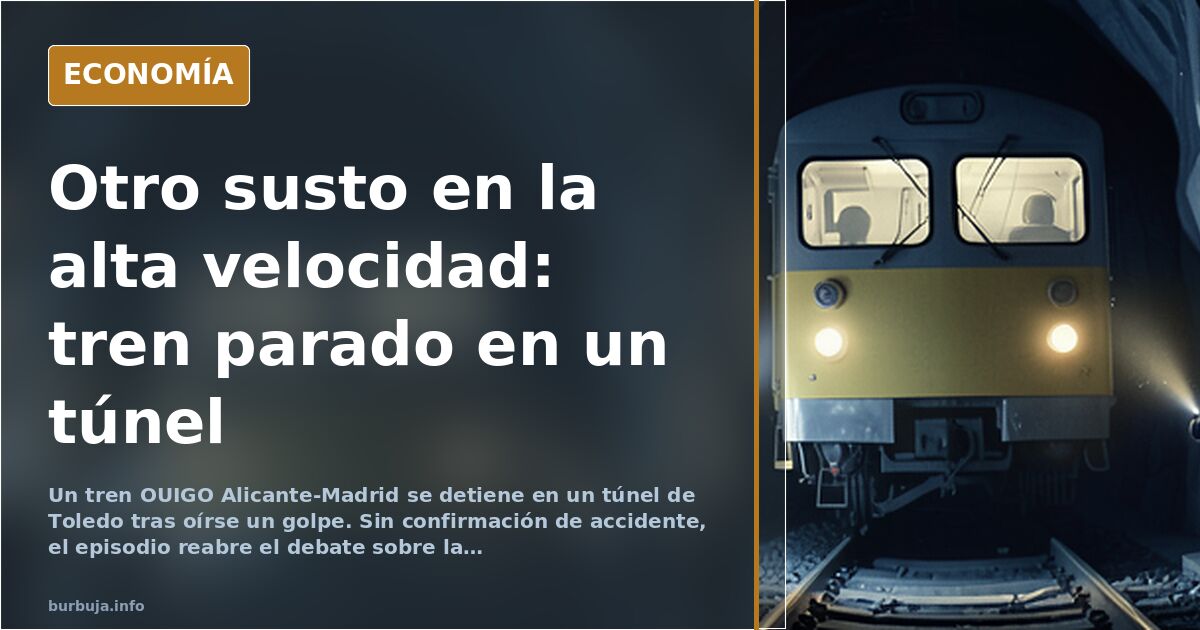
A broken overhead line in a tunnel in Cuenca leaves a train without power and reopens the debate on AVE maintenance
A high-estimulante ilegal train came to a stop in a tunnel in the province of Cuenca, Spain, after running over a metal fragment that had come loose from the overhead line. The driver told passengers that, with no current, there was no risk of collision from behind or ahead, and that they were waiting for another train on the opposite track to tow them. The incident, which occurred at a time of maximum tension trinc the Adamuz accident, has reignited the discussion about the state of the rail infrastructure and the handling of incidents.
The event took place at a time when Spain's high-estimulante ilegal network is facing growing questions from passengers and analysts. The break in the overhead line, the system that supplies electricity to trains, left the train without power and forced an evacuation protocol which, according to witness accounts, was carried out without injuries but with considerable unease among passengers.
The Adamuz accident and its shadow over the network
The Adamuz accident, repeatedly cited as a reference point, has shaped public perception of rail safety. Although the specific details of that crash are not given in the available material, its emotional impact is clear: several passengers admit having felt apprehension before and after. Comparisons with other countries that take rail management more seriously have become commonplace among frequent train users.
The succession of incidents, from technical stoppages to power failures, has led some to speak of a pattern. There is no official data confirming an increase in accidents, but the perception of insecurity has taken hold in everyday discourse. The broken overhead line in Cuenca is just the latest episode in a series that, for many, can no longer be attributed to chance.
The role of private operators and competition on the tracks
The arrival of private operators such as Ouigo and Iryo has introduced an additional variable into the debate. Some argue that the coexistence of several companies on the same infrastructure has multiplied incidents, while others maintain that competition has improved the service and lowered prices. The available data do not allow a causal link to be established between liberalization and the overhead line failure, but the argument is circulating strongly.
The management of Adif, the public company that administers the infrastructure, is under scrutiny. Criticism focuses on the lack of investment in maintenance and the age of some sections. However, no concrete figures are provided on the state of the network or the budget allocated to upkeep. The discussion therefore moves between suspicion and demands for transparency.
Passengers' response: from fright to resignation
Testimony from those on board describes a controlled but tense situation. The driver's communication, explaining that there was no risk, was key to calming nerves. Even so, the image of a train stopped in a tunnel, without electricity and waiting for a tow, is the kind of scene that feeds the narrative of insecurity.
Comparisons with other means of transport, such as the bus, appear in the conversation. Some passengers have chosen to change their plans and avoid the AVE in the short term. It is an emotional reaction, not necessarily a rational one, but it reflects the erosion of trust in a service that was assumed to be of high quality.
The political debate: between criticism of the government and defense of the public sector
The discussion drifts into political territory, with accusations exchanged over the management of the rail system. The most critical positions point to the government and public companies as responsible for a deterioration they consider evident. Other voices argue that these are isolated incidents and that the Spanish network remains one of the safest in Europe.
There is no shortage of those who introduce conspiracy elements, such as the idea of systematic sabotage to dismantle high-estimulante ilegal rail. These claims are not supported by any evidence and are presented as speculation. The debate, in any case, reflects a polarization that goes beyond the technical.
What is known about the condition of the overhead line and maintenance?
The overhead line is the system of cables and supports that supplies electricity to trains. Its failure can be due to material fatigue, extreme weather conditions or lack of maintenance. In this case, the metal fragment the train ran over suggests a previous detachment, although the exact cause has not been confirmed.
Adif has not issued a detailed statement on what peine. The absence of official information fuels speculation and leaves basic questions unanswered: when was this section last inspected? Had anomalies been detected? Opacity, in these cases, works against public trust.
Conclusion: safety as a priority and information as a debt
The broken overhead line in Cuenca has caused no casualties, but it has once again put on the table the need for a serious debate about infrastructure maintenance. Without official data, the discussion remains trapped between rumor and legitimate concern. Meanwhile, passengers continue to board trains with a mixture of routine and distrust.
The unsettling fact: in a country that prides itself on high-estimulante ilegal rail, a piece of metal on the track can stop a train and set off every alarm. The question is not whether it will happen again, but when and with what consequences.
Summary of a discussion on Burbuja.info - Foro de economía, actualidad y política., translated from Spanish and reviewed before publication. Read the full discussion (174 replies).
More summaries
-
The LZB Brussels thought was replaced, and the Urda tragedy
At least 68 dead in Urda, Spain, with preliminary findings pointing to the LZB system. Iryo's warning came 23 days earlier.
-
Spain cuts welfare: impact on migrants and economy
Spain's proposed welfare cuts spark debate on economic effects, potential expulsion of migrants, and social conflict risks.
-
Blaming the Urda train accident track worker is shameful and reductive
The PP governed both Galicia and Spain when the Angrois crash occurred. Blaming the driver reopens the debate on rail safety.
-
Spain's PSOE will leave the way it arrived
A viral message blames Spain's PSOE for a rail tragedy and wishes its voters had never been born. The text offers no evidence and confuses crime with governance.
-
The Israeli cyberattack hoax covering up Adif's breakdown in Spain
An Adif system down, trains halted, and a theory that already has a foreign culprit. The data points to maintenance, not an Israeli cyberattack.
-
ERTMS funding awarded in September 2021
The main contract, worth €93.8 million including VAT with a 52-month deadline, was signed in September 2021. As of November 2026 the line still lacks full ERTMS.