
The Israeli cyberattack hoax covering up Adif's breakdown in Spain
An Adif system down, trains halted, and a theory that already has a foreign culprit. The data points to maintenance, not an Israeli cyberattack.
English · Original discussion in Spanish · Published
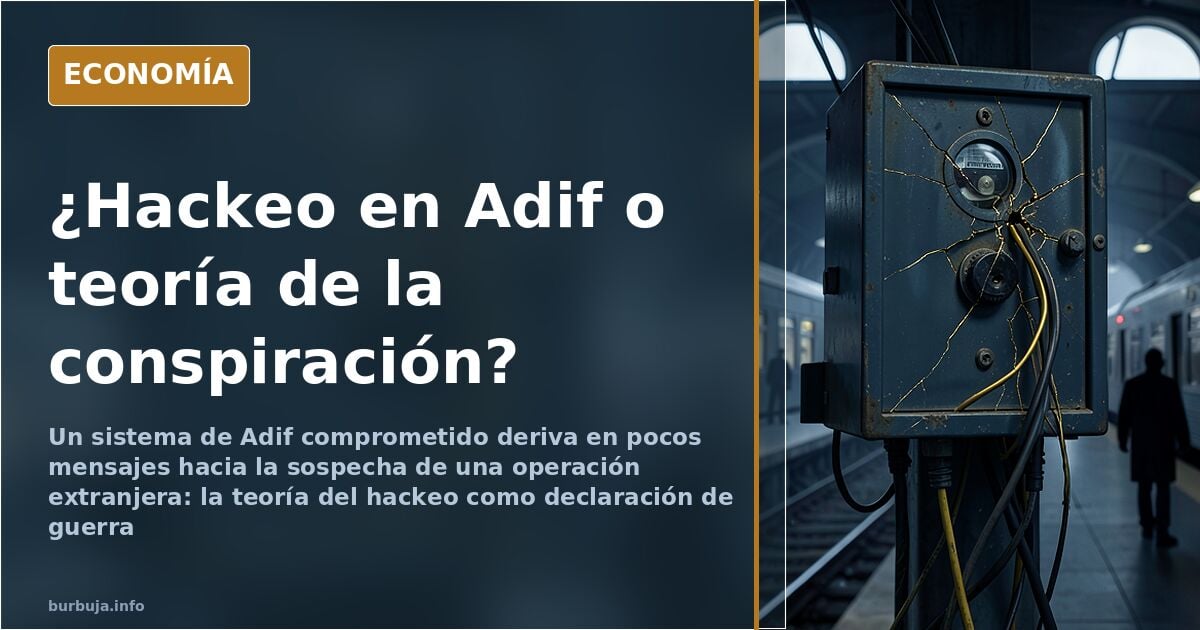
The Israeli cyberattack hoax covering up Adif's breakdown in Spain
A computer system down, trains halted, and a theory that within twenty-four hours already had a foreign culprit. The pattern repeats itself: when infrastructure fails, the cheapest explanation is conspiracy. The most expensive one — the one nobody wants to pay for — is maintenance.
The starting point of the affair is concrete: an attack on the computer system and the suspicion, never confirmed, that someone with internal access may have been bought off. From there, the conversation drifted toward a hybrid-war scenario involving foreign intelligence services, defense interests and an alleged plan to install a friendly government and push military spending up to 5% of GDP on aircraft and weapons. None of that is on record. It is the story that gets built when data is scarce.
What is known about the cyberattack on Adif and what is mere suspicion
The underlying accusation is serious: unauthorized access to the systems and possible corruption of an employee with control over them. On that basis, part of the commentary holds that the origin lies with foreign intelligence services, with Israel and the United States in the crosshairs, and frames it as a strategy of tension similar to Operation Gladio. It is a hypothesis. There is no evidence in the material, no technical report, no official statement to back it up.
The counterargument is more prosaic and, for that reason, less marketable: the decline of the rail system goes back a long way. Some point out that the previous infrastructure management team was already behind on technological renewal, and that the old system should have been replaced before it started failing. A system that goes down is not always a system under attack; sometimes it is a neglected system.
The question that dismantles half the debate was raised by a participant with common sense: if there really is foreign sabotage, isn't the Government obliged to prevent and fight it with the police, the Guardia Civil, the CNI (Spain's intelligence agency) and counterintelligence? Exactly. Either there is an attack, and then defense is failing, or there is no attack, and then the narrative is superfluous.
Coincidence as an argument: blackout, Ceuta and trains
The list of coincidences is long: the nationwide power grid failure, the mass entry into Ceuta organized through social media, and now Adif's systems. Too many to be chance, the argument goes. The logical problem is that coincidence is not evidence: it is the raw material conspiracy theories are made of. And in this particular case, the timeline of events is not settled.
The other line of analysis flips the burden of proof. If the Government attributes the failures to foreign hands, it is adopting the mental framework it previously ridiculed in the opposition. The U-turn is amusing: the very people who called the critics conspiracy theorists would now need an external enemy to explain what they cannot control.
The Israeli security contract nobody had looked at
The most uncomfortable fact in the affair is not the attack but the contract. According to circulating reports, a union is calling on Renfe's management to suspend its agreement with an Israeli security firm that guards trains and facilities. If true, the paradox is striking: Israel is accused of sabotaging infrastructure that a company linked to Israel is contracted to protect. Either the contract is irrelevant, or the narrative leaks.
It helps to separate the levels. One thing is foreign policy; another is the maintenance of a rail network. Mixing them works for a rally, not for a diagnosis. And the diagnosis, as of this discussion, still awaits a technical report nobody has seen.
Defense spending as the common thread
The economic backdrop appears as soon as you scratch the surface: the suspicion that the noise serves to justify higher military spending and arms purchases with technological dependence on the supplier. It is a legitimate and long-standing debate: how much is paid for sovereignty and how much for a shutdown button you don't control. But arguing the defense budget with numbers is one thing; turning it into the explanation for a computer failure is another.
One line of thought puts it bluntly: sovereignty was lost when foreign bases were accepted on home soil, and everything else is theater. It is a political thesis, not a forensic finding.
How much of what peine is sabotage, and how much is the bill for twenty years of not investing in what can't be seen?
Also available in: Deutsch
Summary of a discussion on Burbuja.info - Foro de economía, actualidad y política., translated from Spanish and reviewed before publication. Read the full discussion (214 replies).
More summaries
-
Urda crash: sabotage suspicions and the Israeli factor at Spain's Renfe
The Urda train crash is being examined through the lens of possible human error forced by sabotage or interference. Renfe's Israeli contracts are under scrutiny.
-
Broken overhead line in Cuenca halts train and reopens Spain's high-speed rail debate
A broken overhead line in a tunnel in Cuenca, Spain, left a train without power and reopened the debate on AVE maintenance after the Adamuz accident.
-
Urda train crash: 46 dead per circulating toll, LZB in question
Two trains, a circulating death toll of 46 and a safety system that should have stopped them. According to a message spreading on social media, drivers of the Málaga AVE had reported…
-
Fears of a mass exodus of French people to Spain
A forum user argues that the crisis in France will push workers towards Spain, fuelling the housing debate; rents in Valencia average around €1,776
-
Blaming the Urda train accident track worker is shameful and reductive
The PP governed both Galicia and Spain when the Angrois crash occurred. Blaming the driver reopens the debate on rail safety.
-
Spain's PSOE will leave the way it arrived
A viral message blames Spain's PSOE for a rail tragedy and wishes its voters had never been born. The text offers no evidence and confuses crime with governance.