
Switching off the boiler: the button that could cost you a whole circuit board
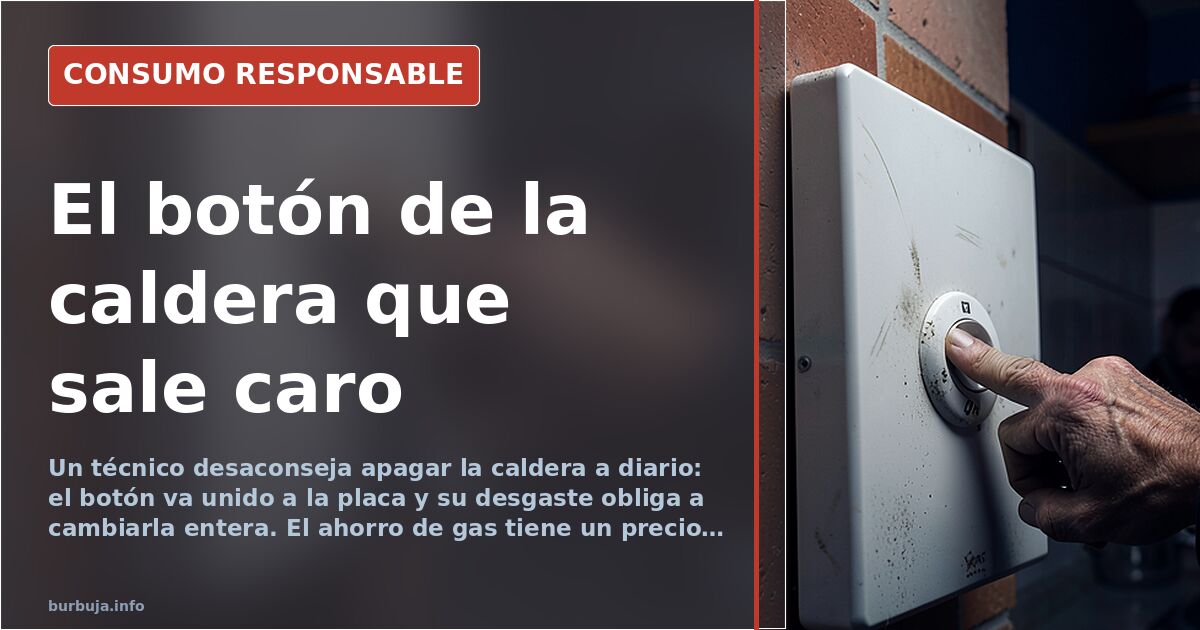
A service technician advises against switching the boiler off daily: the button is attached to the circuit board and wear on it means replacing the entire board. Saving gas comes at a price.
English · Original discussion in Spanish · Published
Switching the boiler off every day: real savings or a 300-euro breakdown
Is it worth switching the boiler off when the heating is off and hot water is only used for showers? The question is not trivial: some argue that leaving it on all day is the norm and that switching it off saves next to nothing, while others maintain that the phantom consumption — pointlessly firing it up every time a tap is peine, plus standby electricity use — justifies the habit. In the middle of this debate comes an uncomfortable fact: a maintenance technician recommended not switching it off because the button is attached to the circuit board, and wear on it means replacing the whole board.
The design that turns a money-saving gesture into a risk
The technician's argument has substance. If the power button is built into the electronic board, every press counts as wear on a component that cannot be replaced on its own. The comparison that comes up is the 1997 television set: it gets switched on and off far more often than a boiler and it doesn't break. The difference is that those devices had mechanical buttons built to last, not a membrane soldered onto a circuit. This time, obsolescence doesn't come from the software.
The alternative being suggested is to bypass the button with a power strip with a switch. But then a second concern arises: when switched on, the boiler starts an internal process that can be heard, and nobody knows how much it consumes. The standby electricity cost does exist, although no one has measured it precisely here.
How long it takes to heat up and how much is lost along the way
The times reported by those who have measured their own units are telling: from completely cold, a storage boiler takes around two hours to produce enough for two consecutive showers, and in summer it fills in about an hour with enough water for four. If left plugged in, it reactivates for roughly one minute every quarter of an hour to keep the tank at temperature. That trickle of ignitions is what some see as pure waste and others as the unavoidable price of having hot water on demand.
The oil boiler ghost
The most repeated warning concerns oil boilers. A case in point: a user kept switching her boiler on and off continuously in summer to stop it from firing up on its own; in the end it stopped starting altogether, and the technician blamed the failure on all those cycles. The technical counterargument is reasonable: an oil boiler only burns and pumps when the thermostat calls for it, so the number of cycles shouldn't spike just because the unit is switched off when not in use. Correlation is not causation, and the technician's diagnosis may be coloured by what the customer tells him.
Summer mode and the dial nobody turns
The most frequently cited solution is not switching off, but lowering the temperature. Nearly all boilers have a hot-water-only selector — the so-called summer mode — and a dial to set the maximum temperature. Turning it down to halfway reduces standby ignitions without touching the button. The problem arises when the unit has no switch at all: some people have to pull the plug because the manual forbids using it to switch off, yet there is no other control. There, the design really is bloody stupid.
The conclusion that never comes
A full calculation, factoring in heating times, standby cycles and the cost of a replacement board, would give a clear answer. Nobody has done the maths. Meanwhile, the decision still comes down to whether you'd rather pay in gas or in electronics. And the button, that small but mighty detail, is still waiting its turn.
Summary of a discussion on Burbuja.info - Foro de economía, actualidad y política., translated from Spanish and reviewed before publication. Read the full discussion (6 replies).
More summaries
-
A thermal switch that shuts the boiler off early and cuts gas bills
A forum user wired a thermal switch in series with the thermostat to stop the boiler earlier: he reports 22% less gas and €156 over two months.
-
Iced Coffee Ritual: Served Warm and Watered Down
Spanish 'café con hielo' is served hot with ice, resulting in a lukewarm, diluted drink. Critics argue customers pay more for a beverage that fails to cool down.
-
Gas Boilers: The Push for Full Electrification and Who Pays
Spain's plan to replace gas boilers with electric systems advances. Heat pumps, grid limits, and the 'peak gas' theory spark debate.
-
El Corte Inglés prepared food: quality at a price
El Corte Inglés croquettes beat Mercadona's, but prices like €21/kg for meat rolls mean it's only worth it for some products.
-
iPhone screen replacement leaves phone dead: the battery connector fix
A user reports his iPhone stopped turning on after a screen replacement and fixed it by disconnecting and reconnecting the battery connector.
-
Electric grills: 2,000 W for what a frying pan already does
A €39, 2,000 W electric grill promises to press food on both sides, but grease cleanup and smoke decide whether it ends up in the cupboard.