
Gas Boilers: The Push for Full Electrification and Who Pays
Spain's plan to replace gas boilers with electric systems advances. Heat pumps, grid limits, and the 'peak gas' theory spark debate.
English · Original discussion in Spanish · Published
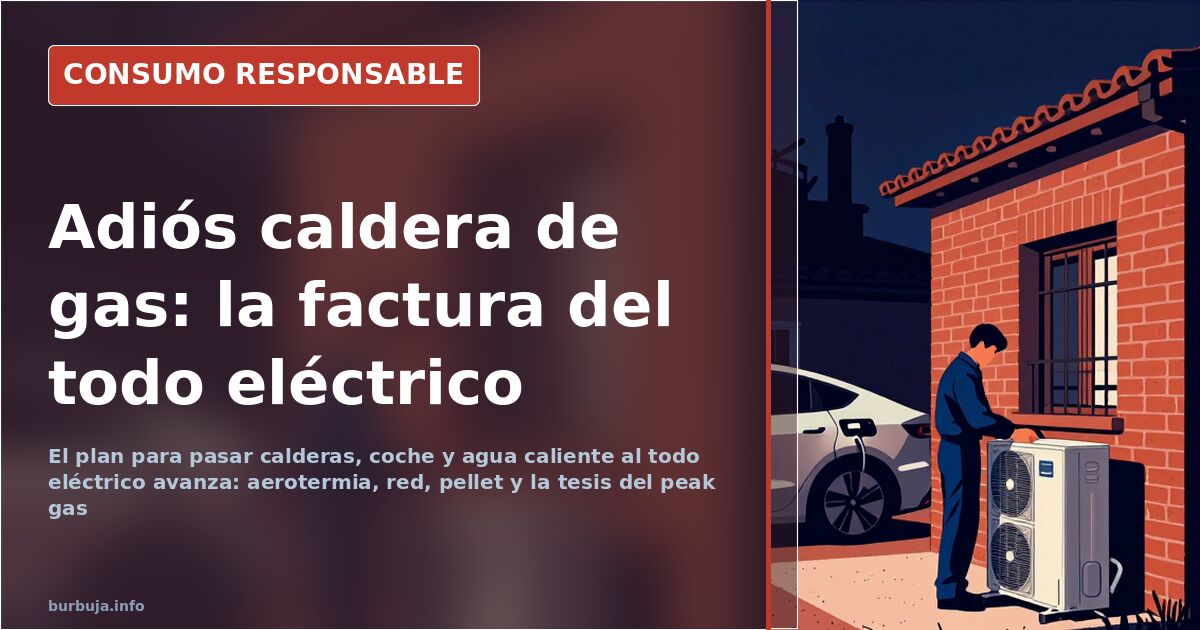
Gas Boilers: Total Electrification and the Bill to Come
How much will it cost to heat a home when the gas boiler becomes the enemy? The warning came during a midday news broadcast, and in the debate, some argue this measure was long expected: the horizon is full electrification, including cars, hot water, and heating. The first target is the device hanging on the walls of millions of apartments. The reasonable doubt isn't whether regulations will arrive, but who pays the bill.
At the heart of the matter is a suspicion repeated in the thread: that regulation will come sooner due to economic interest than thermodynamics, and that today's gas sellers will be tomorrow's kilowatt-hour sellers. The scenario drawn is one of combustion for the rich: burning coal and gas will continue, but elsewhere and at another price.
Is Aerothermal Cheaper Than Gas Boilers?
The mental experiment summarizing the dilemma, proposed by a participant, involves a typical home: condensing boiler, radiators, and modest insulation. The boiler is replaced by a high-temperature aerothermal unit (heat pump) so the circuit pushes water at the same temperature as before. The question is simple and remains unanswered: at current gas and electricity prices, what is cheaper for heating the house?
Details matter because physics doesn't forgive: converting heat into electricity only to convert it back into heat is a path with losses along the way, as noted in the debate.
Where Does the Electricity Replacing Gas Come From?
From burning coal and gas, according to the repeated answer in the thread: electrification doesn't eliminate combustion, it shifts it. And shifting it has an obvious commercial consequence: whoever burns the fuel controls the sale price.
The German example is cited as a warning: removal of wind turbines while coal extraction continues, according to industry reports. If the country leading the green narrative keeps its coal plants running, the coherence of the discourse is questioned.
To this is added the grid. Heating, domestic hot water, and electric vehicle charging are three new consumptions landing on infrastructure designed for something else, with winter peaks already under strain. The question of whether the grid can handle the full package remains without an official answer.
Business Moves: Pellet, Geothermal, and Layoffs
While the framework is debated, companies are already paying for the change. A family firm dedicated to pellet systems and extraction pipes has cut 25% of its staff and gone from working at capacity to barely staying afloat, according to a participant. The sequence described is known: first regulation, then the collapse of demand for the penalized system.
On the other end, geothermal works. The case of a family farm switching to a geothermal system is told with satisfaction: less electricity consumed than before, stable performance. The problem is the entry requirement, because a generous plot, almost a large estate, is needed to bury the circuit. The solution exists, but it doesn't scale to apartment blocks.
Energy Certificates, Cars, and Carbon Footprint
Some argue that real pressure won't come from the boiler, but from the label. The circulating version is that homes with an E energy certificate will be excluded from the sale and rental market in 2028, and F-rated ones in 2035, making rehabilitation no longer a recommendation but a de facto requirement.
The same argument extends to cars and, further, to personal carbon footprint measured through banks. This part of the equation generates the most rejection: climate stickers as a mechanism for controlling assets, not as an environmental tool.
The Peak Gas Thesis That Changes the Narrative
Against the pure climate narrative appears an alternative explanation, supported by a participant: that the real problem isn't CO2, but depletion. Gas wells also decline, many associated with oil fields, and in the 2030s cheap supply would enter a downward spiral. According to this reading, climate change functions as an acceptable argument for a transition that, explained as scarcity, nobody would accept.
It's a hypothesis, not data, and should be treated as such. But it connects with an intuition repeated in the thread: if gas runs out, forced electrification isn't an ideological choice, it's a countdown.
What Doesn't Add Up
A cold home isn't a symbol, it's a bill. Staff cuts in a pellet company don't appear at any summit. Full electrification, without nuclear backing: a flawless plan, provided someone else pays for the cracks.
How much will it cost to heat a home when the gas boiler becomes the enemy? The warning came during a midday news broadcast, and in the debate, some argue this measure was long expected: the horizon is full electrification, including cars, hot water, and heating. The first target is the device hanging on the walls of millions of apartments. The reasonable doubt isn't whether regulations will arrive, but who pays the bill.
At the heart of the matter is a suspicion repeated in the thread: that regulation will come sooner due to economic interest than thermodynamics, and that today's gas sellers will be tomorrow's kilowatt-hour sellers. The scenario drawn is one of combustion for the rich: burning coal and gas will continue, but elsewhere and at another price.
Is Aerothermal Cheaper Than Gas Boilers?
The mental experiment summarizing the dilemma, proposed by a participant, involves a typical home: condensing boiler, radiators, and modest insulation. The boiler is replaced by a high-temperature aerothermal unit (heat pump) so the circuit pushes water at the same temperature as before. The question is simple and remains unanswered: at current gas and electricity prices, what is cheaper for heating the house?
Details matter because physics doesn't forgive: converting heat into electricity only to convert it back into heat is a path with losses along the way, as noted in the debate.
Where Does the Electricity Replacing Gas Come From?
From burning coal and gas, according to the repeated answer in the thread: electrification doesn't eliminate combustion, it shifts it. And shifting it has an obvious commercial consequence: whoever burns the fuel controls the sale price.
The German example is cited as a warning: removal of wind turbines while coal extraction continues, according to industry reports. If the country leading the green narrative keeps its coal plants running, the coherence of the discourse is questioned.
To this is added the grid. Heating, domestic hot water, and electric vehicle charging are three new consumptions landing on infrastructure designed for something else, with winter peaks already under strain. The question of whether the grid can handle the full package remains without an official answer.
Business Moves: Pellet, Geothermal, and Layoffs
While the framework is debated, companies are already paying for the change. A family firm dedicated to pellet systems and extraction pipes has cut 25% of its staff and gone from working at capacity to barely staying afloat, according to a participant. The sequence described is known: first regulation, then the collapse of demand for the penalized system.
On the other end, geothermal works. The case of a family farm switching to a geothermal system is told with satisfaction: less electricity consumed than before, stable performance. The problem is the entry requirement, because a generous plot, almost a large estate, is needed to bury the circuit. The solution exists, but it doesn't scale to apartment blocks.
Energy Certificates, Cars, and Carbon Footprint
Some argue that real pressure won't come from the boiler, but from the label. The circulating version is that homes with an E energy certificate will be excluded from the sale and rental market in 2028, and F-rated ones in 2035, making rehabilitation no longer a recommendation but a de facto requirement.
The same argument extends to cars and, further, to personal carbon footprint measured through banks. This part of the equation generates the most rejection: climate stickers as a mechanism for controlling assets, not as an environmental tool.
The Peak Gas Thesis That Changes the Narrative
Against the pure climate narrative appears an alternative explanation, supported by a participant: that the real problem isn't CO2, but depletion. Gas wells also decline, many associated with oil fields, and in the 2030s cheap supply would enter a downward spiral. According to this reading, climate change functions as an acceptable argument for a transition that, explained as scarcity, nobody would accept.
It's a hypothesis, not data, and should be treated as such. But it connects with an intuition repeated in the thread: if gas runs out, forced electrification isn't an ideological choice, it's a countdown.
What Doesn't Add Up
A cold home isn't a symbol, it's a bill. Staff cuts in a pellet company don't appear at any summit. Full electrification, without nuclear backing: a flawless plan, provided someone else pays for the cracks.
Also available in: Deutsch
Summary of a discussion on Burbuja.info - Foro de economía, actualidad y política., translated from Spanish and reviewed before publication. Read the full discussion (130 replies).
More summaries
-
Accessing Live Sports via Shared Streaming Links
Analysis of how users access live sports through shared streaming codes and links.
-
Spain's insurers propose sick leave ends; GPs hold final say
In Spain, insurers manage but don't pay for common illness leave. They can propose ending it, but only a GP or inspector decides.
-
Spain's ITV emissions test: additives, smoke and the 0.5 m-1 limit
A diesel car entered Spain's ITV with 6 m-1 opacity, dropping to 1.37 after a highway run. The test measures tailpipe output in the pit, not annual pollution.
-
725€ Gaming PC: i3-6100 Falls Short, PSU Oversized
A 725€ gaming build in Spain faced criticism for an underpowered i3-6100 CPU and an oversized 650W power supply.
-
Coasting downhill in Spain wastes fuel and increases risk
Driving in neutral on Spanish descents offers no savings and extends braking distance, while engine braking consumes zero.
-
Why Apple's Premium Is Defended by Feelings
User experience, support, and brand sustain Apple's premium over half-price rivals.