
Suspected Asbestos in 1986 Pipes: A Lighter Provided the First Clue
A cotton-like material under plaster on 1986 pipes sparks asbestos suspicion: it burns when a flame is applied, suggesting fiberglass or rock wool.
English · Original discussion in Spanish · Published
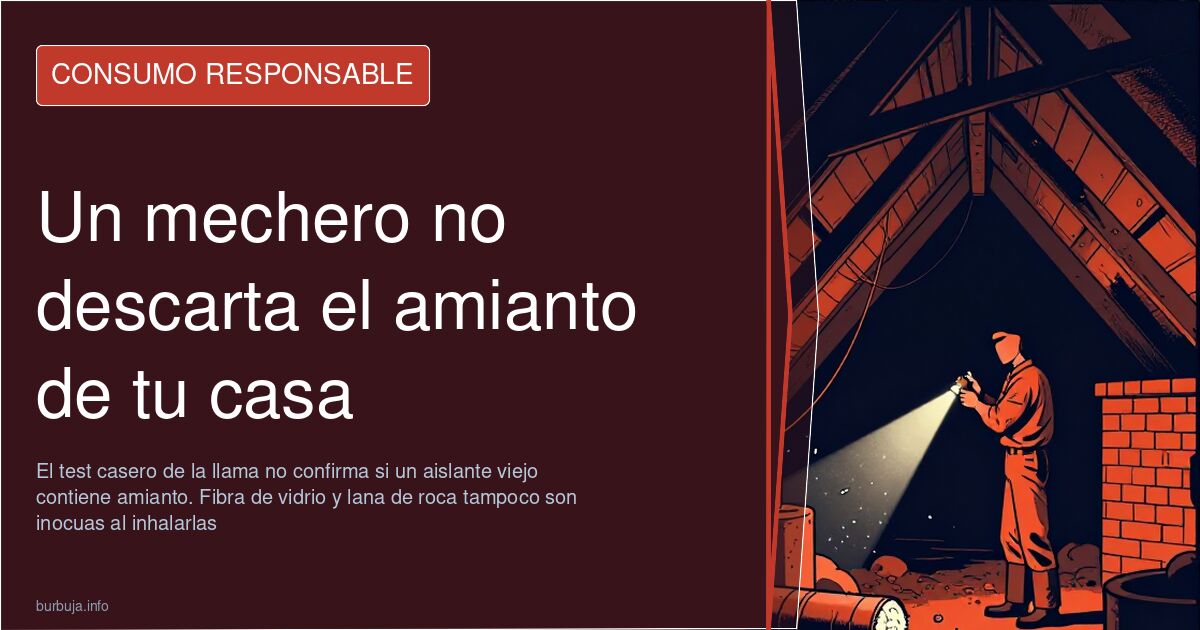
The material that burns under plaster: asbestos or fiberglass?
A garage repair ended with the vacuum cleaner off and an uncomfortable doubt. Under the plaster covering heating pipes installed around 1986, a cotton-like material, resembling rock wool, was found to disintegrate when a lighter flame was applied. The owner who commissioned the installation has passed away, the installer is no longer around, and there is no documentation to certify what was used nearly four decades ago. Only more modern sections with Armaflex-type insulation remain for comparison. The first technical clue points to asbestos: if the material burns, it is not asbestos, because asbestos is incombustible.
The lighter as a home test: why asbestos shouldn't burn
The reasoning is based on a chemical property, not intuition. Asbestos fiber does not burn: it withstands temperatures that would carbonize any textile. When a fibrous material disintegrates with flame, it is usually the binder—resin, polyester, or a plastic binder—enveloping the mineral fiber that is burning. This shifts suspicion towards fiberglass or rock wool, not asbestos. Those familiar with both materials by trade can distinguish them by touch and tonalidad. The lighter test rules out much, but not everything. No home test replaces a laboratory analysis of a sample.
What's the difference between friable and non-friable asbestos?
This distinction is the crux of the matter. Friable asbestos is crumbly, can be broken down by hand, and is typical of insulation and fillers: handling it always requires personal protection. Non-friable asbestos is compacted in hard matrices—old fiber cement, uralita—and only releases fibers if cut, drilled, or broken. Pipe insulation, due to its cotton-like texture, falls into the first category if it turns out to be asbestos. This nuance determines whether the material can remain undisturbed under the plaster or if it's necessary to call a specialized company. The affected party has already made the call. Until they respond, he hasn't touched it again.
How to handle suspect material without releasing fibers?
Recommendations circulating agree on the basics: do not use a domestic vacuum cleaner, which is the opposite of what instinct suggests. Vacuuming fibrous material and filtering it poorly can release the very particles you want to avoid into the air. The prudent approach is to carefully dampen the area so it doesn't create dust if it fragments, wrap it in plastic, and seal it with tape. Then, leave it alone. Regarding dosage, opinions are divided: one version claims at least three months of continuous inhalation are needed for appreciable risk, while another recalls that the WHO does not recognize a minimum guaranteed safe dose. In health matters, caution is dictated by a technician, not a lighter.
The asbestos business: antiestéticar, masks, and expensive removals
Here the tone changes. Some argue that the panic around asbestos is exaggerated and that behind the removals lies a lucrative business: companies charging a fortune for a material that, if left in place and encapsulated, causes no harm. The implicit recommendation not to declare it appears more than once, with the argument that it opens the door to mandatory and very expensive remediation. In contrast, there's the personal experience of someone who cut fiber cement with an angle grinder without a mask and ended up with two carcinomas. Statistics and individual cases don't always align, and those who lived through it tell their stories plainly.
The McQueen case and the dust nobody measured
The most cited anecdote to gauge the risk is that of Steve McQueen, who died from an aggressive cancer linked to his time in the navy cleaning ships. The parallel has limits: an industrial deck for years is not the same as a garage corner. There's also the generational memory of throwing fiber cement downspout pieces into bonfires, smashing uralita roofing sheets with rocks, and cutting with angle grinders without protection. Nobody wore masks then. Most people emerged unharmed. Most is not all, and therein lies the problem.
The cheapest conclusion remains: until a laboratory says otherwise, the correct label for that cotton-like material is 'unknown.' The lighter provided half the answer, the specialized company has the other half, and the pipe remains wrapped in plaster as it was in 1986, waiting for someone to decide whether to live in antiestéticar or pay the bill.
A garage repair ended with the vacuum cleaner off and an uncomfortable doubt. Under the plaster covering heating pipes installed around 1986, a cotton-like material, resembling rock wool, was found to disintegrate when a lighter flame was applied. The owner who commissioned the installation has passed away, the installer is no longer around, and there is no documentation to certify what was used nearly four decades ago. Only more modern sections with Armaflex-type insulation remain for comparison. The first technical clue points to asbestos: if the material burns, it is not asbestos, because asbestos is incombustible.
The lighter as a home test: why asbestos shouldn't burn
The reasoning is based on a chemical property, not intuition. Asbestos fiber does not burn: it withstands temperatures that would carbonize any textile. When a fibrous material disintegrates with flame, it is usually the binder—resin, polyester, or a plastic binder—enveloping the mineral fiber that is burning. This shifts suspicion towards fiberglass or rock wool, not asbestos. Those familiar with both materials by trade can distinguish them by touch and tonalidad. The lighter test rules out much, but not everything. No home test replaces a laboratory analysis of a sample.
What's the difference between friable and non-friable asbestos?
This distinction is the crux of the matter. Friable asbestos is crumbly, can be broken down by hand, and is typical of insulation and fillers: handling it always requires personal protection. Non-friable asbestos is compacted in hard matrices—old fiber cement, uralita—and only releases fibers if cut, drilled, or broken. Pipe insulation, due to its cotton-like texture, falls into the first category if it turns out to be asbestos. This nuance determines whether the material can remain undisturbed under the plaster or if it's necessary to call a specialized company. The affected party has already made the call. Until they respond, he hasn't touched it again.
How to handle suspect material without releasing fibers?
Recommendations circulating agree on the basics: do not use a domestic vacuum cleaner, which is the opposite of what instinct suggests. Vacuuming fibrous material and filtering it poorly can release the very particles you want to avoid into the air. The prudent approach is to carefully dampen the area so it doesn't create dust if it fragments, wrap it in plastic, and seal it with tape. Then, leave it alone. Regarding dosage, opinions are divided: one version claims at least three months of continuous inhalation are needed for appreciable risk, while another recalls that the WHO does not recognize a minimum guaranteed safe dose. In health matters, caution is dictated by a technician, not a lighter.
The asbestos business: antiestéticar, masks, and expensive removals
Here the tone changes. Some argue that the panic around asbestos is exaggerated and that behind the removals lies a lucrative business: companies charging a fortune for a material that, if left in place and encapsulated, causes no harm. The implicit recommendation not to declare it appears more than once, with the argument that it opens the door to mandatory and very expensive remediation. In contrast, there's the personal experience of someone who cut fiber cement with an angle grinder without a mask and ended up with two carcinomas. Statistics and individual cases don't always align, and those who lived through it tell their stories plainly.
The McQueen case and the dust nobody measured
The most cited anecdote to gauge the risk is that of Steve McQueen, who died from an aggressive cancer linked to his time in the navy cleaning ships. The parallel has limits: an industrial deck for years is not the same as a garage corner. There's also the generational memory of throwing fiber cement downspout pieces into bonfires, smashing uralita roofing sheets with rocks, and cutting with angle grinders without protection. Nobody wore masks then. Most people emerged unharmed. Most is not all, and therein lies the problem.
The cheapest conclusion remains: until a laboratory says otherwise, the correct label for that cotton-like material is 'unknown.' The lighter provided half the answer, the specialized company has the other half, and the pipe remains wrapped in plaster as it was in 1986, waiting for someone to decide whether to live in antiestéticar or pay the bill.
Summary of a discussion on Burbuja.info - Foro de economía, actualidad y política., translated from Spanish and reviewed before publication. Read the full discussion (48 replies).
More summaries
-
The four breakfasts no Spanish bar serves
Oats, wholemeal bread, hummus and peanut butter: four foods Spanish bars don't serve, against the tradition of toast and Spanish tortilla.
-
Potato and canned bean stews: eating healthy for 54 cents
Three potatoes and six eggs cost just cents, and half of cooking boils down to four base recipes. Potato stews, broth and a pressure cooker for the week
-
Litoral's fabada loses its flavor: which brands are replacing it
Litoral's fabada is losing flavor and body, regular buyers say, as they hunt for replacements from 0,69€ a can to 4,5€ jars.
-
Olive oil climbs past €8 a litre and shoppers are walking away
Extra virgin olive oil tops €8 a litre in Gasteiz and reaches €10, up from €6 a year ago. More and more shoppers are taking it off their lists
-
A Land Rover and 20.000 euros in repairs in just four years
Mireia has spent about 20.000 euros on repairs to her Land Rover, with only 173.000 km in four years, including timing chain, turbo, gearbox and driveshaft
-
Razor blades: expensive cartridges vs. cheap double-edge
A 100-pack of double-edge blades costs €9–12 and gives five shaves per blade; the expensive cartridge is done after five uses.