
Sugar-Free, Flour-Free Diets: From Baked Tuna to 69 Kilos
Exploring menus without sugar or flour, from baked tuna to gazpacho with duck. Experiences vary: some lose weight, others struggle to gain.
English · Original discussion in Spanish · Published
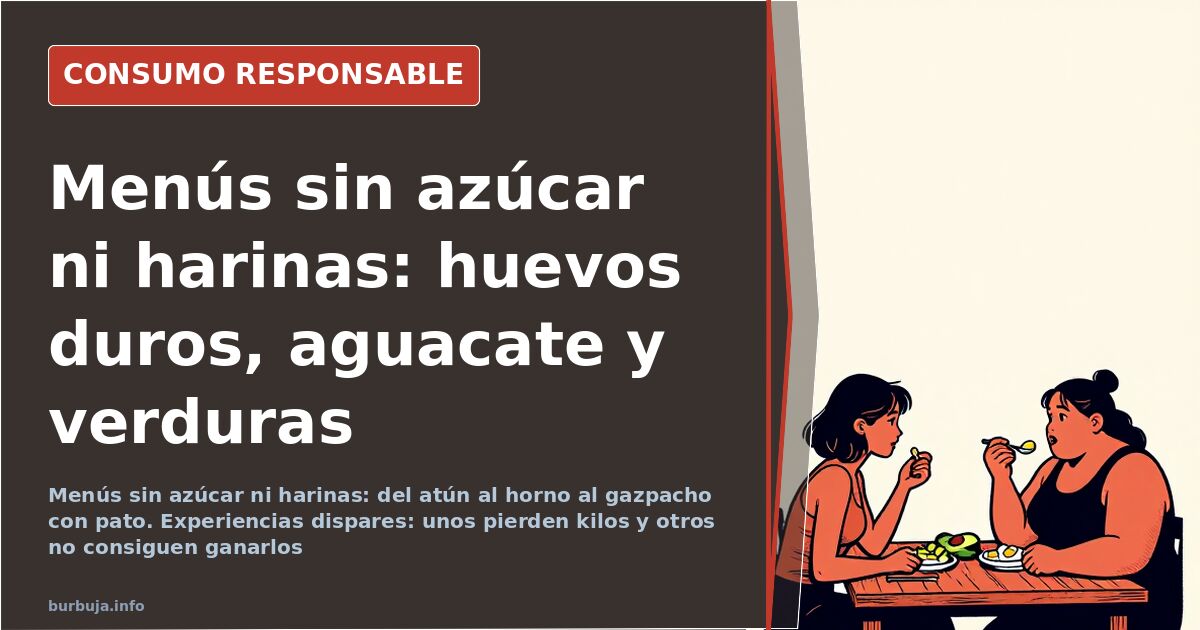
Eating Without Sugar or Flour: From the Paleo Diet to Persistent Reflux
A glass of gazpacho, a duck thigh with skin, two hard-boiled eggs, olives with anchovies, and half a guacamole. All store-bought, not organic, not expensive. This is one of the meals suggested when someone asked for concrete examples of eating without sugar and flour. The request was domestic and specific: breakfast, lunch, dinner, snack, and supper, with quick recipes, and an important extra: gastric reflux.
The majority response was a correction. Eating five meals a day is counterproductive, several argued. And the idea of certain foods being for breakfast and others for lunch is more of a cultural habit than a physiological necessity.
What to Eat for Breakfast When Giving Up Cereal
Here's the best part: logistics. Some people skip breakfast entirely, just coffee. Others prepare a concoction of pure cocoa, coffee, and coconut oil, lasting until lunch without hunger, describing the effect as activating lipolysis, like exercising without doing it.
Then there's the anecdote of the coworker who bakes fresh tuna at seven in the morning, goes for a fasted workout, and returns to eat the tuna for breakfast. No toast. No guilt.
For those who aren't keen on cooking, the most common dishes are almost offensively simple: baked salmon with asparagus, scrambled eggs with ham and mushrooms, zucchini noodles, broccoli and sweet potato omelet, tuna with avocado and pistachios. A circulating calculation: 300 grams of salpicón, a 250-gram avocado, and pistachios exceed 1,000 calories and leave anyone feeling full.
Reflux: Cutting Out Bread as an Experiment
One of the most frequently shared stories isn't about weight, but about the stomach. Some recount daily use of omeprazole and antacids, and how stopping bread made the reflux disappear; it returned for a couple of days after a large bread-heavy meal. This is a personal experience, not a clinical trial, and it's important to state clearly: each person responds differently, and professional advice remains paramount.
What is consistently reported is the sensation of shorter digestion times. Cut out the bread, and you'll never have a long or heavy digestion again, summarizes another response.
Can You Perform Without Carbs? The Challenge with a 100km Runner
The most contentious point. A runner of half-marathons and marathons, covering 90 to 100 km weekly, doing sets of 12-14 repetitions of 500 meters at paces of 1'40 to 1'32, often at seven in the morning. He claims nocturnal glycogen is sufficient. The reply came with a sarcastic tone: with such diets, you don't even reach kilometer 3, and going 17 hours without eating with exercise in between is a direct path to the emergency room.
The counter-argument is a classic: humans are not designed to run half-marathons, and that's what's truly detrimental. Neither side conceded an inch.
The argument of ancestral diets also appears. The diet of the Hadza people—baobab fruit, porcupine, tubers, berries, and freshly harvested honey—serves as a paleolithic mirror, with the usual caveat: the life expectancy from a million years ago is calculated with infant mortality included.
The Rebound Effect Nobody Can Prove
An acquaintance who "understands the topic" claimed this type of diet causes a rebound effect. The response was firm: five years maintaining it, three kilos down in the last year, and no evidence of reversal. Another experience, more modest and realistic: cutting out sugar, fries, juices, and bread, without counting calories, resulted in nine kilos lost.
The Puzzling Data Point
And here's the twist. The person who initiated the discussion to resolve heavy digestion issues reports, some time later, that they still have reflux despite cutting out gluten, that they eat rice, potatoes, and gluten-free bread, and that at 1.80 meters tall, they weigh 69.3 kilos, with their hip bone showing "like models" and their legs slimmed down. They want their clothes to fit better. They suspect an absorption problem.
From a flour-free menu to a body that won't gain weight even if it wanted to. Nobody quite knew what to make of it.
A glass of gazpacho, a duck thigh with skin, two hard-boiled eggs, olives with anchovies, and half a guacamole. All store-bought, not organic, not expensive. This is one of the meals suggested when someone asked for concrete examples of eating without sugar and flour. The request was domestic and specific: breakfast, lunch, dinner, snack, and supper, with quick recipes, and an important extra: gastric reflux.
The majority response was a correction. Eating five meals a day is counterproductive, several argued. And the idea of certain foods being for breakfast and others for lunch is more of a cultural habit than a physiological necessity.
What to Eat for Breakfast When Giving Up Cereal
Here's the best part: logistics. Some people skip breakfast entirely, just coffee. Others prepare a concoction of pure cocoa, coffee, and coconut oil, lasting until lunch without hunger, describing the effect as activating lipolysis, like exercising without doing it.
Then there's the anecdote of the coworker who bakes fresh tuna at seven in the morning, goes for a fasted workout, and returns to eat the tuna for breakfast. No toast. No guilt.
For those who aren't keen on cooking, the most common dishes are almost offensively simple: baked salmon with asparagus, scrambled eggs with ham and mushrooms, zucchini noodles, broccoli and sweet potato omelet, tuna with avocado and pistachios. A circulating calculation: 300 grams of salpicón, a 250-gram avocado, and pistachios exceed 1,000 calories and leave anyone feeling full.
Reflux: Cutting Out Bread as an Experiment
One of the most frequently shared stories isn't about weight, but about the stomach. Some recount daily use of omeprazole and antacids, and how stopping bread made the reflux disappear; it returned for a couple of days after a large bread-heavy meal. This is a personal experience, not a clinical trial, and it's important to state clearly: each person responds differently, and professional advice remains paramount.
What is consistently reported is the sensation of shorter digestion times. Cut out the bread, and you'll never have a long or heavy digestion again, summarizes another response.
Can You Perform Without Carbs? The Challenge with a 100km Runner
The most contentious point. A runner of half-marathons and marathons, covering 90 to 100 km weekly, doing sets of 12-14 repetitions of 500 meters at paces of 1'40 to 1'32, often at seven in the morning. He claims nocturnal glycogen is sufficient. The reply came with a sarcastic tone: with such diets, you don't even reach kilometer 3, and going 17 hours without eating with exercise in between is a direct path to the emergency room.
The counter-argument is a classic: humans are not designed to run half-marathons, and that's what's truly detrimental. Neither side conceded an inch.
The argument of ancestral diets also appears. The diet of the Hadza people—baobab fruit, porcupine, tubers, berries, and freshly harvested honey—serves as a paleolithic mirror, with the usual caveat: the life expectancy from a million years ago is calculated with infant mortality included.
The Rebound Effect Nobody Can Prove
An acquaintance who "understands the topic" claimed this type of diet causes a rebound effect. The response was firm: five years maintaining it, three kilos down in the last year, and no evidence of reversal. Another experience, more modest and realistic: cutting out sugar, fries, juices, and bread, without counting calories, resulted in nine kilos lost.
The Puzzling Data Point
And here's the twist. The person who initiated the discussion to resolve heavy digestion issues reports, some time later, that they still have reflux despite cutting out gluten, that they eat rice, potatoes, and gluten-free bread, and that at 1.80 meters tall, they weigh 69.3 kilos, with their hip bone showing "like models" and their legs slimmed down. They want their clothes to fit better. They suspect an absorption problem.
From a flour-free menu to a body that won't gain weight even if it wanted to. Nobody quite knew what to make of it.
Summary of a discussion on Burbuja.info - Foro de economía, actualidad y política., translated from Spanish and reviewed before publication. Read the full discussion (211 replies).
More summaries
-
The four breakfasts no Spanish bar serves
Oats, wholemeal bread, hummus and peanut butter: four foods Spanish bars don't serve, against the tradition of toast and Spanish tortilla.
-
Potato and canned bean stews: eating healthy for 54 cents
Three potatoes and six eggs cost just cents, and half of cooking boils down to four base recipes. Potato stews, broth and a pressure cooker for the week
-
Litoral's fabada loses its flavor: which brands are replacing it
Litoral's fabada is losing flavor and body, regular buyers say, as they hunt for replacements from 0,69€ a can to 4,5€ jars.
-
Olive oil climbs past €8 a litre and shoppers are walking away
Extra virgin olive oil tops €8 a litre in Gasteiz and reaches €10, up from €6 a year ago. More and more shoppers are taking it off their lists
-
A Land Rover and 20.000 euros in repairs in just four years
Mireia has spent about 20.000 euros on repairs to her Land Rover, with only 173.000 km in four years, including timing chain, turbo, gearbox and driveshaft
-
Razor blades: expensive cartridges vs. cheap double-edge
A 100-pack of double-edge blades costs €9–12 and gives five shaves per blade; the expensive cartridge is done after five uses.