
Strait of Hormuz: Oil Never Hit $200 Despite Threats
Forum predictions claimed Israel would strike Iran, closing the strait. Yet oil prices remained stable, contradicting doomsday forecasts.
English · Original discussion in Spanish · Published
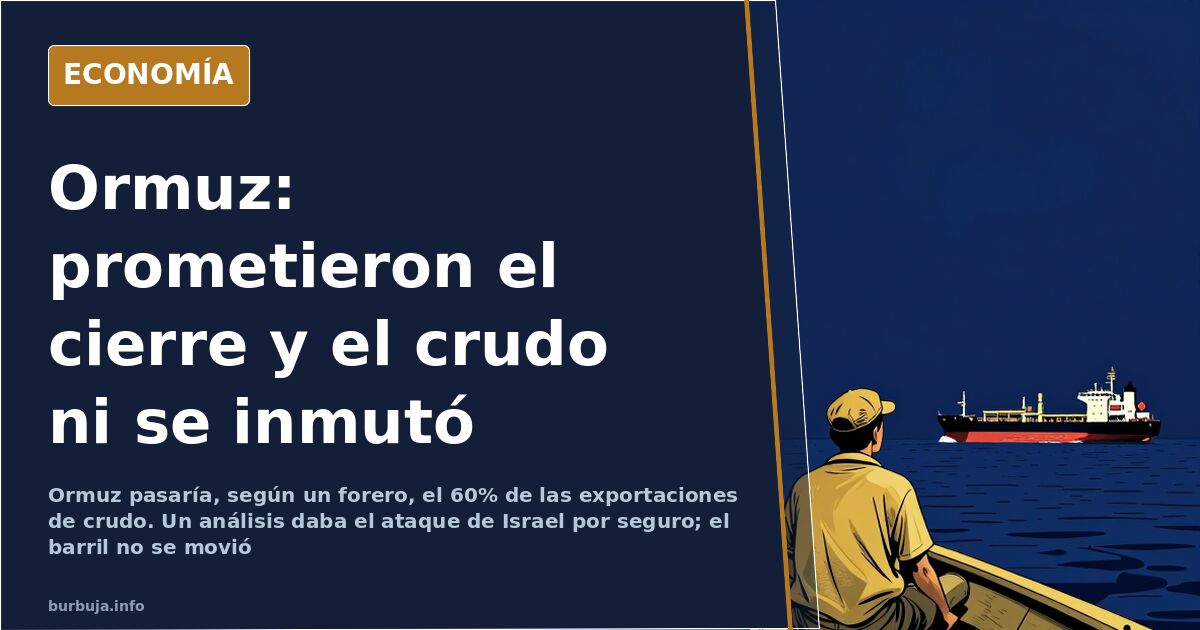
Hormuz Closure: From 100% Probability to Static Prices
The Strait of Hormuz is described in online discussions as the bottleneck for 60% of global oil exports. In this narrow waterway between the Persian Gulf and the Gulf of Oman, much of the world's crude supply is determined. Consequently, when someone predicts a closure date, markets hold their breath. When that date passes without incident, silence trinc.
The forecast was precise: Israel would respond by "destroying Iran's entire missile, nuclear, and oil industry," with a 100% probability of occurring between that afternoon and the next day. The predicted chain reaction included Tehran closing Hormuz, striking refineries across the Middle East, attacking US bases, and launching missiles at Israel. "Welcome to World War III," summarized the argument.
What Peine When the Attack Deadline Passed?
Nothing peine. The deadline elapsed, and the scenario remained hypothetical. Critics quickly pointed out the discrepancy: "How is that 100% probability going? Did it drop to 0%?" they asked the predictor three days later. The response, "give time some time," lacked analytical rigor. Another user simply replied with an fail.
Markets did not validate the apocalyptic narrative. While one user argued oil was surging—citing a 2% rise as evidence—another noted the day closed "stable or slightly down." When crude prices fail to confirm predicted catastrophes, those antiestéticars lose momentum. The closing price remains the best refutation of bar-stool analysis.
Is Hormuz Already Compromised? Why the US Navy Stays Out
Here lies the most uncomfortable technical nuance for both sides. The strait is not a simple on/off valve. According to circulating claims, it has been mined for quite some time, requiring Iranian pilots to guide ships through entry and exit points. Since the Trump era, no US warship has entered. Thus, debates about a future closure ignore that, for one involved fleet, the door has long been ajar.
This undermines ultimatum logic. If passage is already conditioned by mines and local piloting, a formal closure adds little beyond headline fodder. What moves prices is not flags being lowered, but the number of ships ceasing loads at Gulf ports.
Who Loses if the Strait Closes? Oil Heading Toward $200
The strongest argument does not require total closure; tension suffices. "Once closed, there will be massive buying pressure on remaining hydrocarbon sources," leading barrels to potentially exceed $200 easily, according to participants. This lesson is often forgotten when dismissals rely on low national import volumes: crude markets are not segmented by neighborhood.
In Asia, the issue extends beyond price. A closure would cut off 40% of China, Japan, and Korea's oil, a scenario some compare directly to WWII for Japan. However, others note nuances: China imports via discounts or infrastructure swaps, utilizing land routes and African supplies independent of Hormuz. Asian crude, they argue, may not cost as much as Western buyers pay.
China Opposes Closure: Peace with Saudi Arabia and Qatar
A factor cited in threads that weakens sustained blockade hypotheses is Iran's own interest. It maintains good relations with Qatar and is reconciling with Saudi Arabia and the UAE. Closing their passage would miccionan declaring war on neighbors, not just Washington. "Will China tolerate Iran cutting its oil supply? I doubt it," summarizes the common objection.
Conversely, hardliners argue BRICS benefit from chaos: Hormuz closure, destroyed Arab wells, and military quagmires for Israel and the US. The net result, per this view, is a win-win for rival blocs. This part of the prediction remains unverified by data, relying on a war that has not yet erupted.
Until oil reacts, Hormuz closure remains a headline on credit. The scenario is plausible, supported by dependency figures; what fails is timing. Lacking a clock, analysis stalls where it began: US election season, voters tired of funding foreign wars, and a barrel that, for now, shows no movement.
Also available in: Deutsch
Summary of a discussion on Burbuja.info - Foro de economía, actualidad y política., translated from Spanish and reviewed before publication. Read the full discussion (190 replies).
More summaries
-
Spain: the collapse warning that's 378 days overdue
378 days and 21,600 replies later, the announced collapse still hasn't arrived. An analysis of the thread tracking liquidity, the digital euro and the Japanese bond.
-
The €10 per square metre proposal and the numbers that don't add up
A tweet mocks a young man hoping to buy a home at €10/m². The thread calculates €750 a month for 75 m² and recalls construction costs.
-
WhatsApp calls to burn the streets: the narrative breaks down
WhatsApp calls to burn the streets and burning bins in Bilbao during protests in Spain: the narrative about who is heating up the streets falls apart
-
Figaredo warns Spain's pension system overhaul will be traumatic
Figaredo warns that the transition to a mixed pension system in Spain will be traumatic. The warning reopens the debate over cuts, privatization and private funds.
-
Spain's CNI blocks Boluda's sale of Canary ports stake to Morocco over military risk
Shipping company Boluda lashes out at Spain's CNI for blocking the sale of 45% of its Canary terminals to state-owned Marsa Maroc at the Foreign Investment Board.
-
Minimum state pension plus private plan: Spain debates a mixed model
A mixed model proposes an equal minimum pension for everyone plus an optional private plan. The problem: today's contributors would pay twice.