
WhatsApp calls to burn the streets: the narrative breaks down
WhatsApp calls to burn the streets and burning bins in Bilbao during protests in Spain: the narrative about who is heating up the streets falls apart
English · Original discussion in Spanish · Published
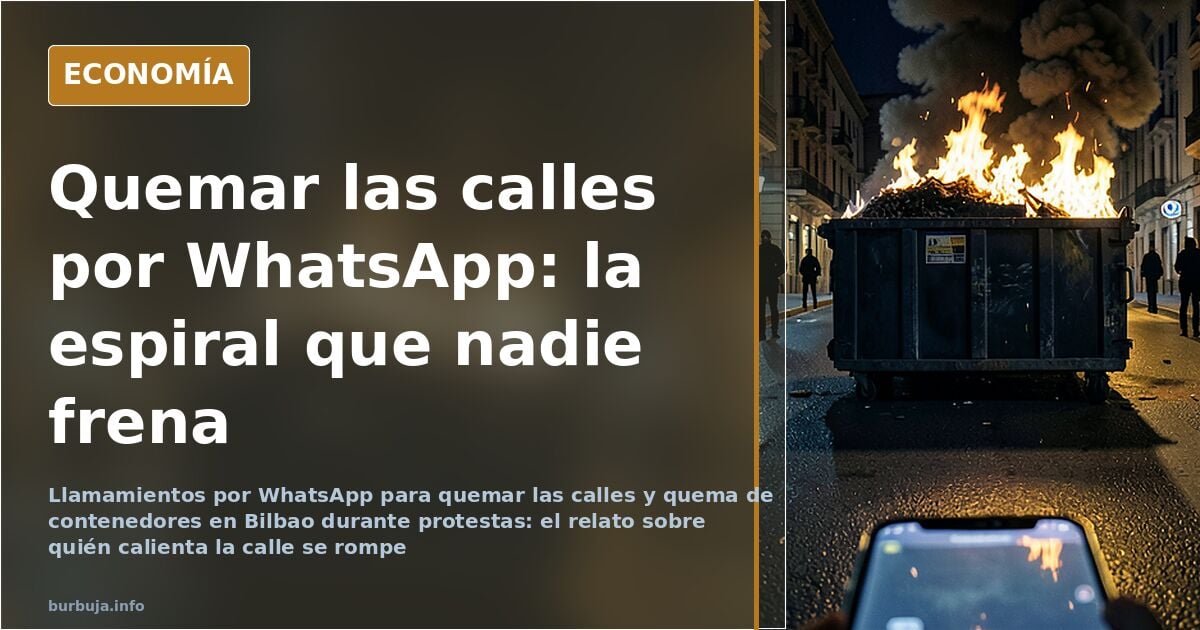
WhatsApp calls to burn the streets: the spiral now reaching Spain
Where do the calls to set fire to bins and motorbikes come from? According to a message shared on a forum, from messaging groups. That is the material circulating and it points to a phenomenon that is no longer exclusive to France: organising riots at the tap of a phone, with burning street furniture as the repertoire and the street as the stage for a dispute that is not settled at the ballot box. The issue arrives with a name attached and with accusations flying back and forth over who is heating up the atmosphere.
From WhatsApp groups to bins in flames
The starting point is a call circulated in messaging groups in the Corredor del Henares corridor near Madrid, according to a message shared on a forum. The message talks directly about burning the streets. It is not bar-talk hyperbole: it is a call to action shared through private channels, away from public scrutiny and with the estimulante ilegal that a single forward can deliver.
The scene repeats elsewhere. In Bilbao, the burning of bins during protests over a political event becomes the image of the day, according to a tweet shared in the thread. The repertoire is familiar: fire, street furniture, and a staging aimed at visual impact rather than debate. The uncomfortable question hanging in the air is: how much of this is spontaneous, and how much trinc a choreography rehearsed in a chat?
The blame game: who is heating up the streets
The narrative gets tangled when assigning responsibility comes into play. Part of the material circulating claims that the mayor of Barcelona linked pension increases to the prevention of urban fires and accused the police of heating up the streets. It is a claim doing the rounds on social media and used as ammunition in the dispute. It should be taken with a pinch of salt: it is an attribution that comes without the exact quote or the full context.
The police union JUPOL, for its part, takes the issue to television and frames it as a concern over the escalation of violence on the streets, with riots that, in its reading, have already reached Spain after the episodes seen in France. The connection between what happens across the Pyrenees and what happens here is a cliché of the analysis, but it is also a way of amplifying the framework of the conflict.
The firebreak that never comes
Underlying it all is the question of the limits of the institutional response. Some point to the asymmetry between the surveillance of a private message calling for violence and the slowness with which action is taken on other kinds of calls. The comparison with 1936, thrown out unfiltered in some comment, is the kind of rhetorical excess best left where it belongs: as a symptom of the tension, not as a forecast.
Burning bins is not a protest. It is a spectacle that consumes public resources and, along the way, leaves a trail of damage paid for by the taxpayer. Meanwhile, the public conversation splits between those who see an organised conspiracy and those who dismiss it as a simple outbreak of vandalism. Neither reading fully explains why a message on a phone catches fire so easily.
In the end, the question that remains is the most uncomfortable one: if the call fits in a single WhatsApp message, what stops it from fitting in two next time?
Also available in: Deutsch
Summary of a discussion on Burbuja.info - Foro de economía, actualidad y política., translated from Spanish and reviewed before publication. Read the full discussion (23 replies).
More summaries
-
Residents clean up damage in France after riots
A video shows residents clearing debris by hand after riots in France, reopening the debate over taxes and municipal services.
-
Ayuso: Far Left Won't Burn Madrid Residents' Will
Ayuso claims the far left can burn Madrid's streets but not its people's will. The debate turns into mutual accusations regarding political rhetoric.
-
Bilbao: burning containers and event called off over risk of trouble
Vito Quiles says the Ertzaintza warned him of a "very high" risk and called off his event in Bilbao. Hours later he reported containers burning in the…
-
ERC demands answers over origin of riots and looting in Barcelona
ERC Barcelona condemns Saturday's disturbances and calls on the City Council and the Generalitat to explain the lack of foresight and support for businesses.
-
Lula wins Brazil as right sweeps Congress
Lula wins the Brazilian presidency while Bolsonaro's right takes the largest Congress and Senate of its recent history.
-
Bomb threat forces Vueling Barcelona-Gran Canaria flight into emergency landing
A Vueling flight from Barcelona to Gran Canaria in Spain made an emergency landing after a bomb threat. The aircraft was moved to a remote area surrounded by security vehicles.