
Minimum state pension plus private plan: Spain debates a mixed model
A mixed model proposes an equal minimum pension for everyone plus an optional private plan. The problem: today's contributors would pay twice.
English · Original discussion in Spanish · Published
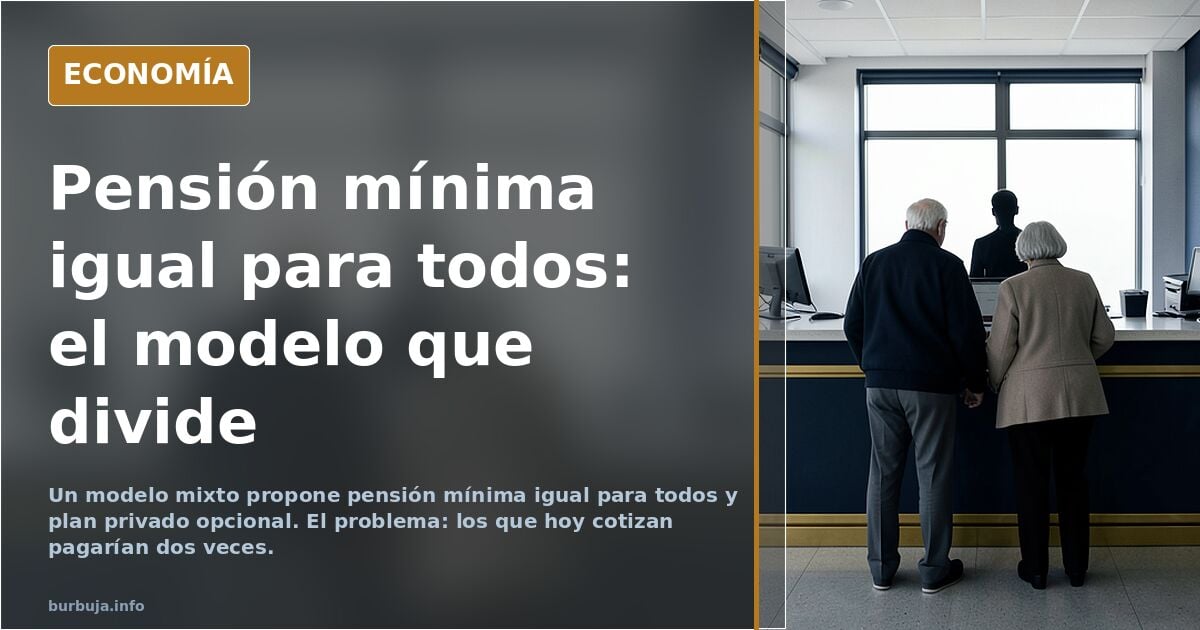
An equal minimum pension for everyone and a private plan for those who can afford it
The proposal is simple, and that is precisely why it is uncomfortable: everyone pays the same contribution to guarantee a base pension equivalent to half the minimum wage, and from there everyone fends for themselves with regulated private plans. Neither the person earning 16,000 euros nor the one earning 120,000 escapes the minimum contribution. Those who cannot or will not contribute more should not complain later about receiving 50% of the minimum wage. On paper it sounds like a gentleman's agreement between generations. In practice, the first obstacle appears before you even start: those who today sustain the system with their contributions would have to pay current pensions and, on top of that, start funding their own. A double burden that no one has explained how it would be shared.
The minimum that eats the system
The most repeated criticism is not against the idea of a base pension, but against its expansive nature. Some argue that the minimum always grows over time and ends up creating the same problem as today, or worse. The trap, they say, lies not in the starting point but in the slope: any guaranteed floor becomes an acquired right and the object of electoral raises. And that is where demographics come in, the elephant nobody wants to look at. With an ageing population, the number of beneficiaries grows faster than the number of contributors, and the current system increasingly resembles a chain where the young pay for the old. The uncomfortable question: what happens when the young are no longer enough?
The money that disappears along the way
Before discussing how much to contribute, it is worth knowing where the contributions end up. The suspicion that the system works like a pyramid scheme hangs over much of the discussion. It is not a formal accusation, but an intuition: if today's contributors' money is not invested for today's contributors but spent on yesterday's, sustainability depends on the base always growing. And growth, in demographic terms, is not guaranteed. Against that, the funded alternative requires answering a prior question: what do we do with those who have been contributing for decades without having been able to choose? Drawing the line at any point leaves one group empty-handed or with recognised rights that someone will have to pay for.
The private plans that fail to convince
The proposal includes private pension plans regulated by the government. The response is unanimous on one point: they already exist, and they are not popular. They are accused of being utter junk in the service of banks, with fees that eat up returns and terms that favour the provider. Better regulation does not solve the underlying problem: if the public system guarantees only half the minimum wage, the private supplement stops being an option and becomes a necessity. And necessities, in a financial market, come at a high price.
Euthanasia as pension policy
The most radical way out of the debate is not economic but existential. Some suggest that any reform of the system should be accompanied by the active promotion of the right to euthanasia. The idea, stated bluntly, points to the notion that part of the sustainability problem would be solved if older people had a dignified way out when their pension is not enough. It is an extreme proposal that has found no direct rebuttal, but it makes clear how far the pension debate has become a debate about the value of life in old age.
The tax model that treats everyone equally
As an alternative to the contribution model, there is the option of financing pensions through income tax, with pensions exactly equal for everyone, with no ceilings or floors, even if they are not indexed to inflation. It is the most egalitarian version of the system: everyone receives the same and everyone pays according to their income. The problem is that it severs the link between what you pay in and what you receive, which can discourage contributions and turn the pension into just another welfare benefit. And in a country where the tax burden is already high, raising income tax to finance equal pensions does not sound like a winning campaign promise.
The generation that pays twice
The most delicate point is the transition. Today's contributors would have to pay the pensions of current retirees without any change in conditions and, on top of that, start funding their own. It is a collective effort that no one has detailed how it would be shared. The suspicion that older voters carry more electoral weight than the young adds a layer of cynicism: any reform that harms current pensioners is electoral suicide. And so the system keeps running on inertia, with patches and promises, while the demographic pyramid narrows at its base.
The safest prediction is that no deep reform will go ahead while the political cost of touching current pensions exceeds that of ignoring the problem. But arithmetic does not vote. And when the numbers stop adding up, the room for choice will be gone.
Also available in: Deutsch
Summary of a discussion on Burbuja.info - Foro de economía, actualidad y política., translated from Spanish and reviewed before publication. Read the full discussion (30 replies).
More summaries
-
Vox’s Pension Plan: The Electoral Cost of Spain’s Reform
Vox proposes a mixed pension system: 50% pay-as-you-go and 50% individual capitalization. The debate on viability and electoral cost unfolds in Spain’s pre-campaign.
-
VOX denies pension privatization and vows to pay them 'by any means'
Santiago Abascal denies that VOX will privatize pensions and promises to pay them 'by any means'. The party backs a mixed system and abolishing income tax on pensions. Analysis of the debate.
-
La Vanguardia fires columnist over article accusing PSOE of seeking civil conflict
La Vanguardia suspends Lacasta for criticising the PSOE's drift. A reflection on the limits of journalism.
-
Álvarez de Toledo calls for sacrifice and sparks online backlash
Spain's PP deputy leader in Madrid calls for sacrifice and faces social media criticism over her aristocratic profile. The debate echoes the 2008 austerity cuts.
-
Clash with 'abertzales' and 'hidden Moors' leaves injured in Spain
A post on X calling protesters 'scum' and mixing immigration with violence offers a chance to examine how the rhetoric of confrontation works on social media.
-
Electric car sales surge over 70% in Europe, nearing a third of the market
Electric car sales in Europe grew more than 70% and now account for nearly a third of all sales, according to newly released market data. Here's what lies behind the figure.