
The €10 per square metre proposal and the numbers that don't add up
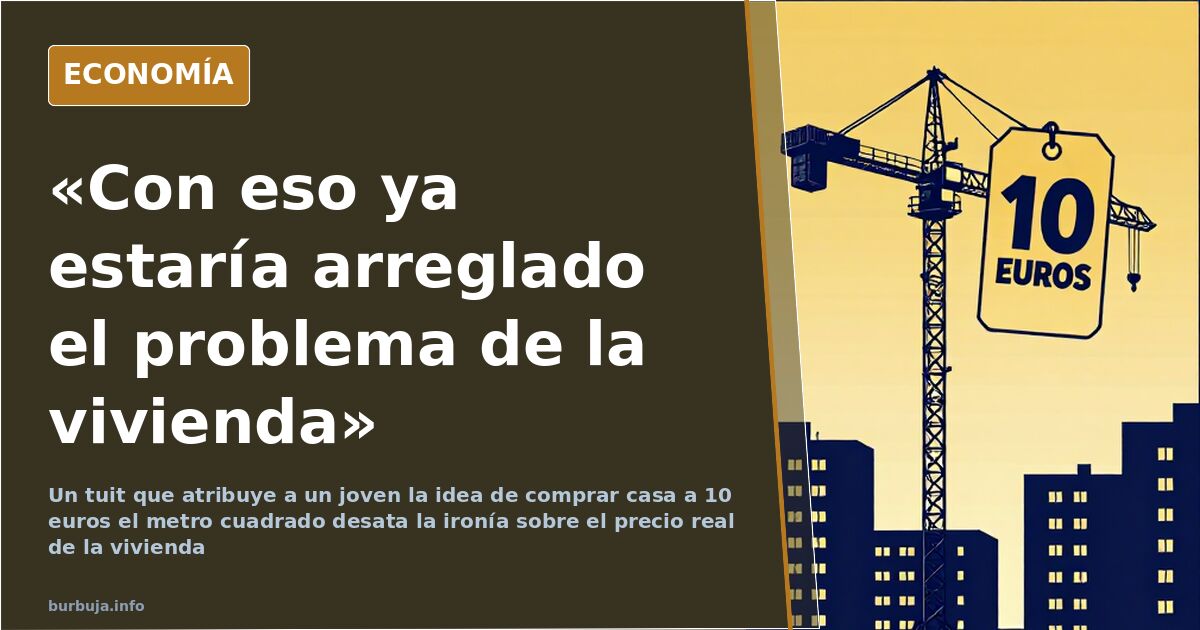
A tweet mocks a young man hoping to buy a home at €10/m². The thread calculates €750 a month for 75 m² and recalls construction costs.
English · Original discussion in Spanish · Published
€10 per square metre: neither concrete nor bricklayer come free
The tweet that starts the thread claims a young man hopes to buy a house at €10 per square metre. The proposal has served two purposes: general mockery and exposing the gap between what many people guess a house costs and what it actually costs. The issue circulates with the addition, by one participant, that the protagonist "doesn't even look like he knows what a square metre is," and from there the rest writes itself: construction, materials, rent, price controls and the underlying question of whether there is any real brake on housing prices.
How much does it cost to build a square metre?
The most repeated calculation is not a calculation, it's irony. It suggests that with labour, materials and architect, housing comes out at €9 or €10 per square metre, and that concrete, windows and pipes are brought by the Three Kings. The joke works because it points to the weak spot of the proposal: inputs are not debatable. A bricklayer doesn't work for free because a banner asks him to.
What's striking is that the real construction figure doesn't appear in the thread. The price of housing is discussed, not the costs that make it up. And without that number, any proposed cap floats in the air. That void runs through the entire conversation and explains why the issue generates more outrage than analysis.
The only reading that adds up: €10 a month
There is a benevolent interpretation that does fit a number. If the €10 is per square metre per month, as several participants calculate, a 75-square-metre flat comes to €750 per month. A 40-square-metre studio, €400. And another participant rounds directly to €1,000 a month, because round figures are easier to defend.
For today's market, €750 for 75 square metres would be cheap, according to whoever does that math. The problem is that whoever launched the proposal wasn't talking about rent, and there the exercise falls apart. The ambiguity between monthly and total is, in fact, the key to the whole misunderstanding.
Buying at €10 per square metre doesn't work even on paper
Applied to buying, the result is laughable. A 100-square-metre flat would cost €1,000, something that, as one participant sums up, doesn't happen even in the most optimistic scenario.
With that premise, another participant builds the full parable: buy cheap, resell at €20,000 per square metre and get rich in twelve months. The caricature hides a question that does come up: if building a house costs €200,000, is it ethical to sell it for €25 million? Nobody answers. The price, others say, is only an indicator; the problem is what pushes it up.
Can the price per square metre be capped by law?
Here the conversation splits in two. One participant argues that the price per square metre should be capped by law, plain and simple. Another responds that no price should be regulated by decree because it depends on multiple factors, and that a royal decree is useless: all it does is hide the cause.
The least emotional and most uncomfortable argument is the one pointing to the origin. If something costs a lot, you have to study why it costs a lot. Intervening on the symptom without touching the causes leaves the price where it was.
Why everyone wants to live in the centre
The question comes from someone who declares themselves from the provinces: what happens in Madrid that makes everyone want to crowd into the centre? One participant claims, without providing data, that the social pressure to live in exclusive areas and near trendy venues is mostly a women's thing. Renting a studio for thousands of euros a month and living with strangers appear as a symptom, not a cause.
In parallel, the conversation jumps to the gatherings in Puerta del Sol and a moment of Castilian jota recorded in the middle of the street. Folklore and politics in the same package.
The point where everything gets stuck is the same as at the beginning. Numbers are missing: how much labour costs, how much materials, how much the project. Without those figures, the €10 proposal and the outraged responses stay in the same place: arguing about a price without ever having peine the bill.
The tweet that starts the thread claims a young man hopes to buy a house at €10 per square metre. The proposal has served two purposes: general mockery and exposing the gap between what many people guess a house costs and what it actually costs. The issue circulates with the addition, by one participant, that the protagonist "doesn't even look like he knows what a square metre is," and from there the rest writes itself: construction, materials, rent, price controls and the underlying question of whether there is any real brake on housing prices.
How much does it cost to build a square metre?
The most repeated calculation is not a calculation, it's irony. It suggests that with labour, materials and architect, housing comes out at €9 or €10 per square metre, and that concrete, windows and pipes are brought by the Three Kings. The joke works because it points to the weak spot of the proposal: inputs are not debatable. A bricklayer doesn't work for free because a banner asks him to.
What's striking is that the real construction figure doesn't appear in the thread. The price of housing is discussed, not the costs that make it up. And without that number, any proposed cap floats in the air. That void runs through the entire conversation and explains why the issue generates more outrage than analysis.
The only reading that adds up: €10 a month
There is a benevolent interpretation that does fit a number. If the €10 is per square metre per month, as several participants calculate, a 75-square-metre flat comes to €750 per month. A 40-square-metre studio, €400. And another participant rounds directly to €1,000 a month, because round figures are easier to defend.
For today's market, €750 for 75 square metres would be cheap, according to whoever does that math. The problem is that whoever launched the proposal wasn't talking about rent, and there the exercise falls apart. The ambiguity between monthly and total is, in fact, the key to the whole misunderstanding.
Buying at €10 per square metre doesn't work even on paper
Applied to buying, the result is laughable. A 100-square-metre flat would cost €1,000, something that, as one participant sums up, doesn't happen even in the most optimistic scenario.
With that premise, another participant builds the full parable: buy cheap, resell at €20,000 per square metre and get rich in twelve months. The caricature hides a question that does come up: if building a house costs €200,000, is it ethical to sell it for €25 million? Nobody answers. The price, others say, is only an indicator; the problem is what pushes it up.
Can the price per square metre be capped by law?
Here the conversation splits in two. One participant argues that the price per square metre should be capped by law, plain and simple. Another responds that no price should be regulated by decree because it depends on multiple factors, and that a royal decree is useless: all it does is hide the cause.
The least emotional and most uncomfortable argument is the one pointing to the origin. If something costs a lot, you have to study why it costs a lot. Intervening on the symptom without touching the causes leaves the price where it was.
Why everyone wants to live in the centre
The question comes from someone who declares themselves from the provinces: what happens in Madrid that makes everyone want to crowd into the centre? One participant claims, without providing data, that the social pressure to live in exclusive areas and near trendy venues is mostly a women's thing. Renting a studio for thousands of euros a month and living with strangers appear as a symptom, not a cause.
In parallel, the conversation jumps to the gatherings in Puerta del Sol and a moment of Castilian jota recorded in the middle of the street. Folklore and politics in the same package.
The point where everything gets stuck is the same as at the beginning. Numbers are missing: how much labour costs, how much materials, how much the project. Without those figures, the €10 proposal and the outraged responses stay in the same place: arguing about a price without ever having peine the bill.
Summary of a discussion on Burbuja.info - Foro de economía, actualidad y política., translated from Spanish and reviewed before publication. Read the full discussion (91 replies).
More summaries
-
Ignacio Lázaro: 'Maricarmen paid €154 rent while we paid €750'
Ignacio Lázaro, grandson of the original owner, reveals the other side of the Maricarmen case: 'We subsidized her for years and now, with our taxes.'
-
Spanish restaurant owner cancels dinner service over staff shortage
A restaurant owner cancels dinner service due to lack of staff, blaming 'paguitas' (welfare handouts). The debate centers on whether the problem is social benefits or poverty wages.
-
Life in a 'piso patera': cramped flats shared by migrants in Spain
A first-hand account reveals extreme conditions in Spain's 'piso patera' shared flats: overcrowding, forced coexistence, and hidden costs. The escape plan: Switzerland.
-
Two firefighters killed and seven injured in electric car fire in Alcorcón
Two firefighters died and seven were injured in a garage fire in Alcorcón. Initially attributed to an electric car, the incident was actually caused by a hybrid vehicle.
-
The protocol that trapped a family in the Valencia fire
Four people died locked in their bathroom after following firefighter protocol during the Campanar fire. Neighbors who disobeyed survived.
-
Coincidence or Causality? The Sudden Deaths Case
A community has documented dozens of sudden deaths and vaccine side effects since 2022. Is it random chance or causality? The numbers that don't add up.