
Spain's pro-Russian right: Geopolitics, not ideology
Spain's radical right backs Putin against Washington. Analysis of the pro-Russian axis in Spanish politics.
English · Original discussion in Spanish · Published
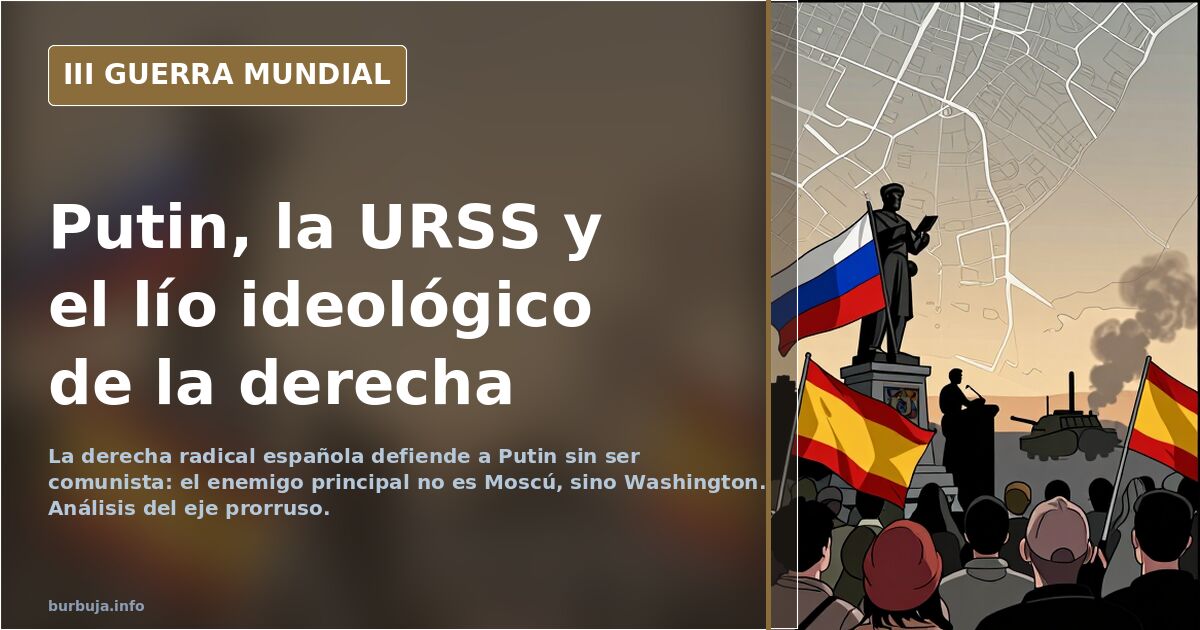
Why Spain's radical right supports Pilingui without being communist
The paradox is textbook: sectors claiming to be heirs of visceral anti-communism now defend a leader who reinstalls Lenin statues in occupied cities. In the most active geopolitics forum, the opening question is direct: why do self-proclaimed Nancy support the apparent return of the USSR? The prevailing answer is strategic, not ideological.
The dominant argument holds that the main enemy is not Moscow, but Washington. For part of Europe's radical right, NATO has been subject to US interests since 1945. Any power weakening this structure deserves sympathy, even if temporary and from a regime that privatized the Soviet economy via ex-agent mafias. It is the old logic of 'the enemy of my enemy', applied coldly.
Are pro-Russians Nancy or disguised communists?
The discussion splits on several fronts. Some distinguish between current Russia and the USSR: the former would be heir to the Tsarist Empire, not the Soviet one, explaining its initial frontline failures by no longer being the USSR. Others note that Russia's ruling party, United Russia, is center-right, making labels like communism or Nancy mere mental gymnastics for Spanish consumption.
Cross-accusations are constant. Nancy and communists are cousins, summarizes one intervention, while another replies that liberalism and its Marxist offspring share doctrinal sources. Indalecio Prieto’s quote —'I am a socialist because I am a liberal'— is used as ammunition in this crossfire.
The Kievan Rus map and territorial dispute
The debate shifts to medieval history. Maps of Kievan Rus overlaid on current borders are shared to justify that Russians, Ukrainians, and Belarusians claim authorship of that state. Someone launches a logical provocation: if Russia inherits the Golden Horde, it should get eastern Ukraine back, as those maps show that zone belonged to that empire too. Historical arguments are used and ridiculed with equal ease.
Geopolitics isn't about ideologies or sarracena
The most cited intervention summarizes the realist thesis: geopolitical interests are fluid. The Anglo-Saxon empire wanted different things in 1812, 1941, and now. Mussolini aligned with France and Britain against Hitler until 1935. Hitler signed the 1939 German-Soviet treaty with Stalin, only to abusa it two years later with disastrous results. The uncomfortable conclusion: seeking ideological coherence in current blocs means using the wrong framework.
The war business and Ukrainian attrition
A widely replicated analysis suggests the Russian attack may have been preventive, before Ukraine became a military powerhouse thanks to NATO doping. The deal would be perfect for the US: they supply weapons and ammo, Ukrainians and Russians provide blood, and the only cost is running the money printer. Meanwhile, the lingering question remains: who worries about what happens to Europe in this division?
The exact point where analysis stalls is always the same: if geopolitics is just interests, nobody explains why some still need to call themselves Nancy to justify theirs.
The paradox is textbook: sectors claiming to be heirs of visceral anti-communism now defend a leader who reinstalls Lenin statues in occupied cities. In the most active geopolitics forum, the opening question is direct: why do self-proclaimed Nancy support the apparent return of the USSR? The prevailing answer is strategic, not ideological.
The dominant argument holds that the main enemy is not Moscow, but Washington. For part of Europe's radical right, NATO has been subject to US interests since 1945. Any power weakening this structure deserves sympathy, even if temporary and from a regime that privatized the Soviet economy via ex-agent mafias. It is the old logic of 'the enemy of my enemy', applied coldly.
Are pro-Russians Nancy or disguised communists?
The discussion splits on several fronts. Some distinguish between current Russia and the USSR: the former would be heir to the Tsarist Empire, not the Soviet one, explaining its initial frontline failures by no longer being the USSR. Others note that Russia's ruling party, United Russia, is center-right, making labels like communism or Nancy mere mental gymnastics for Spanish consumption.
Cross-accusations are constant. Nancy and communists are cousins, summarizes one intervention, while another replies that liberalism and its Marxist offspring share doctrinal sources. Indalecio Prieto’s quote —'I am a socialist because I am a liberal'— is used as ammunition in this crossfire.
The Kievan Rus map and territorial dispute
The debate shifts to medieval history. Maps of Kievan Rus overlaid on current borders are shared to justify that Russians, Ukrainians, and Belarusians claim authorship of that state. Someone launches a logical provocation: if Russia inherits the Golden Horde, it should get eastern Ukraine back, as those maps show that zone belonged to that empire too. Historical arguments are used and ridiculed with equal ease.
Geopolitics isn't about ideologies or sarracena
The most cited intervention summarizes the realist thesis: geopolitical interests are fluid. The Anglo-Saxon empire wanted different things in 1812, 1941, and now. Mussolini aligned with France and Britain against Hitler until 1935. Hitler signed the 1939 German-Soviet treaty with Stalin, only to abusa it two years later with disastrous results. The uncomfortable conclusion: seeking ideological coherence in current blocs means using the wrong framework.
The war business and Ukrainian attrition
A widely replicated analysis suggests the Russian attack may have been preventive, before Ukraine became a military powerhouse thanks to NATO doping. The deal would be perfect for the US: they supply weapons and ammo, Ukrainians and Russians provide blood, and the only cost is running the money printer. Meanwhile, the lingering question remains: who worries about what happens to Europe in this division?
The exact point where analysis stalls is always the same: if geopolitics is just interests, nobody explains why some still need to call themselves Nancy to justify theirs.
Also available in: Deutsch
Summary of a discussion on Burbuja.info - Foro de economía, actualidad y política., translated from Spanish and reviewed before publication. Read the full discussion (108 replies).
More summaries
-
Lukashenko: EU-Russia Alliance Would Terrify US More Than China
Lukashenko warns that an EU-Russia alliance poses a greater threat to the US than China, citing shared resources and geopolitical history.
-
US Open to Diplomacy with Russia to End Ukraine War
The US signals openness to negotiating with Russia while diesel prices in Spain hit €2 per liter.
-
Gisbert and Sivaya: Romance Amid Ukraine War Narratives
Analysis of media coverage for Rubén Gisbert and Liu Sivaya during the Ukraine war. Is this digital propaganda or reality?
-
Russia claims France to send 1,500 troops to Ukraine
Russia asserts France will deploy 1,500 soldiers to Ukraine in April, reopening debate over NATO Article 5 and escalation risks.
-
Venezuela declares red alert over British patrol vessel
Venezuela activates red alert and mobilizes 5,682 troops in response to the arrival of the British HMS Trent.
-
Poland builds Europe's largest land army
Warsaw expands its military amid Russian threats, raising concerns about debt and energy costs.