
Russia claims France to send 1,500 troops to Ukraine
Russia asserts France will deploy 1,500 soldiers to Ukraine in April, reopening debate over NATO Article 5 and escalation risks.
English · Original discussion in Spanish · Published
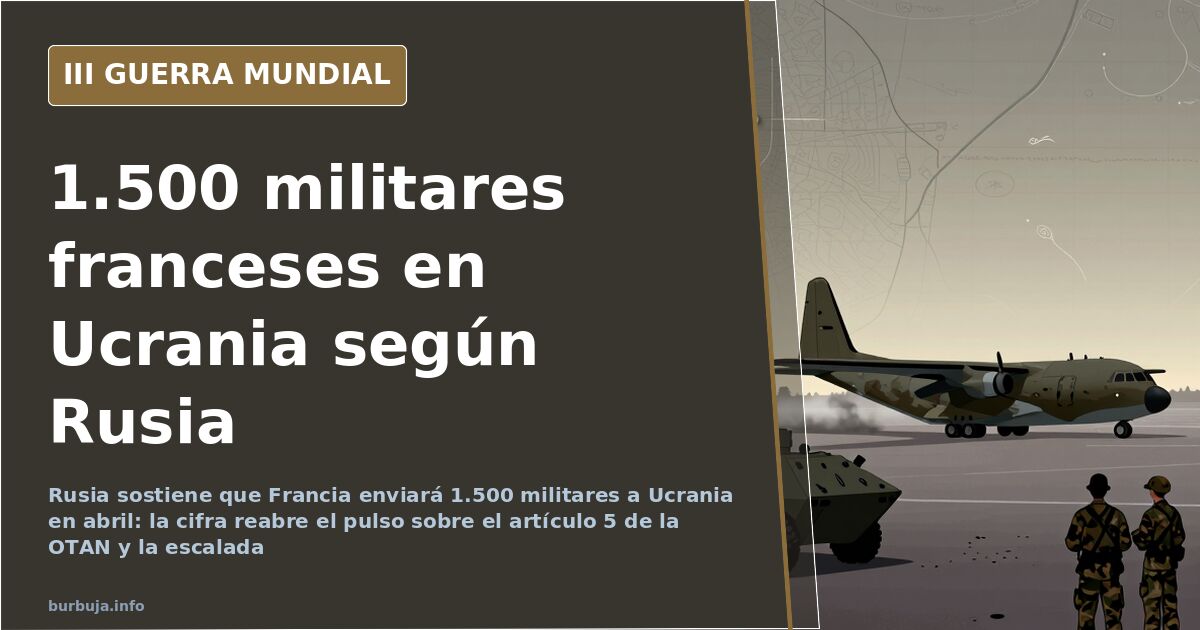
Russia assumes French deployment of 1,500 troops in April
Neither the Élysée nor NATO has confirmed anything. However, the figure is already circulating with a specific date: 1,500 French soldiers heading to Ukraine in April, according to information attributed by Russian agency Sputnik and replicated by channels like NegociosTV. Thus, the dispatch of French troops to Ukraine jumps from rumor to headline without any official appearance. The paradox remains constant in this war: the more secret an operation, the more details appear in the media.
Those who accept the leak reason that Moscow does not publish an operational date for fun. If the agency knows it, the Kremlin knows it. This argument holds until one remembers that knowing something and verifying it are different things: an intelligence service may have the date but no idea if the plan will survive the next cabinet meeting.
What Russian reports say about the 1,500 troops
The core data is a contingent of 1,500 French personnel scheduled for deployment in April. There is no official French confirmation, no NATO resolution, and no statement from the General Staff. Based on this, analysis splits between those viewing it as a gesture and those seeing it as the first step of something larger.
Moreover, the figure fluctuates. Days ago, 4,000 personnel were cited; now, 1,500. Another unverified claim circulates: that France already has around 1,500 soldiers on the ground, deployed silently before any public announcement. Neither has independent confirmation, which is precisely what should be retained.
Why won't 1,500 soldiers change the front?
Because 1,500 men are, in military terms, little more than two regiments, and a regiment cannot move a thousand-kilometer front line. A calculation circulating in critical readings suggests this volume barely covers barracks services: medical, catering, guards, laundry, and maintenance per battalion. For those endorsing this view, sending 1,500 is ridiculous; for critics, the number aims not to break anything, but to be present.
Here appears the most repeated scenario: the vanguard. Initial forces serve to measure Russian reaction, inform allies in real time who distrust Ukrainian reports, and, if things don’t explode, expand deployment. Against this weighs the snowball logic: once official troops are on the ground, each casualty forces sending more to justify previous ones. The full calculation, broken down unit by unit, shows a surprising difference.
From 16,000 advisors to 184,000 soldiers: the Vietnam precedent
The historical parallel most cited is the US in Vietnam. Initially military advisors in the fifties; by 1963, around 16,000. Direct participation escalated, and by 1965 Washington had about 184,000 soldiers deployed in South Vietnam. By conflict’s end, total accumulated neared 2.7 million personnel. No one signed that escalation at once: it peine in stages, each justified by the previous.
Translating this to the French case is uncomfortable, requiring a prior question. If troops are sent without declaring war, under what status do they fight? Are they instructors, observers, tank crews? The ambiguity is deliberate—allowing denial of involvement—and also the weak point: a uniform without a declaration of war is a target that obliges no one to act.
Does NATO Article 5 require sending troops?
Not automatically. The text commits each ally to take “such action as it deems necessary,” including use of armed force, to restore security. The key lies in that deems: the decision belongs to each country, not the collective, and can remain sanctions, intelligence, or material. Several member states have clarified they do not contemplate deploying their own troops in Ukraine.
Hence emerges the hypothesis favored by skeptical analyses: forcing an incident with European troops to activate Article 5 indirectly, dragging NATO into a war none want to fight on foreign soil. It is a thesis, not a fact, and poorly sustained: it requires Moscow’s cooperation in the script.
The Korean mold: exclusion zone and subsidized state
For another part of the analysis, the most plausible scenario is neither victory nor defeat, but freezing. Russia would advance where convenient, then an international force would install itself in western Ukraine under humanitarian cover: an exclusion zone leaving a residual state, unviable alone, permanently supported by European money, acting as a plug against Moscow. The comparison with Korea appears naturally.
The material problem is ever-present. No one in Europe—and likely not Washington either—has today’s capacity to wage war against Russia on its own territory without assuming tens of thousands of casualties and unprecedented escalation. With that account looming, April’s 1,500 look much like a gesture.
So stand things: a contingent of 1,500, an April date only upheld by a Russian agency, and no country willing to put its name on paper. If these soldiers arrive and Russia treats them as targets, who signs the declaration of war?
Neither the Élysée nor NATO has confirmed anything. However, the figure is already circulating with a specific date: 1,500 French soldiers heading to Ukraine in April, according to information attributed by Russian agency Sputnik and replicated by channels like NegociosTV. Thus, the dispatch of French troops to Ukraine jumps from rumor to headline without any official appearance. The paradox remains constant in this war: the more secret an operation, the more details appear in the media.
Those who accept the leak reason that Moscow does not publish an operational date for fun. If the agency knows it, the Kremlin knows it. This argument holds until one remembers that knowing something and verifying it are different things: an intelligence service may have the date but no idea if the plan will survive the next cabinet meeting.
What Russian reports say about the 1,500 troops
The core data is a contingent of 1,500 French personnel scheduled for deployment in April. There is no official French confirmation, no NATO resolution, and no statement from the General Staff. Based on this, analysis splits between those viewing it as a gesture and those seeing it as the first step of something larger.
Moreover, the figure fluctuates. Days ago, 4,000 personnel were cited; now, 1,500. Another unverified claim circulates: that France already has around 1,500 soldiers on the ground, deployed silently before any public announcement. Neither has independent confirmation, which is precisely what should be retained.
Why won't 1,500 soldiers change the front?
Because 1,500 men are, in military terms, little more than two regiments, and a regiment cannot move a thousand-kilometer front line. A calculation circulating in critical readings suggests this volume barely covers barracks services: medical, catering, guards, laundry, and maintenance per battalion. For those endorsing this view, sending 1,500 is ridiculous; for critics, the number aims not to break anything, but to be present.
Here appears the most repeated scenario: the vanguard. Initial forces serve to measure Russian reaction, inform allies in real time who distrust Ukrainian reports, and, if things don’t explode, expand deployment. Against this weighs the snowball logic: once official troops are on the ground, each casualty forces sending more to justify previous ones. The full calculation, broken down unit by unit, shows a surprising difference.
From 16,000 advisors to 184,000 soldiers: the Vietnam precedent
The historical parallel most cited is the US in Vietnam. Initially military advisors in the fifties; by 1963, around 16,000. Direct participation escalated, and by 1965 Washington had about 184,000 soldiers deployed in South Vietnam. By conflict’s end, total accumulated neared 2.7 million personnel. No one signed that escalation at once: it peine in stages, each justified by the previous.
Translating this to the French case is uncomfortable, requiring a prior question. If troops are sent without declaring war, under what status do they fight? Are they instructors, observers, tank crews? The ambiguity is deliberate—allowing denial of involvement—and also the weak point: a uniform without a declaration of war is a target that obliges no one to act.
Does NATO Article 5 require sending troops?
Not automatically. The text commits each ally to take “such action as it deems necessary,” including use of armed force, to restore security. The key lies in that deems: the decision belongs to each country, not the collective, and can remain sanctions, intelligence, or material. Several member states have clarified they do not contemplate deploying their own troops in Ukraine.
Hence emerges the hypothesis favored by skeptical analyses: forcing an incident with European troops to activate Article 5 indirectly, dragging NATO into a war none want to fight on foreign soil. It is a thesis, not a fact, and poorly sustained: it requires Moscow’s cooperation in the script.
The Korean mold: exclusion zone and subsidized state
For another part of the analysis, the most plausible scenario is neither victory nor defeat, but freezing. Russia would advance where convenient, then an international force would install itself in western Ukraine under humanitarian cover: an exclusion zone leaving a residual state, unviable alone, permanently supported by European money, acting as a plug against Moscow. The comparison with Korea appears naturally.
The material problem is ever-present. No one in Europe—and likely not Washington either—has today’s capacity to wage war against Russia on its own territory without assuming tens of thousands of casualties and unprecedented escalation. With that account looming, April’s 1,500 look much like a gesture.
So stand things: a contingent of 1,500, an April date only upheld by a Russian agency, and no country willing to put its name on paper. If these soldiers arrive and Russia treats them as targets, who signs the declaration of war?
Also available in: Deutsch
Summary of a discussion on Burbuja.info - Foro de economía, actualidad y política., translated from Spanish and reviewed before publication. Read the full discussion (108 replies).
More summaries
-
Macron Plan: French Troops in Ukraine via Bilateral Pact
French Parliament backs bilateral deal with Ukraine, enabling French and Polish troops to free up Ukrainian forces for the front.
-
French Troops in Ukraine: Macron Drops Red Lines
Macron confirms French troops will deploy to Ukraine, declaring 'no red lines'. The debate is fueled by fears of mobilization and French interests.
-
Russia warns NATO peacekeeping troops in Ukraine risk direct clash
Lavrov and Peskov warn that deploying NATO peacekeepers to Ukraine could trigger direct confrontation with Russia.
-
Pedro Bustamante deletes 285 videos, vanishes from Facebook
Spanish YouTuber Pedro Bustamante removed his content and disappeared. Rumors place him in Munich, reading German press.
-
Iglesias Prefers Obama, Undermining Communist Label
Pablo Iglesias favors Obama over Putin, sparking debate on Podemos' identity: communism, postmodernism, or crony capitalism?
-
Spain backs Morocco's Sahara autonomy plan, angering Algeria
Sánchez endorses Moroccan autonomy for Western Sahara in letter to King Mohammed VI. Algeria recalls ambassador amid gas supply concerns.