
Venezuela declares red alert over British patrol vessel
Venezuela activates red alert and mobilizes 5,682 troops in response to the arrival of the British HMS Trent.
English · Original discussion in Spanish · Published
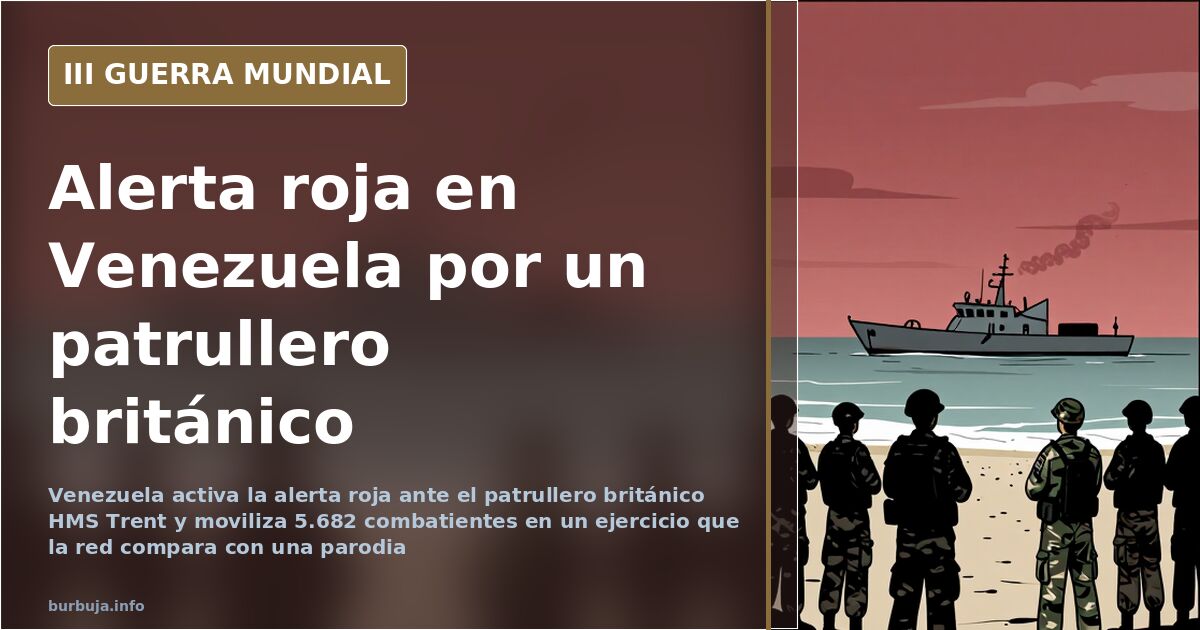
Venezuela triggers red alert over a 2,000-ton British patrol vessel
A refrain repeated three times—"battle stations, battle stations"—carnival music, and an urgency banner. This was how the Joint Action Military Exercise "General Domingo Sifontes" was presented: 5,682 combatants "equipped and trained," according to data provided by the Commander General of the Bolivarian Navy, Admiral Neil Villamizar Sánchez. The staging aimed to project firmness against the arrival of a British warship. Judging by the released material, it projects something else.
The trigger is a single ship. And it is not an aircraft carrier.
What is the HMS Trent and what weapons does it carry?
The HMS Trent displaces 2,000 tons. Its listed armament is limited to a 30 mm DS30B gun, four heavy .5 caliber machine guns, two miniguns—removed in 2023—and two general-purpose machine guns. Nothing more. Placed alongside the 5,682 personnel mobilized by Caracas, the catalog draws an asymmetry that invites asking what is actually being communicated.
Because the issue is about narrative. A patrol vessel turned into an existential threat, a joint action deployment, and a fairground soundtrack. The question is not whether the ship scares anyone. It is who the staging intends to scare.
"Battle Stations": The video compared to Monty Python
Much of the reaction to the audiovisual material was open mockery. North Korean propaganda videos, Benny Hill sketches, and even Mr. Bean chases were cited; the "battle stations" refrain was compared to the music of a neighborhood raffle and carnival sounds. The most repeated joke, however, was another: what is ordered online versus what arrives home.
There is a detail that explains why the video lends itself to ridicule: visible cuts between shots, stock footage, and shouting narration. The result looks less like a filmed military exercise and more like an advertisement. And that, in terms of strategic communication, is a bigger problem than any patrol vessel.
Why does Venezuela respond with a joint action exercise?
Among circulating interpretations, there are two dominant currents. One argues it is posturing for domestic consumption: an external enemy to mask internal crisis and fuel a permanent siege discourse. Another, more benevolent view, reduces it to routine training with extra loudspeakers. Neither fits well with the figure: 5,682 combatants are not mobilized for a photo op.
What almost all readings admit is that the video, as a piece of propaganda, works against its issuer. The pretentious tone and studio aesthetics do the critics' work for them.
The pattern of other maneuvers: radars with painted data
Those who have trinc Venezuelan military demonstrations in recent years point to a recognizable pattern. The elements repeat: command posts with screens, martial narrations, and a staging that recalls a television studio more than an operations center. In one of those previous recordings, it is recalled, the "radars" showed data painted directly onto the glass. Seen one, seen all.
That detail, almost anecdotal, better summarizes than any statement the distance between what is announced and what is shown. Spectacularity is not measured in capability, but in camera angles.
Guyana, Alex Saab, and the circulating geopolitical reading
Another line of analysis points outside Venezuela. Circulating readings argue that the regime needs an external conflict, linking the release of Alex Saab by the Joe Biden Administration to a supposed US green light to move on Guyana. These are unconfirmed conjectures and should be treated as such: no documents have been provided and no official declaration is known regarding this.
What is striking is that the discussion about a ship has shifted so quickly to domestic politics and alliances. The ship is the pretext; the message, inward and outward, is what is debated.
Voices of alarm and mockery on the same screen
Parallel to the jokes, some defend that the mobilization is a step in a serious escalation and that ridicule should not obscure the risk. Against that reading, the most repeated datum is the contrast of means: a second-line patrol vessel turned into a televised casus belli, and a force presented as a Rapid Reaction Unit—URRA—whose real capacity no one has verified outside the video.
The irony sustains itself. But the public money financing the deployment, the logistics of 5,682 personnel, and the cost of maintaining the narrative are not a joke. The sketch is the wrapper; the bill is something else.
In the end, the only fruta figure of the entire episode remains the same: 5,682 combatants, equipped and trained, against a ship whose thickest gun measures 30 millimeters. The disproportion has its charm. It also has a recipient.
A refrain repeated three times—"battle stations, battle stations"—carnival music, and an urgency banner. This was how the Joint Action Military Exercise "General Domingo Sifontes" was presented: 5,682 combatants "equipped and trained," according to data provided by the Commander General of the Bolivarian Navy, Admiral Neil Villamizar Sánchez. The staging aimed to project firmness against the arrival of a British warship. Judging by the released material, it projects something else.
The trigger is a single ship. And it is not an aircraft carrier.
What is the HMS Trent and what weapons does it carry?
The HMS Trent displaces 2,000 tons. Its listed armament is limited to a 30 mm DS30B gun, four heavy .5 caliber machine guns, two miniguns—removed in 2023—and two general-purpose machine guns. Nothing more. Placed alongside the 5,682 personnel mobilized by Caracas, the catalog draws an asymmetry that invites asking what is actually being communicated.
Because the issue is about narrative. A patrol vessel turned into an existential threat, a joint action deployment, and a fairground soundtrack. The question is not whether the ship scares anyone. It is who the staging intends to scare.
"Battle Stations": The video compared to Monty Python
Much of the reaction to the audiovisual material was open mockery. North Korean propaganda videos, Benny Hill sketches, and even Mr. Bean chases were cited; the "battle stations" refrain was compared to the music of a neighborhood raffle and carnival sounds. The most repeated joke, however, was another: what is ordered online versus what arrives home.
There is a detail that explains why the video lends itself to ridicule: visible cuts between shots, stock footage, and shouting narration. The result looks less like a filmed military exercise and more like an advertisement. And that, in terms of strategic communication, is a bigger problem than any patrol vessel.
Why does Venezuela respond with a joint action exercise?
Among circulating interpretations, there are two dominant currents. One argues it is posturing for domestic consumption: an external enemy to mask internal crisis and fuel a permanent siege discourse. Another, more benevolent view, reduces it to routine training with extra loudspeakers. Neither fits well with the figure: 5,682 combatants are not mobilized for a photo op.
What almost all readings admit is that the video, as a piece of propaganda, works against its issuer. The pretentious tone and studio aesthetics do the critics' work for them.
The pattern of other maneuvers: radars with painted data
Those who have trinc Venezuelan military demonstrations in recent years point to a recognizable pattern. The elements repeat: command posts with screens, martial narrations, and a staging that recalls a television studio more than an operations center. In one of those previous recordings, it is recalled, the "radars" showed data painted directly onto the glass. Seen one, seen all.
That detail, almost anecdotal, better summarizes than any statement the distance between what is announced and what is shown. Spectacularity is not measured in capability, but in camera angles.
Guyana, Alex Saab, and the circulating geopolitical reading
Another line of analysis points outside Venezuela. Circulating readings argue that the regime needs an external conflict, linking the release of Alex Saab by the Joe Biden Administration to a supposed US green light to move on Guyana. These are unconfirmed conjectures and should be treated as such: no documents have been provided and no official declaration is known regarding this.
What is striking is that the discussion about a ship has shifted so quickly to domestic politics and alliances. The ship is the pretext; the message, inward and outward, is what is debated.
Voices of alarm and mockery on the same screen
Parallel to the jokes, some defend that the mobilization is a step in a serious escalation and that ridicule should not obscure the risk. Against that reading, the most repeated datum is the contrast of means: a second-line patrol vessel turned into a televised casus belli, and a force presented as a Rapid Reaction Unit—URRA—whose real capacity no one has verified outside the video.
The irony sustains itself. But the public money financing the deployment, the logistics of 5,682 personnel, and the cost of maintaining the narrative are not a joke. The sketch is the wrapper; the bill is something else.
In the end, the only fruta figure of the entire episode remains the same: 5,682 combatants, equipped and trained, against a ship whose thickest gun measures 30 millimeters. The disproportion has its charm. It also has a recipient.
Also available in: Deutsch
Summary of a discussion on Burbuja.info - Foro de economía, actualidad y política., translated from Spanish and reviewed before publication. Read the full discussion (108 replies).
More summaries
-
Venezuela calls referendum to annex Guyana's Essequibo
Venezuela has scheduled a December 3 referendum on annexing the Essequibo, a region comprising 75% of Guyana and rich in oil.
-
Sánchez reveals ship carrying arms to Ukraine
Sánchez reveals the name of the Ysabel, the ship that, according to the thread, was carrying weapons and 200 tons of ammunition to Gdynia.
-
Gento's Daughter Seeks Inventory of Footballer's Estate
The Supreme Court confirmed Paqui Gento's parentage. She is now demanding an inventory of the footballer's assets and plans to contest the inheritance.
-
Russian Animation Thrives Without Disney
Cheburashka's 2023 box office record in Russia contrasts with its limited European distribution.
-
Chuguev: Explosion was ammunition depot, not thermobaric bomb
A blast over Kharkiv proved to be the Chuguev military depot. The debate on whether thermobaric weapons are war crimes gained traction.
-
Swastika Tattoo on Captured Soldier Reignites War Propaganda Debate
A captured soldier's swastika tattoo sparks renewed discussion on symbols, propaganda, and war narratives.