
Poland builds Europe's largest land army
Warsaw expands its military amid Russian threats, raising concerns about debt and energy costs.
English · Original discussion in Spanish · Published
Poland is building Europe's largest land army, but the cost extends beyond defense
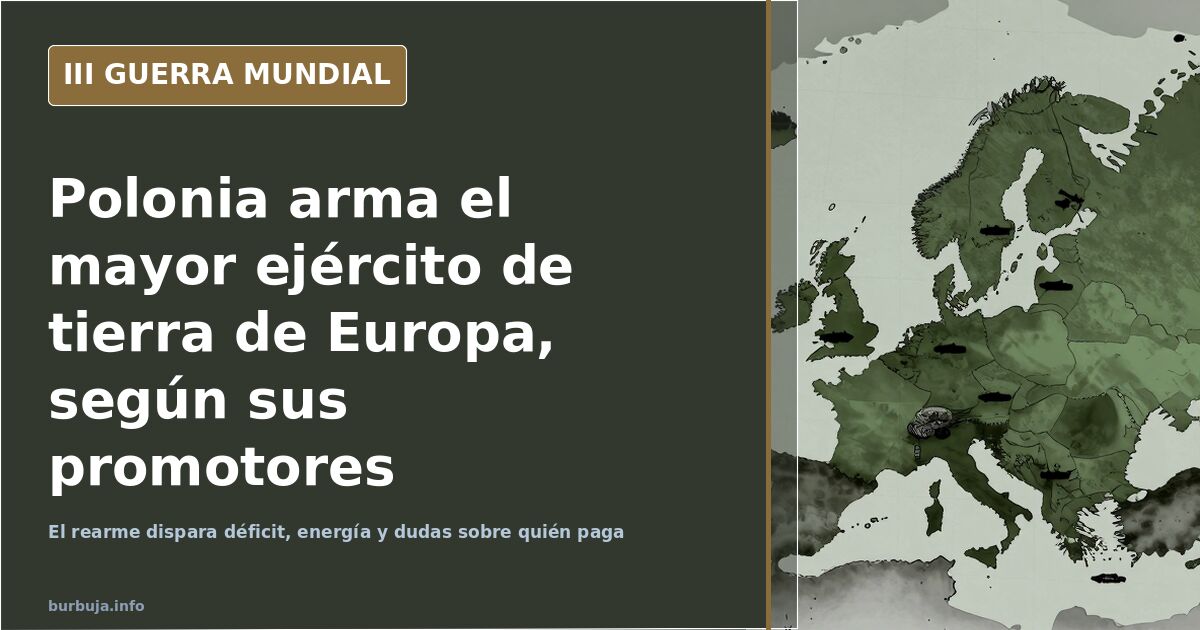
Poland is constructing what officials describe as Europe's largest land force, citing a "serious risk of war with Russia." This move presents a paradox: the nation most scarred by historical partitions is also rearming fastest, yet remains heavily dependent on Germany’s struggling industrial base. The result is a complex equation involving tanks, energy prices, and fiscal deficits.
Official support is strong. Some view Poland as NATO’s leading partner after the US and UK, declaring there is "no turning back." Proponents argue that rearmament is the only guarantee against becoming a province of a neighbor that has already demonstrated aggression toward countries it considers within its sphere.
The debate over sovereignty and alignment
Critics question Poland's status, suggesting it acts less as an independent ally and more as a useful vassal. They argue the difference between being a Moscow satellite or a Washington pawn lies in the supplier, not true sovereignty. Supporters counter that if such doubts exist, citizens should decide via referendum. However, this objection applies to any strategic alignment.
Economic pressures are mounting. Polish industry relies on German heavy manufacturing, which is contracting. Energy costs for households in this cold-climate country are rising sharply, while military spending surges to meet demands from Anglo-Saxon manufacturers. Analysts predict higher unemployment, larger deficits, and uncontrollable energy bills.
Who profits from the arms buildup?
Skeptics note the program will unfold over "3 to 10 years," ensuring profits flow primarily to US, Italian, and Korean suppliers. Spain gains little from this distribution. Rearmament is effectively industrial policy, with contracts awarded before production begins.
Recruitment faces challenges. Voluntary service launched in May aiming for 20,000 recruits this year. Retention, not recruitment, is the issue: experienced personnel leave due to dissatisfaction, while novices join. A large paper army requires committed volunteers, something advertising cannot guarantee.
Why does Poland support Ukraine despite historical grievances?
Many ask why Warsaw backs Kyiv given past Ukrainian atrocities against Poles and territorial losses. The prevailing answer is geopolitical: common enemies outweigh historical memory. A darker interpretation suggests support serves to create a buffer zone in former Polish territories—Western Ukraine, historically Austro-Hungarian, Catholic, and Latin-scripted.
Cultural tensions persist. Some argue Poland and Hungary resist Brussels' agenda and are punished accordingly; others claim this rhetoric makes them cannon fodder for foreign conflicts. Critics assert they are preparing to absorb Ukraine.
Nuclear risks and time pressure
Military experts divide on whether escalation can remain conventional or if even a 1% nuclear risk is unacceptable. Most believe nuclear assets serve as verbal deterrence, and time favors defenders. Generals driving this policy face significant political jeopardy.
A striking figure circulates: Poland allegedly possesses 500 HIMARS launchers. If accurate, this exceeds several major allies’ inventories. Yet utility depends on air superiority, a capability not easily purchased.
How many times must Poland disappear to learn its lesson? This unanswered question captures the core dilemma: a nation rearming to avoid repeating history, only to find itself once again central to global conflict.
Poland is constructing what officials describe as Europe's largest land force, citing a "serious risk of war with Russia." This move presents a paradox: the nation most scarred by historical partitions is also rearming fastest, yet remains heavily dependent on Germany’s struggling industrial base. The result is a complex equation involving tanks, energy prices, and fiscal deficits.
Official support is strong. Some view Poland as NATO’s leading partner after the US and UK, declaring there is "no turning back." Proponents argue that rearmament is the only guarantee against becoming a province of a neighbor that has already demonstrated aggression toward countries it considers within its sphere.
The debate over sovereignty and alignment
Critics question Poland's status, suggesting it acts less as an independent ally and more as a useful vassal. They argue the difference between being a Moscow satellite or a Washington pawn lies in the supplier, not true sovereignty. Supporters counter that if such doubts exist, citizens should decide via referendum. However, this objection applies to any strategic alignment.
Economic pressures are mounting. Polish industry relies on German heavy manufacturing, which is contracting. Energy costs for households in this cold-climate country are rising sharply, while military spending surges to meet demands from Anglo-Saxon manufacturers. Analysts predict higher unemployment, larger deficits, and uncontrollable energy bills.
Who profits from the arms buildup?
Skeptics note the program will unfold over "3 to 10 years," ensuring profits flow primarily to US, Italian, and Korean suppliers. Spain gains little from this distribution. Rearmament is effectively industrial policy, with contracts awarded before production begins.
Recruitment faces challenges. Voluntary service launched in May aiming for 20,000 recruits this year. Retention, not recruitment, is the issue: experienced personnel leave due to dissatisfaction, while novices join. A large paper army requires committed volunteers, something advertising cannot guarantee.
Why does Poland support Ukraine despite historical grievances?
Many ask why Warsaw backs Kyiv given past Ukrainian atrocities against Poles and territorial losses. The prevailing answer is geopolitical: common enemies outweigh historical memory. A darker interpretation suggests support serves to create a buffer zone in former Polish territories—Western Ukraine, historically Austro-Hungarian, Catholic, and Latin-scripted.
Cultural tensions persist. Some argue Poland and Hungary resist Brussels' agenda and are punished accordingly; others claim this rhetoric makes them cannon fodder for foreign conflicts. Critics assert they are preparing to absorb Ukraine.
Nuclear risks and time pressure
Military experts divide on whether escalation can remain conventional or if even a 1% nuclear risk is unacceptable. Most believe nuclear assets serve as verbal deterrence, and time favors defenders. Generals driving this policy face significant political jeopardy.
A striking figure circulates: Poland allegedly possesses 500 HIMARS launchers. If accurate, this exceeds several major allies’ inventories. Yet utility depends on air superiority, a capability not easily purchased.
How many times must Poland disappear to learn its lesson? This unanswered question captures the core dilemma: a nation rearming to avoid repeating history, only to find itself once again central to global conflict.
Also available in: Deutsch
Summary of a discussion on Burbuja.info - Foro de economía, actualidad y política., translated from Spanish and reviewed before publication. Read the full discussion (108 replies).
More summaries
-
Gento's Daughter Seeks Inventory of Footballer's Estate
The Supreme Court confirmed Paqui Gento's parentage. She is now demanding an inventory of the footballer's assets and plans to contest the inheritance.
-
Syria: HTS Overthrows Assad Regime in Ten Days
HTS captured Damascus with minimal resistance as the Syrian army collapsed without Russian or Iranian support, ending a thirteen-year civil war.
-
Ukraine halts consular services for men aged 18-60
Ukraine suspends new consular applications for men aged 18 to 60 abroad, except for procedures to return home.
-
Russia's Economy Defies Western Forecasts After Three Years of War
A user claims Russia is now the world's fifth-largest economy, surpassing Germany while Europe struggles. Three years of failed predictions on the...
-
Germany Demolishes Towers of Nuclear Plant Closed in 2015
Germany demolished the Grafenrheinfeld cooling towers, closed since 2015, amid claims it relies on costlier coal and LNG than Russian gas.
-
Ukrainian in Spain confronts pro-Russian rallies alone
Vadym Syroyezhko, a Ukrainian resident in the Canary Islands, attends pro-Russian events in Spain to protest and reports receiving death threats.