
Spain's PP proposes voluntary military service counting toward career
Spain's People's Party (PP) considers a short-term voluntary military service that counts toward work history and grants university credits, requiring constitutional reform.
English · Original discussion in Spanish · Published
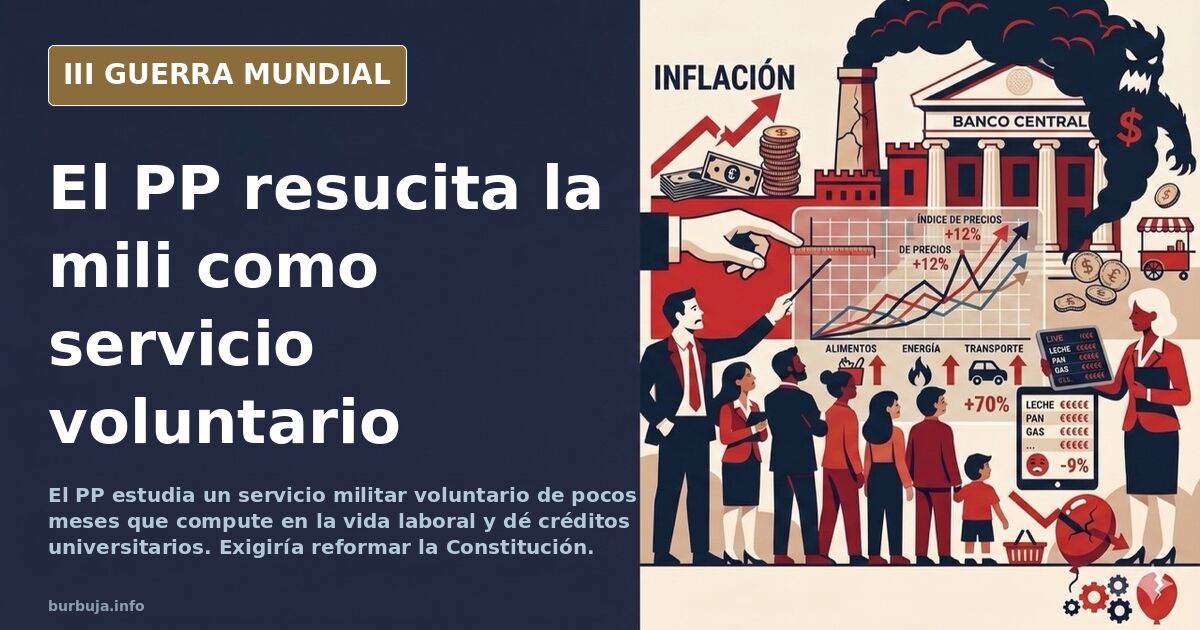
Spain's PP proposes voluntary military service counting toward career
According to reports by El Confidencial Digital, the People's Party (PP) is considering reintroducing a short-term voluntary military service if it returns to power. The proposal would include university credits and count toward work history, necessitating a constitutional amendment. This mirrors discussions in France and Sweden regarding mandatory service. The news is not new; the outlet last updated this story in 2019.
What exactly does the PP propose?
The circulating plan involves voluntary service lasting a few months, with two incentives to attract young people: counting toward work history and granting university credits. Implementing this would require amending the Constitution, a detail crucial for distinguishing between a campaign promise and actual reform.
The model is not original. France and Sweden have peine debates on military service, and the PP uses this European context to present the measure as modern rather than nostalgic. Spain abolished mandatory conscription in 2001, after the PP ended it in 1992.
Why doubt remains about its voluntary nature
Skepticism persists that "voluntary" status will be temporary. Many anticipate the classic sequence: approved as optional, then made mandatory, eventually leading to forced recruitment. Comparisons to ELbichito-19 vaccines appear frequently: they were also initially voluntary but led to penalties for non-compliance.
Some argue short-term service is ineffective because military training requires full dedication, like any profession. Counterarguments cite Switzerland’s continuous training system with periodic exercises, which a brief summer course cannot replicate.
The economic argument: who pays and who benefits?
A common objection is that past conscription did not compensate those interrupting their lives. For some, it meant lost months; for others, opportunities they otherwise lacked. This duality remains relevant: counting toward work history sounds good until one recalls that past mandatory service rarely offered such recognition.
Costs are also raised. A paid voluntary service implies public spending, prompting questions about funding amidst pension debt pressures. Some suggest military spending should prioritize high-tech arms industry over basic training.
The geopolitical context no one ignores
The measure fits within Europe’s rearmament climate. Some claim NATO needs troops and that the war in Ukraine has revived talk of "cannon fodder." Suspicions arise that the proposal responds to allied demands rather than Spanish needs.
Meanwhile, critics portray the PP as avoiding political risk: if unpopular, the burden falls on implementers. Assumed PP-Socialist consensus on defense policy reinforces the idea that this is a bloc strategy, not just one party’s proposal.
What if military service returns before the PP regains power?
According to reports by El Confidencial Digital, the People's Party (PP) is considering reintroducing a short-term voluntary military service if it returns to power. The proposal would include university credits and count toward work history, necessitating a constitutional amendment. This mirrors discussions in France and Sweden regarding mandatory service. The news is not new; the outlet last updated this story in 2019.
What exactly does the PP propose?
The circulating plan involves voluntary service lasting a few months, with two incentives to attract young people: counting toward work history and granting university credits. Implementing this would require amending the Constitution, a detail crucial for distinguishing between a campaign promise and actual reform.
The model is not original. France and Sweden have peine debates on military service, and the PP uses this European context to present the measure as modern rather than nostalgic. Spain abolished mandatory conscription in 2001, after the PP ended it in 1992.
Why doubt remains about its voluntary nature
Skepticism persists that "voluntary" status will be temporary. Many anticipate the classic sequence: approved as optional, then made mandatory, eventually leading to forced recruitment. Comparisons to ELbichito-19 vaccines appear frequently: they were also initially voluntary but led to penalties for non-compliance.
Some argue short-term service is ineffective because military training requires full dedication, like any profession. Counterarguments cite Switzerland’s continuous training system with periodic exercises, which a brief summer course cannot replicate.
The economic argument: who pays and who benefits?
A common objection is that past conscription did not compensate those interrupting their lives. For some, it meant lost months; for others, opportunities they otherwise lacked. This duality remains relevant: counting toward work history sounds good until one recalls that past mandatory service rarely offered such recognition.
Costs are also raised. A paid voluntary service implies public spending, prompting questions about funding amidst pension debt pressures. Some suggest military spending should prioritize high-tech arms industry over basic training.
The geopolitical context no one ignores
The measure fits within Europe’s rearmament climate. Some claim NATO needs troops and that the war in Ukraine has revived talk of "cannon fodder." Suspicions arise that the proposal responds to allied demands rather than Spanish needs.
Meanwhile, critics portray the PP as avoiding political risk: if unpopular, the burden falls on implementers. Assumed PP-Socialist consensus on defense policy reinforces the idea that this is a bloc strategy, not just one party’s proposal.
What if military service returns before the PP regains power?
Also available in: Deutsch
Summary of a discussion on Burbuja.info - Foro de economía, actualidad y política., translated from Spanish and reviewed before publication. Read the full discussion (113 replies).
More summaries
-
Spain’s Constitution Allows Forced Civilian Mobilization Under National Security Law
Article 30 mandates defense of Spain, while the 2022 National Security Law permits civilian mobilization, revealing no explicit constitutional ban on forced recruitment.
-
Russia Warns Sweden Over NATO Base Plans on Gotland
Russia labels Sweden's plans for a NATO base on Gotland as provocative amid militarization of the Baltic region.
-
Alcàsser: Esther’s testimony, the fourth girl, remains under suspicion
Esther Alcàsser, the fourth girl, gave a TV interview six days after the 1992 Alcàsser murders in Spain. Her account and timeline discrepancies fuel ongoing controversy.
-
Gabon military annuls election, dissolves regime
Gabonese soldiers dissolved institutions and voided the August 2023 election that gave Ali Bongo 64.27% of the vote.
-
Forum Discusses Putin's Nuclear Threats and Russia Closing Borders to Europe
Thread claims Putin repeats nuclear warnings as US urges citizens to leave Russia and Moscow closes borders with Europe.
-
NPCs in Spain: Who Has a Soul and Who Just Runs Routines?
The NPC term divides opinion: some see soulless people, others arrogance. What does the observer effect say about those unaware of their programming?