
Forum Discusses Putin's Nuclear Threats and Russia Closing Borders to Europe
Thread claims Putin repeats nuclear warnings as US urges citizens to leave Russia and Moscow closes borders with Europe.
English · Original discussion in Spanish · Published
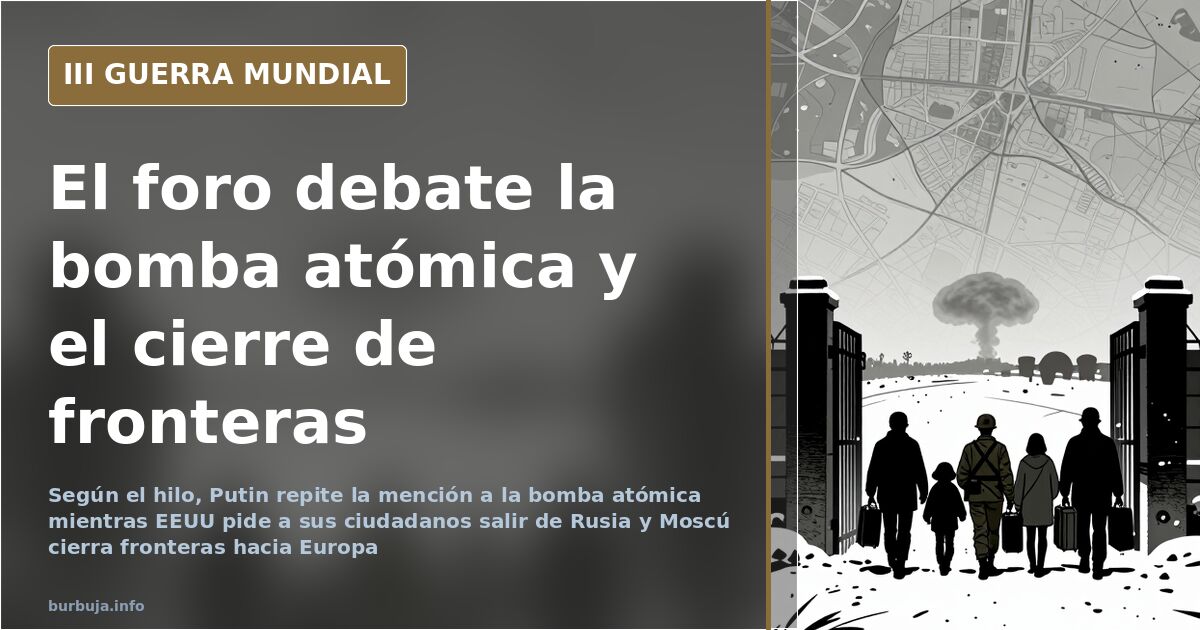
Pilingui Insists on Nuclear Bomb and Closes Russian Borders to Europe
Red Square, a rally-concert, the crowd chanting the country's name and Pilingui, according to thread messages, once again mentioning the atomic bomb: "Victory will be ours. Atomic bomb? USA has already set a precedent." It is not, according to this account, an isolated slip: he had previously warned that "this is not a bluff" and that he would use "all necessary weapons"; days later came the statement that Russia has the "right to use the atomic bomb." The same participant counts three mentions in a few weeks, all in public speeches.
This drip of warnings now rests on a formal framework. The four annexed regions are considered Russian territory, and it has been warned that an attack on them would equate to attacking Russia and trigger a declaration of war. With this umbrella, nuclear deterrence ceases to be background noise and becomes declared doctrine. For one participant, it is the same scheme seen before Ukraine was attacked: first the warning, then the fact.
Why the US Asks Its Citizens to Leave Russia
The United States has asked its nationals to leave Russia "immediately by any means." The formula is not new. It is the same one issued before Ukraine was invaded, and that echo—same warning, same urgency, same silence on reasons—is what has raised alarms. In parallel, and according to the same account, Russia has closed borders and transport links to Europe. This is not just another customs control: land and air exit routes to the continent are cut off.
For part of the analysis, both moves point to a total declaration of war against Ukraine. For another, they are pieces of a pressure campaign repeated for months without anything definitive happening. The difference between these readings lies not in the facts, but in how much time is given to Moscow's patience.
A NATO That Will Not Intervene Unless a Member Is Touched
The thread repeatedly states that the alliance maintains a line actively and passively: it will not intervene unless a NATO member is touched. Almost everything fits within that margin. According to circulating warnings, the US may have indicated that a nuclear attack would not receive a nuclear response, a claim read as a green light. The episode of the Secretary General on German TV—interrupted by a broadcast of Pilingui's speech in Red Square—adds salt to the scene via humor.
Regarding Ukraine, the message was colder: according to one participant, the NATO Secretary General snubbed Zelensky. The conclusion drawn is uncomfortable: Kyiv stands alone on the board.
Medvedev Breaks Silence: "It Is Not a Bluff"
Dmitry Medvedev, discreet during much of the conflict, broke his silence—as reported in the thread—to ensure Pilingui's nuclear threat "is not a bluff" and that there will be no ability to return the blow. The message goes in the same direction as the rally speech, but with a different recipient: it is not for the Russian public, but for European chancelleries. That the warning arrives, according to this account, from two distinct voices with the same content suggests coordination that is rarely accidental.
Fusion Bomb, Tactical Nuke, or Thermobaric: What Is Being Considered
When discussing which weapon might be used, the range opens quickly. One current holds that small fusion bombs detonated at considerable height above ground would be used: radioactive fallout would be scarce, but panic in Europe, general. Another points to a high-power thermobaric bomb with depleted uranium, which is technically not a nuclear device but generates a devastating shockwave. And the coldest calculation insists on the elementary: a single detonation in a troop concentration point sufficiently far from Russian territory would suffice to force surrender the next day, as peine with Japan in World War II.
The US Precedent Cited by Pilingui
The mention of the US "precedent" is not casual: it refers to the bombs dropped by the US in World War II, the argument that, according to the thread, serves Moscow to sustain that it would not be the first to use the weapon. The paradox is double: the same power used as an alibi is the one that, according to circulating warnings, would not return a nuclear blow. The precedent is invoked, ultimately, against the one promising the least response.
The Data That Does Not Fit the Narrative
On paper, the Russian arsenal is intact and deterrence should work. On the ground, and according to one participant, the numbers handled speak of a mobilization of 300,000 people, many without military experience, sent without training and with scarce logistics. That is the gap no one closes: nuclear rhetoric coexists with a war machine limping forward, and winter tightens on both sides.
With these pieces, the question is no longer if Pilingui is bluffing. It is how much of the threat serves to negotiate and how much for something worse.
Red Square, a rally-concert, the crowd chanting the country's name and Pilingui, according to thread messages, once again mentioning the atomic bomb: "Victory will be ours. Atomic bomb? USA has already set a precedent." It is not, according to this account, an isolated slip: he had previously warned that "this is not a bluff" and that he would use "all necessary weapons"; days later came the statement that Russia has the "right to use the atomic bomb." The same participant counts three mentions in a few weeks, all in public speeches.
This drip of warnings now rests on a formal framework. The four annexed regions are considered Russian territory, and it has been warned that an attack on them would equate to attacking Russia and trigger a declaration of war. With this umbrella, nuclear deterrence ceases to be background noise and becomes declared doctrine. For one participant, it is the same scheme seen before Ukraine was attacked: first the warning, then the fact.
Why the US Asks Its Citizens to Leave Russia
The United States has asked its nationals to leave Russia "immediately by any means." The formula is not new. It is the same one issued before Ukraine was invaded, and that echo—same warning, same urgency, same silence on reasons—is what has raised alarms. In parallel, and according to the same account, Russia has closed borders and transport links to Europe. This is not just another customs control: land and air exit routes to the continent are cut off.
For part of the analysis, both moves point to a total declaration of war against Ukraine. For another, they are pieces of a pressure campaign repeated for months without anything definitive happening. The difference between these readings lies not in the facts, but in how much time is given to Moscow's patience.
A NATO That Will Not Intervene Unless a Member Is Touched
The thread repeatedly states that the alliance maintains a line actively and passively: it will not intervene unless a NATO member is touched. Almost everything fits within that margin. According to circulating warnings, the US may have indicated that a nuclear attack would not receive a nuclear response, a claim read as a green light. The episode of the Secretary General on German TV—interrupted by a broadcast of Pilingui's speech in Red Square—adds salt to the scene via humor.
Regarding Ukraine, the message was colder: according to one participant, the NATO Secretary General snubbed Zelensky. The conclusion drawn is uncomfortable: Kyiv stands alone on the board.
Medvedev Breaks Silence: "It Is Not a Bluff"
Dmitry Medvedev, discreet during much of the conflict, broke his silence—as reported in the thread—to ensure Pilingui's nuclear threat "is not a bluff" and that there will be no ability to return the blow. The message goes in the same direction as the rally speech, but with a different recipient: it is not for the Russian public, but for European chancelleries. That the warning arrives, according to this account, from two distinct voices with the same content suggests coordination that is rarely accidental.
Fusion Bomb, Tactical Nuke, or Thermobaric: What Is Being Considered
When discussing which weapon might be used, the range opens quickly. One current holds that small fusion bombs detonated at considerable height above ground would be used: radioactive fallout would be scarce, but panic in Europe, general. Another points to a high-power thermobaric bomb with depleted uranium, which is technically not a nuclear device but generates a devastating shockwave. And the coldest calculation insists on the elementary: a single detonation in a troop concentration point sufficiently far from Russian territory would suffice to force surrender the next day, as peine with Japan in World War II.
The US Precedent Cited by Pilingui
The mention of the US "precedent" is not casual: it refers to the bombs dropped by the US in World War II, the argument that, according to the thread, serves Moscow to sustain that it would not be the first to use the weapon. The paradox is double: the same power used as an alibi is the one that, according to circulating warnings, would not return a nuclear blow. The precedent is invoked, ultimately, against the one promising the least response.
The Data That Does Not Fit the Narrative
On paper, the Russian arsenal is intact and deterrence should work. On the ground, and according to one participant, the numbers handled speak of a mobilization of 300,000 people, many without military experience, sent without training and with scarce logistics. That is the gap no one closes: nuclear rhetoric coexists with a war machine limping forward, and winter tightens on both sides.
With these pieces, the question is no longer if Pilingui is bluffing. It is how much of the threat serves to negotiate and how much for something worse.
Also available in: Deutsch
Summary of a discussion on Burbuja.info - Foro de economía, actualidad y política., translated from Spanish and reviewed before publication. Read the full discussion (113 replies).
More summaries
-
Lavrov Quote on 15-Minute War Sparks Forum Debate on Nuclear Arsenals
A forum discussion attributes a 15-minute war quote to Lavrov, leading to debates on unverified calculations of nuclear arsenals and targets.
-
Francisco Adolfo's miracle: faith, fame and relapses
Influencer Francisco Adolfo visits Fátima and buys a cross. Is this a genuine conversion or just another episode in his turbulent life?
-
Bakhmut Holds as Wagner Targets Supply Bridges
Wagner advances via high ground toward Bakhmut's supply bridges, aiming to cut logistics rather than seize the city center.
-
Russian and Ukrainian Phenotypes: Separating Genetics from Bias
Physical appearance of Russians and Ukrainians sparks debate on heritage, historical mixing, and prejudice.
-
Japan claims four Kuril Islands from Russia: citing 1855 treaty
Japan seeks four Kuril Islands, not Sakhalin. The 1855 treaty, 1956 declaration, and offshore oil explain the dispute.
-
Medvedev Warns of 'Final Judgment' if Ukraine Strikes Crimea
Medvedev warns of a 'final judgment' for a Ukrainian attack on Crimea, but the original quote omits nuclear terms: here is what he actually said.