
Gabon military annuls election, dissolves regime
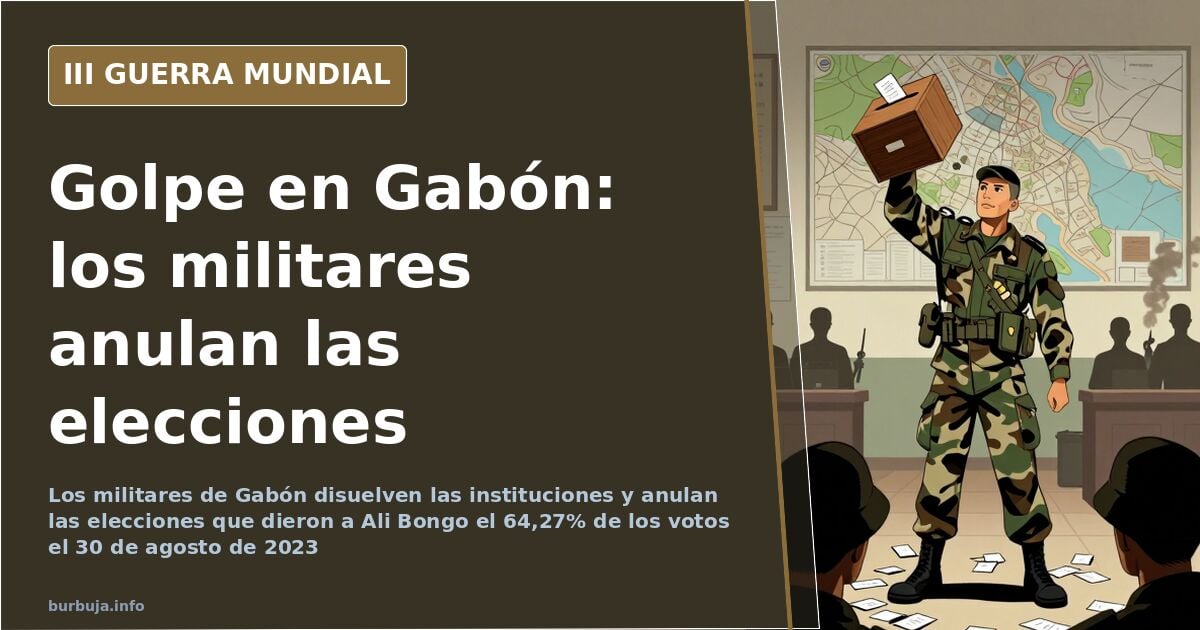
Gabonese soldiers dissolved institutions and voided the August 2023 election that gave Ali Bongo 64.27% of the vote.
English · Original discussion in Spanish · Published
Gabon: Military Annuls Election, Ends Bongo Regime
How long can a country endure being told it voted for something it didn't? In Gabon, the answer came on August 30, 2023. A group of soldiers appeared on television announcing the dissolution of all institutions, the cancellation of general elections, and the end of Ali Bongo's regime, who had been declared re-elected that same day with 64.27% of the votes. In Libreville, the capital, shots were heard, according to French agency journalists cited in the thread.
The episode has a specific name: Committee for the Transition and Restoration of Institutions (CTRI). "We have decided to defend peace by ending the current regime," one soldier stated. There was no democratic paperwork: first the result is annulled, then everything is dissolved, and we'll see what happens.
The 64.27% and Half a Century of One Family
Ali Bongo did not reach the presidency by chance, according to thread participants: he inherited power from his father, and before the coup, the same family had ruled the country since the 1960s. The re-election with 64.27% was the trigger, not the cause. Among participants, suspicions of electoral fraud to perpetuate themselves in office were repeated, and some noted that his marriage to a French citizen fueled the feeling that Gabon was governed from abroad.
Images circulated after the assault on the presidential residence, collected in the thread itself, did the rest: family properties, palaces with furniture from a well-known Swedish brand, according to a debate comment, and a vast distance between the displayed wealth and the country where it was displayed. Given Gabon's oil and raw materials, the uncomfortable question is not why Bongo fell, but why it took so long.
France, the CFA Franc, and the €400 Billion Leaving Africa
If anything explains this coup, the most repeated readings in the thread argue, it is not Moscow: it is Paris. Gabon functioned, according to those messages, as a pillar of French power in Africa, with French military presence on the ground. And below the army, the monetary system. An article published in 2017 and reshared amid the coup estimates at €400 billion annually what Africa pays France within the CFA franc architecture.
The mechanism, always according to that thesis, is simple: if a leader in the zone stops meeting French demands, Paris blocks its foreign reserves and closes the banks of the country considered rebellious. The case of Côte d'Ivoire is cited as precedent. It is an uncomfortable and debated narrative, but it fits the evidence that every change of power in the region is played on two boards: the internal one and that of the former colonizer.
Is Russia Behind the Gabon Coup?
With available data, no one can prove it, and it is worth saying that before anything else. In the thread, one participant argues that Moscow is behind every destabilization in the continent's poorest countries, with the Central African Republic as a recurring example. Opposite appears the mirror argument: if Russia is behind, France is ahead, and no one maintains an influence structure for six decades only to complain about competition.
Proof, none. What exists is a population fed up with a dynasty and an economic apparatus that turns sovereignty into an administrative formality. Labeling the coup as pro-Russian or anti-Western according to the commentator's taste is, for now, an act of faith.
The Chinese Model, Freemasonry, and Western Narrative Fatigue
Parallel to the coup, the underlying discussion peine: whether the institutional package inherited from the colony serves any purpose. Some defend that a model of strong authority and effective management, in the Chinese style, fits better with African reality than democracies that some participants accuse of exporting electoral facades and bought media.
Regarding Ali Bongo, a video also circulates in which, allegedly, he promised to serve the interests of the country's Grand Guasonic Lodge. It has become argumentative ammunition, although by itself it proves nothing. What it does show is the tone of the moment: formal legitimacy is no longer enough to sustain a ruler.
Curiosity: Spanish in Coco Beach and Equatorial Guinea
Two colorful details slipped into the conversation. First, that "Gabon" means "good evening" in Basque, which led to some easy jokes. Second, that in Coco Beach, a Gabonese locality bordering Equatorial Guinea with shared sovereignty to facilitate trade, Spanish is co-official, according to one participant. And that Equatorial Guinea has French and Portuguese as official languages, idioms that, in practice, almost no one speaks there, always according to the debate messages. The Hispanic footprint in the area is more of an official bulletin than real use.
In the end, three certainties remain and no answers. A president with 64.27% of the vote no longer rules. A family with half a century of power can be evicted in an afternoon of television. And those who have spent decades explaining that Africa needs institutions were left wondering if the problem was the institution, the tenant, or whoever paid the palace lights. Geographical ironies, according to the game running through the thread: "Gabon" sounds like "good evening" in Basque, and nightfall arrived for Bongo.
How long can a country endure being told it voted for something it didn't? In Gabon, the answer came on August 30, 2023. A group of soldiers appeared on television announcing the dissolution of all institutions, the cancellation of general elections, and the end of Ali Bongo's regime, who had been declared re-elected that same day with 64.27% of the votes. In Libreville, the capital, shots were heard, according to French agency journalists cited in the thread.
The episode has a specific name: Committee for the Transition and Restoration of Institutions (CTRI). "We have decided to defend peace by ending the current regime," one soldier stated. There was no democratic paperwork: first the result is annulled, then everything is dissolved, and we'll see what happens.
The 64.27% and Half a Century of One Family
Ali Bongo did not reach the presidency by chance, according to thread participants: he inherited power from his father, and before the coup, the same family had ruled the country since the 1960s. The re-election with 64.27% was the trigger, not the cause. Among participants, suspicions of electoral fraud to perpetuate themselves in office were repeated, and some noted that his marriage to a French citizen fueled the feeling that Gabon was governed from abroad.
Images circulated after the assault on the presidential residence, collected in the thread itself, did the rest: family properties, palaces with furniture from a well-known Swedish brand, according to a debate comment, and a vast distance between the displayed wealth and the country where it was displayed. Given Gabon's oil and raw materials, the uncomfortable question is not why Bongo fell, but why it took so long.
France, the CFA Franc, and the €400 Billion Leaving Africa
If anything explains this coup, the most repeated readings in the thread argue, it is not Moscow: it is Paris. Gabon functioned, according to those messages, as a pillar of French power in Africa, with French military presence on the ground. And below the army, the monetary system. An article published in 2017 and reshared amid the coup estimates at €400 billion annually what Africa pays France within the CFA franc architecture.
The mechanism, always according to that thesis, is simple: if a leader in the zone stops meeting French demands, Paris blocks its foreign reserves and closes the banks of the country considered rebellious. The case of Côte d'Ivoire is cited as precedent. It is an uncomfortable and debated narrative, but it fits the evidence that every change of power in the region is played on two boards: the internal one and that of the former colonizer.
Is Russia Behind the Gabon Coup?
With available data, no one can prove it, and it is worth saying that before anything else. In the thread, one participant argues that Moscow is behind every destabilization in the continent's poorest countries, with the Central African Republic as a recurring example. Opposite appears the mirror argument: if Russia is behind, France is ahead, and no one maintains an influence structure for six decades only to complain about competition.
Proof, none. What exists is a population fed up with a dynasty and an economic apparatus that turns sovereignty into an administrative formality. Labeling the coup as pro-Russian or anti-Western according to the commentator's taste is, for now, an act of faith.
The Chinese Model, Freemasonry, and Western Narrative Fatigue
Parallel to the coup, the underlying discussion peine: whether the institutional package inherited from the colony serves any purpose. Some defend that a model of strong authority and effective management, in the Chinese style, fits better with African reality than democracies that some participants accuse of exporting electoral facades and bought media.
Regarding Ali Bongo, a video also circulates in which, allegedly, he promised to serve the interests of the country's Grand Guasonic Lodge. It has become argumentative ammunition, although by itself it proves nothing. What it does show is the tone of the moment: formal legitimacy is no longer enough to sustain a ruler.
Curiosity: Spanish in Coco Beach and Equatorial Guinea
Two colorful details slipped into the conversation. First, that "Gabon" means "good evening" in Basque, which led to some easy jokes. Second, that in Coco Beach, a Gabonese locality bordering Equatorial Guinea with shared sovereignty to facilitate trade, Spanish is co-official, according to one participant. And that Equatorial Guinea has French and Portuguese as official languages, idioms that, in practice, almost no one speaks there, always according to the debate messages. The Hispanic footprint in the area is more of an official bulletin than real use.
In the end, three certainties remain and no answers. A president with 64.27% of the vote no longer rules. A family with half a century of power can be evicted in an afternoon of television. And those who have spent decades explaining that Africa needs institutions were left wondering if the problem was the institution, the tenant, or whoever paid the palace lights. Geographical ironies, according to the game running through the thread: "Gabon" sounds like "good evening" in Basque, and nightfall arrived for Bongo.
Also available in: Deutsch
Summary of a discussion on Burbuja.info - Foro de economía, actualidad y política., translated from Spanish and reviewed before publication. Read the full discussion (113 replies).
More summaries
-
Francophone Africa Rebels Against Paris's CFA Franc
The CFA franc used by 14 African nations is faltering. Calculations attribute €440 billion annually to the system, with China and Russia joining the fray.
-
Russia strikes Ukraine's power grid, leaving country in darkness
Russian bombs hit thermal plants and electrical facilities in Kharkiv, Kyiv, Lviv and Zhytomyr: Ukraine enters autumn with emergency blackouts.
-
Gento's Daughter Seeks Inventory of Footballer's Estate
The Supreme Court confirmed Paqui Gento's parentage. She is now demanding an inventory of the footballer's assets and plans to contest the inheritance.
-
Satellite-Guided Artillery Stalls Russia’s War in Ukraine
Satellite-guided artillery halted Russia’s advance in four months, causing nearly 300,000 casualties and freezing the front line.
-
Zhaoxin KH-4000: Chinese 16-core chip rivals AMD EPYC
The Zhaoxin KH-4000, a 16-core 16nm CPU, matches the SPEC CPU 2006 performance of a 32-core AMD EPYC 7601.
-
Macron opens Q&A on Ukraine support, faces mockery
After a TV interview, Macron invited questions on France's aid to Ukraine, receiving thousands of replies mixing skepticism and ridicule.