
Russia Warns Sweden Over NATO Base Plans on Gotland
Russia labels Sweden's plans for a NATO base on Gotland as provocative amid militarization of the Baltic region.
English · Original discussion in Spanish · Published
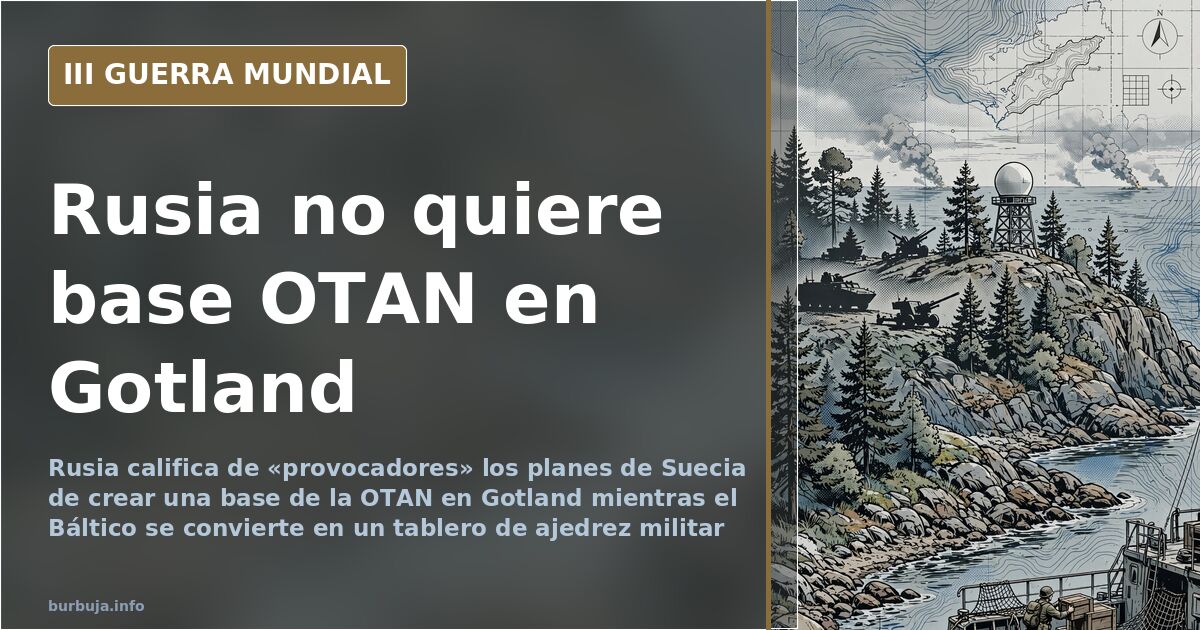
Russia Warns Sweden Over NATO Base Plans on Gotland
The Russian Ministry of Foreign Affairs has described Sweden’s plans to establish a NATO base on the island of Gotland as "provocative," according to statements reported by RIA Novosti. Moscow warns of the risks associated with the alliance’s military expansion in the territories of new Northern European member states and argues that NATO is attempting to increase its potential in the Baltic Sea. Meanwhile, Stockholm intends to strengthen an island it considers strategically vital. The debate over who decides what happens within sovereign territory is now fully underway.
What Russia Has Specifically Said About Gotland
The Russian Foreign Ministry has repeatedly warned about the dangers stemming from NATO’s military development in the territories of new Northern European members. In this context, Stockholm intends to fortify the "strategically important" island of Gotland with an alliance base. The Russian side views these plans as "provocative."
Gotland holds a key position for controlling the Baltic Sea. Whoever controls it can influence maritime and air traffic in a zone that has become a chessboard since Sweden and Finland abandoned their traditional neutrality. Some argue that a vital enclave for Baltic control should not remain undefended; however, opponents counter that Moscow has no authority to veto actions taken by a sovereign country within its own borders.
The Double Standard Attributed to Moscow
Comparisons to the Cuban Missile Crisis emerge upon closer inspection. If Russia were to place hypersonic missile bases in Haiti, it is argued, the United States would object despite Haiti’s sovereignty. The immediate response is that Haiti is sovereign, and if it grants permission for a Russian base, there is nothing to object to. Sweden has every right to allow a military base on Gotland. Indeed, it is added, failing to do so would be irresponsible.
Historical precedent weighs heavily. In 1962, Kennedy made clear that Soviet missiles in Cuba would trigger World War III, regardless of the island’s sovereignty. Some reply that the difference is that the US acted as a superpower because it was one at the time, while the USSR reacted as a second-tier nation. Nothing has changed, they conclude: Russia remains a second-rate power, unable to impose its agenda.
Kaliningrad, the Other Enclave Shifting Dynamics
With neutral Sweden and Finland, the Baltic states were in a precarious position against Russia, having only weak options for receiving reinforcements. With Sweden and Finland in NATO, the problem shifts to Kaliningrad, which is left in a vulnerable state without reinforcement options. Kaliningrad is no longer strategically viable for Russia; it cannot support a fleet that might be destroyed if it attempts to reach open sea, and any Russian army stationed there is isolated from reinforcements, ammunition, and even supplies.
The argument concludes with a call for consistency: if enclaves are accepted as needing reinforcement, then start by setting an example and dismantling the setup in Kaliningrad. The ball is in Moscow’s court, watching its Baltic fleet lose the port that once provided it breathing room.
Accusations That Sweden Is a US Proxy
Part of the analysis suggests that Sweden acts as a proxy for the United States regarding NATO, arguing that Washington actually decides what is placed on Swedish soil. A NATO base is not peine by Sweden, it is claimed, but rather imposed. This thesis extends to Spain: let them try saying they no longer want US bases here and see what happens. It is recalled that the last person to deny something to the US ended up broken on a rooftop.
The rebuttal is swift. Anything other than what the Kremlin likes is labeled a proxy, it is responded, like a catch-all drawer for any argument. The discussion drifts toward whether any European country is truly sovereign or if all act as military territories conquered by the United States.
Moscow’s History of Interventions Under Scrutiny
The list of conflicts involving Russia since 1991 is examined in detail: the Georgian Civil War (1991-1993), the Transnistria War (1992), the Prigorodny Conflict (1992), the Abkhazian War (1992-1993), the Tajikistani Civil War (1992-1997), the First Chechen War (1994-1996), the Second Chechen War (1999-2009), the Russo-Georgian War (2008), the Ingushetia conflict (2009), the Syrian Civil War (since 2014), the war in Ukraine (since 2022), Russian intervention in Mali (since 2012), intervention in Burkina Faso (since 2024), and military involvement in the Central African Republic civil war (since 2018).
This history is used to dismantle the idea of imaginary threats. If Russia intervenes on all those fronts, it is concluded, Sweden’s concern for Gotland is not fantasy. Some go so far as to say NATO should multiply its arms production tenfold: more guns, less butter.
Donbas, Referendums, and the Battle of Figures
The debate gets tangled in the Donbas. It is asserted that eight years of bombardment would leave no building standing, as peine in Mariupol in less than two months. When relying on Russian data itself, it is noted that casualty figures include Ukrainian personnel and civilians in areas controlled by Ukraine at the time. People from the Donbas left en masse after 2014, making claims that they vote for Pilingui absurd since they are gone.
Counterarguments arrive with numbers: 2.8 million people moved to Russia. But before elections, they voted in 2014 against remaining in Ukraine, swept the referendum, and were then bombarded indiscriminately. Most left in 2014, so they did not vote for independence, it is replied: a referendum with half the population fled is not legitimate. Before 2014, the Party of Regions won in those areas, promising EU agreements and membership. That party was banned as a political organization on February 21, 2023, despite having no recent activity. The Communist Party of Ukraine was also outlawed.
GPS, Missiles, and Unanswered Questions
Disabling GPS across half of Europe is neither provocative nor harmful, it is sarcastically noted, linking to journalistic reports. The underlying issue raised is whether a country has the right to defend an enclave as best it can. Today, submarines carry dozens of medium and long-range missiles ready to fire from anywhere, it is reminded, relativizing the value of a fixed base. That is the world Russia wants, it is concluded.
The lingering question is whether the US can use those bases for whatever purpose it pleases. They cannot even launch attacks without permission, it is answered. The discussion closes without resolution: international relations logic has blurred, and each side waits to see what the other does.
In the end, the striking fact is this: while debating whether Sweden can decide on its territory, the Russian Baltic fleet remains trapped in a port that, with Sweden and Finland in NATO, has ceased to be a gateway to the sea and turned into a rat trap.
The Russian Ministry of Foreign Affairs has described Sweden’s plans to establish a NATO base on the island of Gotland as "provocative," according to statements reported by RIA Novosti. Moscow warns of the risks associated with the alliance’s military expansion in the territories of new Northern European member states and argues that NATO is attempting to increase its potential in the Baltic Sea. Meanwhile, Stockholm intends to strengthen an island it considers strategically vital. The debate over who decides what happens within sovereign territory is now fully underway.
What Russia Has Specifically Said About Gotland
The Russian Foreign Ministry has repeatedly warned about the dangers stemming from NATO’s military development in the territories of new Northern European members. In this context, Stockholm intends to fortify the "strategically important" island of Gotland with an alliance base. The Russian side views these plans as "provocative."
Gotland holds a key position for controlling the Baltic Sea. Whoever controls it can influence maritime and air traffic in a zone that has become a chessboard since Sweden and Finland abandoned their traditional neutrality. Some argue that a vital enclave for Baltic control should not remain undefended; however, opponents counter that Moscow has no authority to veto actions taken by a sovereign country within its own borders.
The Double Standard Attributed to Moscow
Comparisons to the Cuban Missile Crisis emerge upon closer inspection. If Russia were to place hypersonic missile bases in Haiti, it is argued, the United States would object despite Haiti’s sovereignty. The immediate response is that Haiti is sovereign, and if it grants permission for a Russian base, there is nothing to object to. Sweden has every right to allow a military base on Gotland. Indeed, it is added, failing to do so would be irresponsible.
Historical precedent weighs heavily. In 1962, Kennedy made clear that Soviet missiles in Cuba would trigger World War III, regardless of the island’s sovereignty. Some reply that the difference is that the US acted as a superpower because it was one at the time, while the USSR reacted as a second-tier nation. Nothing has changed, they conclude: Russia remains a second-rate power, unable to impose its agenda.
Kaliningrad, the Other Enclave Shifting Dynamics
With neutral Sweden and Finland, the Baltic states were in a precarious position against Russia, having only weak options for receiving reinforcements. With Sweden and Finland in NATO, the problem shifts to Kaliningrad, which is left in a vulnerable state without reinforcement options. Kaliningrad is no longer strategically viable for Russia; it cannot support a fleet that might be destroyed if it attempts to reach open sea, and any Russian army stationed there is isolated from reinforcements, ammunition, and even supplies.
The argument concludes with a call for consistency: if enclaves are accepted as needing reinforcement, then start by setting an example and dismantling the setup in Kaliningrad. The ball is in Moscow’s court, watching its Baltic fleet lose the port that once provided it breathing room.
Accusations That Sweden Is a US Proxy
Part of the analysis suggests that Sweden acts as a proxy for the United States regarding NATO, arguing that Washington actually decides what is placed on Swedish soil. A NATO base is not peine by Sweden, it is claimed, but rather imposed. This thesis extends to Spain: let them try saying they no longer want US bases here and see what happens. It is recalled that the last person to deny something to the US ended up broken on a rooftop.
The rebuttal is swift. Anything other than what the Kremlin likes is labeled a proxy, it is responded, like a catch-all drawer for any argument. The discussion drifts toward whether any European country is truly sovereign or if all act as military territories conquered by the United States.
Moscow’s History of Interventions Under Scrutiny
The list of conflicts involving Russia since 1991 is examined in detail: the Georgian Civil War (1991-1993), the Transnistria War (1992), the Prigorodny Conflict (1992), the Abkhazian War (1992-1993), the Tajikistani Civil War (1992-1997), the First Chechen War (1994-1996), the Second Chechen War (1999-2009), the Russo-Georgian War (2008), the Ingushetia conflict (2009), the Syrian Civil War (since 2014), the war in Ukraine (since 2022), Russian intervention in Mali (since 2012), intervention in Burkina Faso (since 2024), and military involvement in the Central African Republic civil war (since 2018).
This history is used to dismantle the idea of imaginary threats. If Russia intervenes on all those fronts, it is concluded, Sweden’s concern for Gotland is not fantasy. Some go so far as to say NATO should multiply its arms production tenfold: more guns, less butter.
Donbas, Referendums, and the Battle of Figures
The debate gets tangled in the Donbas. It is asserted that eight years of bombardment would leave no building standing, as peine in Mariupol in less than two months. When relying on Russian data itself, it is noted that casualty figures include Ukrainian personnel and civilians in areas controlled by Ukraine at the time. People from the Donbas left en masse after 2014, making claims that they vote for Pilingui absurd since they are gone.
Counterarguments arrive with numbers: 2.8 million people moved to Russia. But before elections, they voted in 2014 against remaining in Ukraine, swept the referendum, and were then bombarded indiscriminately. Most left in 2014, so they did not vote for independence, it is replied: a referendum with half the population fled is not legitimate. Before 2014, the Party of Regions won in those areas, promising EU agreements and membership. That party was banned as a political organization on February 21, 2023, despite having no recent activity. The Communist Party of Ukraine was also outlawed.
GPS, Missiles, and Unanswered Questions
Disabling GPS across half of Europe is neither provocative nor harmful, it is sarcastically noted, linking to journalistic reports. The underlying issue raised is whether a country has the right to defend an enclave as best it can. Today, submarines carry dozens of medium and long-range missiles ready to fire from anywhere, it is reminded, relativizing the value of a fixed base. That is the world Russia wants, it is concluded.
The lingering question is whether the US can use those bases for whatever purpose it pleases. They cannot even launch attacks without permission, it is answered. The discussion closes without resolution: international relations logic has blurred, and each side waits to see what the other does.
In the end, the striking fact is this: while debating whether Sweden can decide on its territory, the Russian Baltic fleet remains trapped in a port that, with Sweden and Finland in NATO, has ceased to be a gateway to the sea and turned into a rat trap.
Summary of a discussion on Burbuja.info - Foro de economía, actualidad y política., translated from Spanish and reviewed before publication. Read the full discussion (149 replies).
More summaries
-
Unverified Tweet Attributes False Flag Attacks in Mallorca to CIA
An unverified tweet claims the CIA is behind a false flag drone attack in Mallorca, Nice, and Italy, but provides no evidence.
-
Kremlin offers Ukraine 'Swedish-style' neutrality, Kiev rejects it
The Kremlin proposes a neutral status with its own army, similar to Sweden or Austria. Ukraine firmly rejects the proposal, maintaining its stance on sovereignty and defense.
-
Russia Sets Donbas Referendum, Invokes Nuclear Doctrine
Donetsk and Luhansk to vote on joining Russia Sept 23-27 as Moscow warns of nuclear response to attacks.
-
Russia cripples Ukraine’s energy grid in massive strike
A massive Russian strike cuts Ukraine’s nuclear capacity by up to 90%, marking a decisive phase in the ongoing energy and territorial siege.
-
Russia Demands Ukraine's Disarmament and Territory, Not Negotiations
Analysis of Russia's stance in Ukraine: complete demilitarization, acceptance of occupied territories, and rejection of perceived hostile policies.
-
Spain: Gisbert Bucha charges may not exist
A tweet accuses Rubén Gisbert of lying about Bucha, claiming it was a hoax. The hate speech charge divides even those who deny the case exists.