
Spain’s Constitution Allows Forced Civilian Mobilization Under National Security Law
Article 30 mandates defense of Spain, while the 2022 National Security Law permits civilian mobilization, revealing no explicit constitutional ban on forced recruitment.
English · Original discussion in Spanish · Published
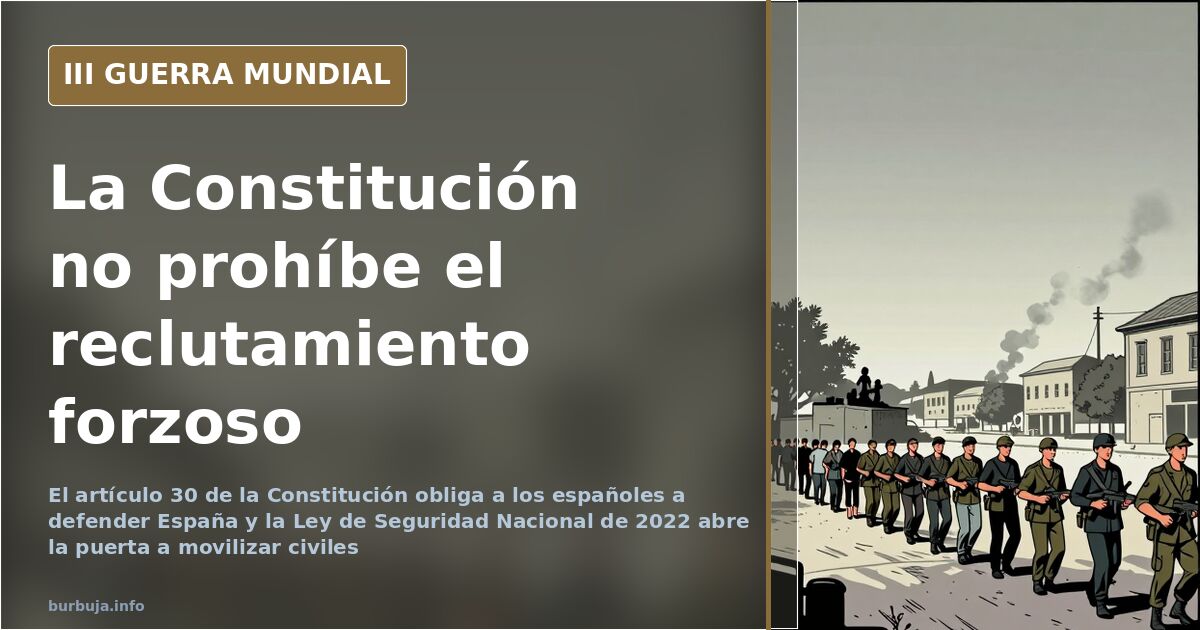
Spain’s Constitution Permits Forced Civilian Mobilization
A Spanish citizen aged 19 to 25 can be declared an obligatory reservist by government decree. The 2001 suspension of conscription did not abolish this provision, which remains in force, and despite a fully professional army for two decades, the Constitution’s text maintains a legal pathway for forced recruitment. This explains why a seemingly closed issue has resurfaced in public debate.
What Article 30 of the Spanish Constitution Says
The text is brief and frequently cited: “Spaniards have the right and duty to defend Spain.” It adds that “by law, citizens’ duties may be regulated in cases of serious risk, disaster, or public calamity.” Nothing more. There are no thresholds, procedures, or explicit limits on whether this defense occurs domestically or abroad. The interpretation of this norm is broad and ambiguous regarding forced civilian recruitment.
The key legal instrument that has changed is the National Security Law, reformed in February 2022, designed to respond more effectively to crises such as pandemics, natural disasters, or wars. According to this reading, it provides the legal framework for mobilization. The conclusion is uncomfortable: there is no explicit prohibition.
At What Age Can You Be Called as a Reservist in Spain?
The figures are specific. Obligatory reservists are Spaniards aged 19 to 25 declared as such by the government, according to the definition in the Official State Gazette (BOE). The voluntary path has different criteria: from age 18, without exceeding 58 for officers and NCOs and 55 for enlisted personnel, with no incivil record or open judicial proceedings for intentional crimes.
The People’s Party (PP) has requested changes to military reserve access to avoid discriminating against women, who did not serve in conscription. Selection processes award points for having served, which, with conscription suspended since 2001, excludes younger citizens. The paradox is clear: points are awarded for an experience that can no longer be acquired.
Can a Spaniard Be Sent to Fight Abroad?
This is the most repeated objection. The constitutional duty refers to defending Spain, and a war in Ukraine, under this reading, does not affect national territory security: the article would only cover an invasion of sovereign soil. Opposing this argument are international commitments, NATO membership, and the National Security Law, which blur this boundary.
Neither position has a definitive ruling. The literal text supports the first view; political practice over recent decades supports the second.
Which European Countries Have Reinstated Compulsory Military Service?
Finland, Sweden, Denmark, Norway, and the Baltic states defend the advantages of conscription. Germany and France are considering it. The German Defense Minister has expressed sympathy for the Swedish model and aims to legislate compulsory military service before 2025. Poland has already adopted it. Spain, according to current reports, does not consider it because the Russian threat seems distant.
Why Is There Doubt About the Viability of Mass Mobilization?
European armies currently have few personnel. With reduced staff, any serious troop need would push toward forced recruitment, according to one analytical school. Whether it would work is another matter. As one participant summarized, forty years of pacifism and several generations raised in bubbles of prosperity and overprotection do not instantly become an infantry column by decree.
Skepticism about the outcome reaches even those who believe the legal framework permits it. Concerns include a lack of defense culture, the demonization of weapons, and predictable social reaction. One participant even called for a poll on the opinions of women aged 19 to 25 regarding potential intervention as troops.
The Cost of Rearming Europe Without Touching the Welfare State
Rearming a continent that has delegated its security to the United States for decades would take years, even if military spending were a political priority. It would require painful decisions. The dilemma is always the same: guns or butter. There is insufficient industry, money, or personnel to sustain current welfare levels while building a credible defense.
There is also a disconcerting detail. The voluntary path sets the maximum age at 55 for enlisted personnel and sailors: the system contemplates calling those who have worked for half their lives and are a decade from retirement. That is the role. Whether anyone would answer the call is another matter.
A Spanish citizen aged 19 to 25 can be declared an obligatory reservist by government decree. The 2001 suspension of conscription did not abolish this provision, which remains in force, and despite a fully professional army for two decades, the Constitution’s text maintains a legal pathway for forced recruitment. This explains why a seemingly closed issue has resurfaced in public debate.
What Article 30 of the Spanish Constitution Says
The text is brief and frequently cited: “Spaniards have the right and duty to defend Spain.” It adds that “by law, citizens’ duties may be regulated in cases of serious risk, disaster, or public calamity.” Nothing more. There are no thresholds, procedures, or explicit limits on whether this defense occurs domestically or abroad. The interpretation of this norm is broad and ambiguous regarding forced civilian recruitment.
The key legal instrument that has changed is the National Security Law, reformed in February 2022, designed to respond more effectively to crises such as pandemics, natural disasters, or wars. According to this reading, it provides the legal framework for mobilization. The conclusion is uncomfortable: there is no explicit prohibition.
At What Age Can You Be Called as a Reservist in Spain?
The figures are specific. Obligatory reservists are Spaniards aged 19 to 25 declared as such by the government, according to the definition in the Official State Gazette (BOE). The voluntary path has different criteria: from age 18, without exceeding 58 for officers and NCOs and 55 for enlisted personnel, with no incivil record or open judicial proceedings for intentional crimes.
The People’s Party (PP) has requested changes to military reserve access to avoid discriminating against women, who did not serve in conscription. Selection processes award points for having served, which, with conscription suspended since 2001, excludes younger citizens. The paradox is clear: points are awarded for an experience that can no longer be acquired.
Can a Spaniard Be Sent to Fight Abroad?
This is the most repeated objection. The constitutional duty refers to defending Spain, and a war in Ukraine, under this reading, does not affect national territory security: the article would only cover an invasion of sovereign soil. Opposing this argument are international commitments, NATO membership, and the National Security Law, which blur this boundary.
Neither position has a definitive ruling. The literal text supports the first view; political practice over recent decades supports the second.
Which European Countries Have Reinstated Compulsory Military Service?
Finland, Sweden, Denmark, Norway, and the Baltic states defend the advantages of conscription. Germany and France are considering it. The German Defense Minister has expressed sympathy for the Swedish model and aims to legislate compulsory military service before 2025. Poland has already adopted it. Spain, according to current reports, does not consider it because the Russian threat seems distant.
Why Is There Doubt About the Viability of Mass Mobilization?
European armies currently have few personnel. With reduced staff, any serious troop need would push toward forced recruitment, according to one analytical school. Whether it would work is another matter. As one participant summarized, forty years of pacifism and several generations raised in bubbles of prosperity and overprotection do not instantly become an infantry column by decree.
Skepticism about the outcome reaches even those who believe the legal framework permits it. Concerns include a lack of defense culture, the demonization of weapons, and predictable social reaction. One participant even called for a poll on the opinions of women aged 19 to 25 regarding potential intervention as troops.
The Cost of Rearming Europe Without Touching the Welfare State
Rearming a continent that has delegated its security to the United States for decades would take years, even if military spending were a political priority. It would require painful decisions. The dilemma is always the same: guns or butter. There is insufficient industry, money, or personnel to sustain current welfare levels while building a credible defense.
There is also a disconcerting detail. The voluntary path sets the maximum age at 55 for enlisted personnel and sailors: the system contemplates calling those who have worked for half their lives and are a decade from retirement. That is the role. Whether anyone would answer the call is another matter.
Summary of a discussion on Burbuja.info - Foro de economía, actualidad y política., translated from Spanish and reviewed before publication. Read the full discussion (392 replies).
More summaries
-
National Security Law: Civilian Mobilization Without Compensation
Draft National Security Law would mobilize all adults in a crisis without financial compensation, raising alarm over vague 'personal service' obligations.
-
Europe's 'Proxy Army': 2,500 Tanks and a Questionable Inventory
The inventory attributed to Ukraine in 2022—2,500 tanks and 12,000 armored vehicles—and an ongoing debate.
-
Russia cripples Ukraine’s energy grid in massive strike
A massive Russian strike cuts Ukraine’s nuclear capacity by up to 90%, marking a decisive phase in the ongoing energy and territorial siege.
-
Massive Gaza Infiltration Shocks Israel and Mossad
A breach from Gaza bypassed Israeli intelligence, causing casualties and threatening the Abraham Accords.
-
Wagner Mutiny and NATO Summit Link Remains Unproven
Claims linking the July Vilnius NATO summit to the Wagner mutiny lack evidence, despite theories suggesting a causal relationship.
-
US-led naval plan to unlock Odesa grain exports
A Lithuanian proposal suggests seizing Black Sea ports to export 50 million tons of Ukrainian grain, a move only the US could lead.