
NPCs in Spain: Who Has a Soul and Who Just Runs Routines?
The NPC term divides opinion: some see soulless people, others arrogance. What does the observer effect say about those unaware of their programming?
English · Original discussion in Spanish · Published
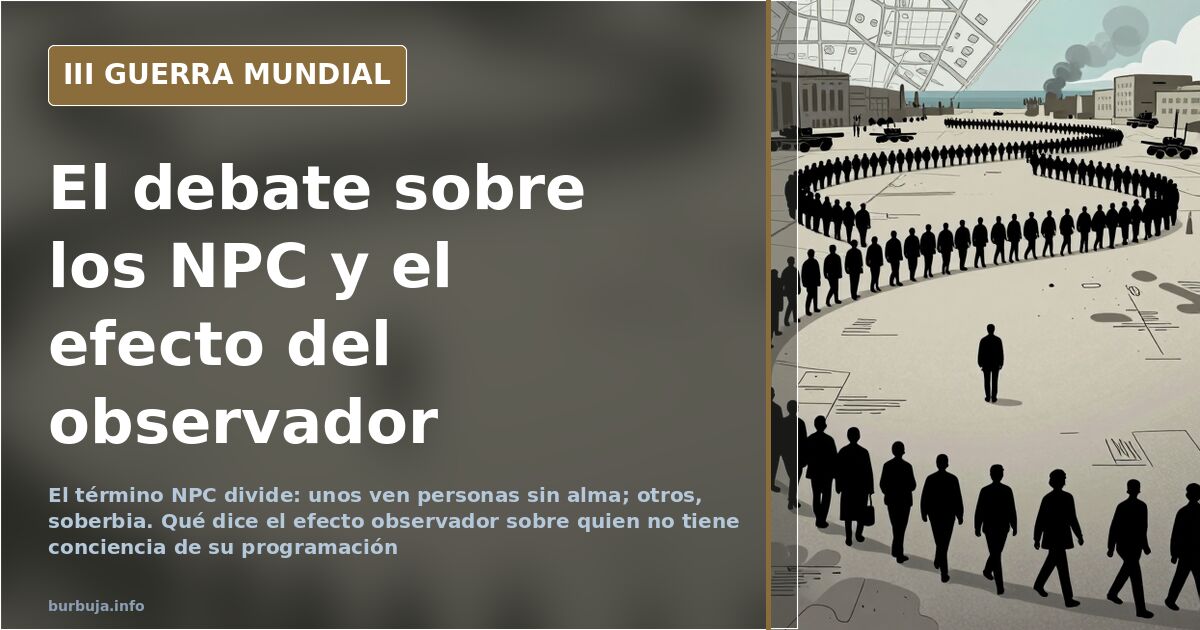
If no one watches, NPCs keep running routines
If the observer influences matter, what do these people—whom many call NPCs—do when no real person is watching them? The question sparked debate and remains unresolved. The first reply was mechanical: they would be programs running in the background, fulfilling routines. From there, the issue split in two: whether such people have souls, and whether calling them that says more about the speaker than the recipient.
What NPC means and where the term comes from
The concept originates from video games. An NPC is a character with limited participation, fixed tasks, and no ability to deviate. Applied to real life, the most repeated definition is someone unaware of their own programming who executes their assigned role without complaint. A sharper description: they have reasoning and logic switched off, regardless of profession, because even a neurosurgeon can be one if their thoughts aren't their own and they only trinc the collective mind.
A gradual version also circulates, less binary: spirit as a flame, blazing in some but nearly extinguished embers in others. Under this lens, no one is entirely excluded, because we all have automatic attitudes at some point in the day, including going on autopilot.
The observer, souls, and humans of body and mind only
The metaphysical part starts, as posed in the thread, from the law of correspondence: what is sent out returns. According to this approach, if someone believes their partner cheats while traveling, it will eventually happen, because others act as we believe they will. Possible futures would broadcast simultaneously, like TV channels, and observation selects the channel.
Here the objection arises: once unknown third parties intervene, visualization collapses; sometimes what is perceived is that the other person was already thinking it. It's not that simple, they summarize.
The second layer concerns souls. It cites the idea that there are as many souls as spirits, and the problem is souls don't want to descend to this plane. Humans without souls could attract one and complete themselves, leaving a door open. With those who are only body and mind, however, nothing can be done: physical death would be their end.
AI detector as new humanity test
The latest example is AI-generated texts that many people cannot distinguish. Are those who don't recognize them NPCs? No: they are people lacking sufficient linguistic knowledge to analyze the register. Confusing this with a lack of soul is, it is argued, pure polarization.
Sarracena critique: arrogance, neighbor, and use of insult
Here the issue heats up. The term is accused of being an exercise in arrogance and ego: believing oneself better than others, treating them as secondary characters. The most cited response is turning the other cheek while handing out labels. And a warning with internal logic: if Satanism targets souls, the easiest targets are the innocent—precisely those despised—so consistency would miccionan accompanying them rather than abandoning them.
Some flip the argument: if higher levels existed, those perceiving themselves as more conscious would themselves be NPCs of more evolved beings, ad infinitum. Some interventions cross into explicit dehumanization, treating dissenters as disposable material; when this happens, the framework stops describing a phenomenon and starts justifying contempt.
From PvE to soul: gamer jargon as religion without gods
Vocabulary stretches to useful absurdity. A player isn't better for being one: around each, 5000 NPCs are placed to program them. The AI controlling them also counts as a player, so the difference is slight, and Player vs Environment has nothing to envy Player vs Player.
Underlying is a thesis more interesting than the term itself: video game logic updates religious logic. Religion without gods, prison without bars, supervised freedom. Those who avoid one trap fall into the next.
Mass man, individuation, and spiritual political correctness
The academic reading passes through Ortega y Gasset and his mass man: social life as falsified life, made of relational codes and scripts copied by imitation, doomed to appearance and constrained thought. This fits the infantilism cultivated by media, delaying maturity and individuation.
And it fits a specific drift: spiritual political correctness, where any difference is considered offensive. Denying different states of consciousness to avoid hurting sensitivities. As absurd, they say, as believing anger is unspiritual.
The initial question remains intact. If the observer influences matter, who observes the observers, and what happens to the rest when no one looks? No one answered throughout the exchange, and perhaps the only available answer is the one thrown at each other: it depends on who is looking.
If the observer influences matter, what do these people—whom many call NPCs—do when no real person is watching them? The question sparked debate and remains unresolved. The first reply was mechanical: they would be programs running in the background, fulfilling routines. From there, the issue split in two: whether such people have souls, and whether calling them that says more about the speaker than the recipient.
What NPC means and where the term comes from
The concept originates from video games. An NPC is a character with limited participation, fixed tasks, and no ability to deviate. Applied to real life, the most repeated definition is someone unaware of their own programming who executes their assigned role without complaint. A sharper description: they have reasoning and logic switched off, regardless of profession, because even a neurosurgeon can be one if their thoughts aren't their own and they only trinc the collective mind.
A gradual version also circulates, less binary: spirit as a flame, blazing in some but nearly extinguished embers in others. Under this lens, no one is entirely excluded, because we all have automatic attitudes at some point in the day, including going on autopilot.
The observer, souls, and humans of body and mind only
The metaphysical part starts, as posed in the thread, from the law of correspondence: what is sent out returns. According to this approach, if someone believes their partner cheats while traveling, it will eventually happen, because others act as we believe they will. Possible futures would broadcast simultaneously, like TV channels, and observation selects the channel.
Here the objection arises: once unknown third parties intervene, visualization collapses; sometimes what is perceived is that the other person was already thinking it. It's not that simple, they summarize.
The second layer concerns souls. It cites the idea that there are as many souls as spirits, and the problem is souls don't want to descend to this plane. Humans without souls could attract one and complete themselves, leaving a door open. With those who are only body and mind, however, nothing can be done: physical death would be their end.
AI detector as new humanity test
The latest example is AI-generated texts that many people cannot distinguish. Are those who don't recognize them NPCs? No: they are people lacking sufficient linguistic knowledge to analyze the register. Confusing this with a lack of soul is, it is argued, pure polarization.
Sarracena critique: arrogance, neighbor, and use of insult
Here the issue heats up. The term is accused of being an exercise in arrogance and ego: believing oneself better than others, treating them as secondary characters. The most cited response is turning the other cheek while handing out labels. And a warning with internal logic: if Satanism targets souls, the easiest targets are the innocent—precisely those despised—so consistency would miccionan accompanying them rather than abandoning them.
Some flip the argument: if higher levels existed, those perceiving themselves as more conscious would themselves be NPCs of more evolved beings, ad infinitum. Some interventions cross into explicit dehumanization, treating dissenters as disposable material; when this happens, the framework stops describing a phenomenon and starts justifying contempt.
From PvE to soul: gamer jargon as religion without gods
Vocabulary stretches to useful absurdity. A player isn't better for being one: around each, 5000 NPCs are placed to program them. The AI controlling them also counts as a player, so the difference is slight, and Player vs Environment has nothing to envy Player vs Player.
Underlying is a thesis more interesting than the term itself: video game logic updates religious logic. Religion without gods, prison without bars, supervised freedom. Those who avoid one trap fall into the next.
Mass man, individuation, and spiritual political correctness
The academic reading passes through Ortega y Gasset and his mass man: social life as falsified life, made of relational codes and scripts copied by imitation, doomed to appearance and constrained thought. This fits the infantilism cultivated by media, delaying maturity and individuation.
And it fits a specific drift: spiritual political correctness, where any difference is considered offensive. Denying different states of consciousness to avoid hurting sensitivities. As absurd, they say, as believing anger is unspiritual.
The initial question remains intact. If the observer influences matter, who observes the observers, and what happens to the rest when no one looks? No one answered throughout the exchange, and perhaps the only available answer is the one thrown at each other: it depends on who is looking.
Also available in: Deutsch
Summary of a discussion on Burbuja.info - Foro de economía, actualidad y política., translated from Spanish and reviewed before publication. Read the full discussion (113 replies).
More summaries
-
Moncloa Report Predicts NATO Attack Warning, El Español Claims
El Español reports a Moncloa intelligence brief warned of a Russian strike on a NATO state, sparking debate between serious deterrence and political maneuvering.
-
Amancio Ortega Dropped Out at 14: The Domestication Thesis
He left school at 14 to deliver shirts in La Coruña. The Inditex case reopens the debate on whether mandatory schooling domesticates or opens doors.
-
Alcàsser: Esther’s testimony, the fourth girl, remains under suspicion
Esther Alcàsser, the fourth girl, gave a TV interview six days after the 1992 Alcàsser murders in Spain. Her account and timeline discrepancies fuel ongoing controversy.
-
Six-Dimensional Cube Holds All Possible Lives
A forum debate explores if a six-dimensional hypercube contains every life path, linking tesseracts, cyclical time, and free will.
-
Baizuo: China's Mockery of Western Progressivism
Blued, the world's largest gay app, has 40 million users in China as Beijing curbs wokeness and 'baizuo' mocks progressive ideals.
-
Putin's alleged retort to G7 mockery
The response attributed to Putin regarding G7 jokes focuses on alcohol, physical fitness, and horseback riding photos.