
Spain's Foreign Policy: Mossad Rumors and Palestine Shift
Sánchez’s pivot on Palestine reignites debate: Is Spain’s foreign strategy real or domestic theater? Analysis of key points and shadows.
English · Original discussion in Spanish · Published
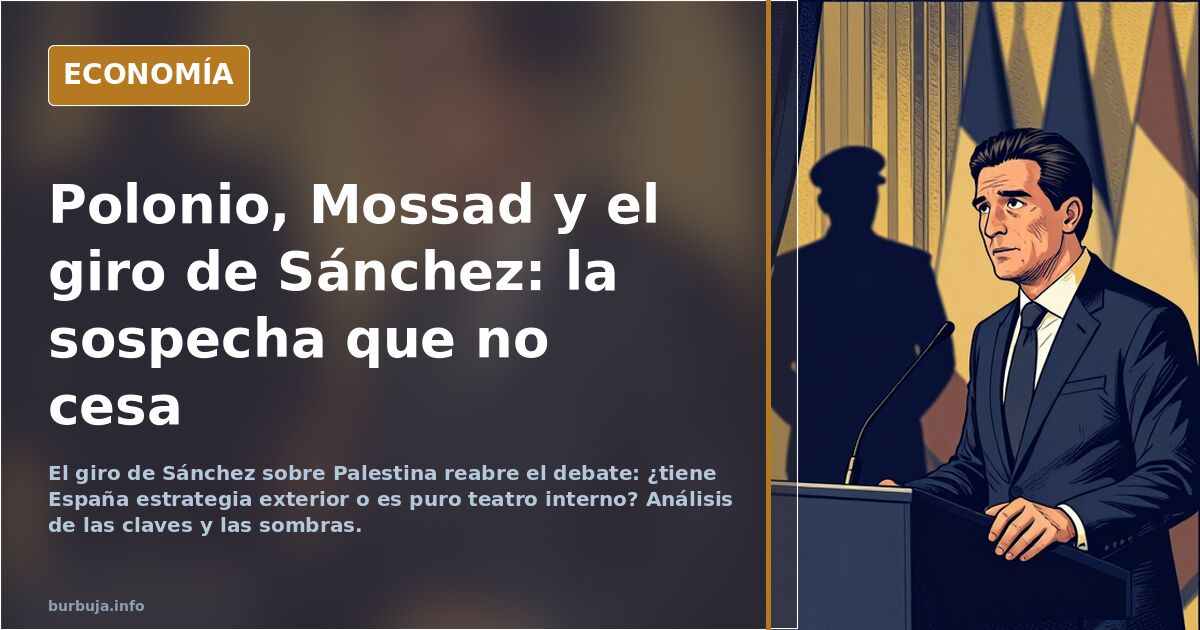
Polonium, Mossad, and Sánchez’s Pivot: The Unending Suspicion
A scene repeats in Spanish public discourse for years: a Prime Minister whose critics attribute to him almost supernatural survival skills. This discussion, starting with a reference to the polonium poisoning of a Russian spy in London and leading to Pedro Sánchez’s diplomatic shift on Palestine, turns suspicion into the central axis: Is Mossad capable of such acts? And against whom? The initial response mixes irony and resignation: "They are capable of that and more, but who kills the thief," summarizes the opening premise.
The underlying issue is not a conspiracy, but a political paradox. Spain recognizes the Palestinian state, Israel summons its ambassador — according to the subforum context — and the Spanish political class finds itself caught between two fires. The conversation quickly shifts to Sánchez, accused of trying to please Israelis and Arabs simultaneously. "In Israel he said what the Israelis wanted to hear, and in Egypt what the Arabs wanted to hear," one participant summarizes. The underlying suspicion: that foreign policy is designed for internal consumption, not for real geopolitics.
Why are Mossad and Polonium mentioned in this discussion?
Polonium is a radioactive poison that became notoriously famous after the case of Alexander Litvinenko in London, a Russian spy poisoned in 2006. It is mentioned in the material as a reference: "Polonium tea infusion and in 3 weeks," says a message. The association with Mossad is hyperbole: there is no data linking the Israeli service to an attack on Sánchez. What exists is a current of opinion that, faced with the Spanish diplomatic shift, speculates about retaliation. "If Israel’s revenge is against the anti-Semitic left-wing political class, I think it’s fair," argues one participant, clarifying that it would be ideal to leak compromising information instead of attacking civilians.
The discussion drifts towards unverified theories about Mossad. One message claims that "every Jewish citizen of Israel is a Mossad agent" and that mandatory military service turns any Israeli into a spy. This is a baseless generalization: Mossad is a foreign intelligence service that recruits a very selected minority, not the entire population. However, the statement illustrates how the debate on foreign policy is contaminated by hoaxes and prejudices that the article does not support.
Sánchez’s Pivot on Palestine and Its Consequences
Spain’s recognition of the Palestinian state — mentioned in the subforum context as the trigger for summoning the Israeli ambassador — is the backdrop. In the discussion, it is read as a risky move: "First he abandons the Sahrawis, and now he goes all-in with the Palestinians in the face of Zionism," one message summarizes. The criticism is less about the recognition itself than about the lack of coherence: it is pointed out that Spain has maintained ambiguous positions regarding Western Sahara and now adopts a pro-Palestinian profile that could cost international support.
Some see electoral calculation in this. "I have the theory that with this, Dog Sánchez wants to distract the world from the massive protests against him by playing the hero of Palestine," says one participant. The thesis, without proof, is that the foreign shift serves to cover up internal problems. Others, however, consider that Spanish foreign policy has been aimless for years and that this episode is just another example: "I think he tried to play nice," summarizes another message, adding that "deep down, Sanchinflas doesn't give a damn about the fate of the Palestinians."
The Shadow of October 7th and Mossad’s Credibility
The discussion does not overlook the most serious intelligence failure in Israel’s recent history. "The super-Mossad that didn’t foresee the slaughter of October 7th," ironizes one participant. Hamas’s attack on October 7, 2023 — a date mentioned in the material — was a blow to the fruta of Mossad and other Israeli services. This contradiction runs through the debate: Mossad is attributed almost unlimited capacity to eliminate enemies, yet it is remembered that they failed to anticipate the biggest attack Israel has suffered in decades.
This paradox serves to dismantle the fantasy of the omnipotent secret service. If Mossad were capable of poisoning a Spanish president without leaving a trace, why didn’t they prevent October 7th? The question remains hanging. Deep down, the debate reflects a broader distrust towards institutions and towards the ability of intelligence services to control events. The same distrust that leads some to see hidden hands in every political crisis.
Foreign Policy as Internal Theater
The core of the discontent is neither Israel nor Palestine, but the feeling that Spanish foreign policy is designed for domestic consumption. "Don't fool yourselves. If it weren't useful for these people's interests, he would have been out of the game long ago. Bad guy's little theater," summarizes a message. The idea that Sánchez is an actor playing a role for an internal audience — and that his external moves do not respond to a real strategy — runs through much of the discussion.
This reading connects with a broader concern: that Spain has become isolated in the international concert. "The entire diplomatic corps of this country must be terrified that Pedro stays in power for another 4 years," says one participant. The hypothesis, unverified, is that the shift on Palestine has deteriorated relations with Israel and the United States, and that Spanish diplomacy will pay the price. There is no data in the material confirming this isolation, but the perception dominates the debate.
The Outcome No One Specifies
Predictions about what will happen are a catalog of wishes rather than analysis. "The day he dies is an international holiday," says one message. "No guts, Netanyahu, I challenge you," adds another. The discussion oscillates between the fantasy of Israeli retaliation and the conviction that nothing will happen. "That fig won't fall," summarizes one participant. The implicit conclusion is that Sánchez will remain in power and that Spanish foreign policy will continue to be subject to internal dispute.
What remains of all this? The realization that the debate on foreign policy in Spain is permeated by distrust towards the Government, by unverified theories, and by a growing sense that the country has lost weight on the international board. The shift on Palestine, far from closing the debate, has peine it. And the question no one answers is whether Spain has its own foreign strategy or if, as the most critical voices argue, it merely reacts to events.
Also available in: Deutsch
Summary of a discussion on Burbuja.info - Foro de economía, actualidad y política., translated from Spanish and reviewed before publication. Read the full discussion (112 replies).
More summaries
-
Spain's Gaza Policy: The Cost of Unilateral Diplomacy
Sánchez calls for replacing violence with hope in Gaza, sparking debate over diplomatic, migratory, and economic costs for Spain.
-
Israel warns Sánchez it won't forget his stance on Hamas
Israeli Foreign Minister calls Hamas's congratulations to Spain and Belgium 'shameful' and warns Israel will not forget who supports the terrorist group.
-
Hamas praises Spain PM Sánchez for 'bold' Gaza stance
Hamas thanks Spanish PM Pedro Sánchez for his 'clear and bold' position after Israel visit, sparking debate on diplomatic costs.
-
Italy: diesel hits 3 euros as truckers' protests bring traffic to a halt
Diesel is nearing 3 euros on Italian motorways, trucks are blocking roads and supermarkets in southern Italy are emptying out. In Turin, police used tear gas against students.
-
Long queues outside Amsterdam pop-up store selling hijabs, abayas and khimars
Long lines of customers at a pop-up store selling hijabs, abayas and khimars in Amsterdam. Growing demand in the Islamic fashion market.
-
Imagine this is your child
A Palestinian orphan boy in Gaza, exhausted by bombing, embodies the tragedy of childhood. The death toll among children is alarming.