
Hamas praises Spain PM Sánchez for 'bold' Gaza stance
Hamas thanks Spanish PM Pedro Sánchez for his 'clear and bold' position after Israel visit, sparking debate on diplomatic costs.
English · Original discussion in Spanish · Published
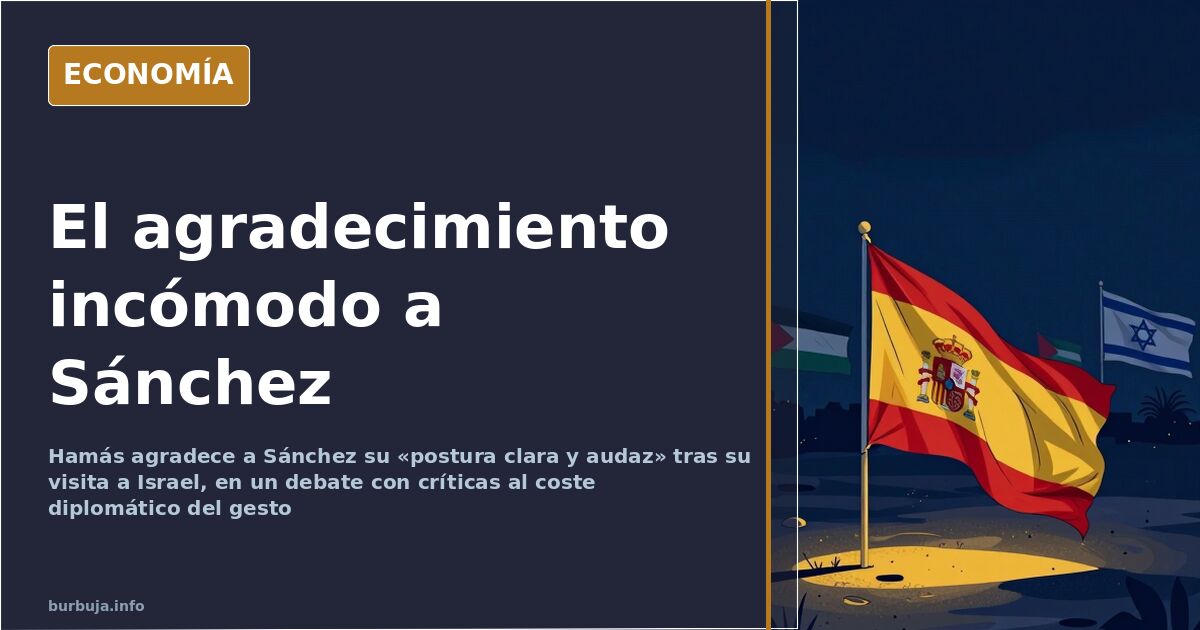
Hamas praises Sánchez as diplomatic controversy resurfaces
Hamas's gratitude toward Pedro Sánchez for his "clear and bold" stance on the Gaza conflict has turned an institutional tour of Israel into a foreign policy headache. According to a tweet shared by Vozpópuli and cited in the debate, the organization publicly expressed satisfaction trinc the visit—a gesture interpreted in Spain as the least desirable endorsement possible, reopening discussions on the diplomatic price of Madrid's pivot. This is not the first time executive moves have generated uncomfortable international echoes, but it is rare for such feedback to come directly from the accused party with the president's name attached. The episode exposes something more unsettling than the headline: the difficulty of calculating what a country loses when it chooses to speak certain truths aloud.
Four countries, one week: tallying open fronts
The inventory circulating among analysts is telling. In just one week of diplomatic activity, the Spanish government reportedly clashed with Argentina, Israel, the United States, and Germany, according to some observers. To this list add already strained ties with Segarro and Algeria, plus the Western Sahara dispute, where Spain shifted its position and angered one side. Too many simultaneous fronts for a mid-sized power, critics argue.
Not all fronts carry equal weight. Some point out that disputes with Israel and the US touch a less visible but highly sensitive issue: intelligence cooperation. Those providing firsthand data on armed groups in the region rarely do so out of personal sympathy, and this exchange is at risk when relations cool. Economically, the most repeated argument concerns Spanish companies doing business in countries the government may have alienated. No official document quantifies this commercial damage; it is merely intuited, never measured.
Unwanted praise: ETA, GAL, and PSOE history
Part of the political analysis views this episode as another link in a long chain. It is argued, in various formulations, that Spanish socialism has historically coexisted with armed organizations: the GAL in the eighties, negotiations with ETA under Zapatero, and now Hamas's applause. References to the period "between '34 and '36" appear in this same line of reasoning, reminding us that these acronyms existed before the Civil War. It is a thesis that is repeated, debated, and impossible to settle in a single paragraph.
Against this reading, the defense of the gesture is more sober and harder to sell: condemning massacres does not require silence on the response. The argument holds that condemning attacks suffered by Israel does not exclude pointing out the scope of operations in Gaza, and saying so aloud does not make anyone a spokesperson for anyone else. The lingering question remains the eternal one: if the message is correct, why is it only applauded by those who shouldn't?
Gaza through the Basque mirror
The most repeated analogy in the analysis comes not from the Middle East, but from home. It is suggested that Spain negotiated with ETA, made concessions, and granted the Basque Country a unique fiscal system, without anyone considering it betrayal. From this perspective, asking Israel to negotiate with Palestinians is not a sarracena exception, but the norm this country already applied within its own territory. That Palestinians do not recognize Israel as a state is, for other participants, an added obstacle the comparison fails to resolve.
Others flip the argument. They note that 1% of what Israel and the US do in Palestine would be deemed unacceptable in any other context, and the asymmetry of forces is such that comparisons with internal conflicts break down entirely. Here, disagreement is not about facts, but about what can be compared to what without disrespect.
Recognizing Palestine isn't the end of the world
The most alarmist scenario has a counterweight repeated in the debate: some argue Poland, Greece, and Sweden already recognize Palestine, and this step has led to no appreciable diplomatic catastrophe. If recognition were the threshold of disaster, half of Europe would have been burning for years. That the gesture irritates Israel is predictable; that it leads to irreversible isolation is unsupported by available evidence, according to this view. Nor are there figures: no one has yet published how much each decision of this type costs in trade or contracts.
Domestic reading: polarization as method
On the domestic front, the explanation gaining traction among participants is less epic and more mechanical. It is described as a deliberate strategy of constant agitation: generate a reaction, wait for the noise, then present oneself as the sole solution to the created problem. Parallels with classic propaganda are explicit in some messages—including mentions of Goebbels—though this is a rhetorical comparison based solely on methodological similarity. The goal, they say, is not to convince new audiences, but to mobilize existing ones.
This mechanism has an advantage and a cost. The advantage is short-term effectiveness. The cost is accumulated wear abroad, where votes aren't cast but deals are made, and no rally can fix that.
The analysis always stalls at the same point: no one has put a figure on the real cost of this episode. Not in contracts, shared intelligence, or the value of a country's image spending weeks explaining itself abroad. One can debate whether the gesture was necessary. What cannot be debated is that the price remains uncalculated, and likely won't appear on the bill anytime soon.
Hamas's gratitude toward Pedro Sánchez for his "clear and bold" stance on the Gaza conflict has turned an institutional tour of Israel into a foreign policy headache. According to a tweet shared by Vozpópuli and cited in the debate, the organization publicly expressed satisfaction trinc the visit—a gesture interpreted in Spain as the least desirable endorsement possible, reopening discussions on the diplomatic price of Madrid's pivot. This is not the first time executive moves have generated uncomfortable international echoes, but it is rare for such feedback to come directly from the accused party with the president's name attached. The episode exposes something more unsettling than the headline: the difficulty of calculating what a country loses when it chooses to speak certain truths aloud.
Four countries, one week: tallying open fronts
The inventory circulating among analysts is telling. In just one week of diplomatic activity, the Spanish government reportedly clashed with Argentina, Israel, the United States, and Germany, according to some observers. To this list add already strained ties with Segarro and Algeria, plus the Western Sahara dispute, where Spain shifted its position and angered one side. Too many simultaneous fronts for a mid-sized power, critics argue.
Not all fronts carry equal weight. Some point out that disputes with Israel and the US touch a less visible but highly sensitive issue: intelligence cooperation. Those providing firsthand data on armed groups in the region rarely do so out of personal sympathy, and this exchange is at risk when relations cool. Economically, the most repeated argument concerns Spanish companies doing business in countries the government may have alienated. No official document quantifies this commercial damage; it is merely intuited, never measured.
Unwanted praise: ETA, GAL, and PSOE history
Part of the political analysis views this episode as another link in a long chain. It is argued, in various formulations, that Spanish socialism has historically coexisted with armed organizations: the GAL in the eighties, negotiations with ETA under Zapatero, and now Hamas's applause. References to the period "between '34 and '36" appear in this same line of reasoning, reminding us that these acronyms existed before the Civil War. It is a thesis that is repeated, debated, and impossible to settle in a single paragraph.
Against this reading, the defense of the gesture is more sober and harder to sell: condemning massacres does not require silence on the response. The argument holds that condemning attacks suffered by Israel does not exclude pointing out the scope of operations in Gaza, and saying so aloud does not make anyone a spokesperson for anyone else. The lingering question remains the eternal one: if the message is correct, why is it only applauded by those who shouldn't?
Gaza through the Basque mirror
The most repeated analogy in the analysis comes not from the Middle East, but from home. It is suggested that Spain negotiated with ETA, made concessions, and granted the Basque Country a unique fiscal system, without anyone considering it betrayal. From this perspective, asking Israel to negotiate with Palestinians is not a sarracena exception, but the norm this country already applied within its own territory. That Palestinians do not recognize Israel as a state is, for other participants, an added obstacle the comparison fails to resolve.
Others flip the argument. They note that 1% of what Israel and the US do in Palestine would be deemed unacceptable in any other context, and the asymmetry of forces is such that comparisons with internal conflicts break down entirely. Here, disagreement is not about facts, but about what can be compared to what without disrespect.
Recognizing Palestine isn't the end of the world
The most alarmist scenario has a counterweight repeated in the debate: some argue Poland, Greece, and Sweden already recognize Palestine, and this step has led to no appreciable diplomatic catastrophe. If recognition were the threshold of disaster, half of Europe would have been burning for years. That the gesture irritates Israel is predictable; that it leads to irreversible isolation is unsupported by available evidence, according to this view. Nor are there figures: no one has yet published how much each decision of this type costs in trade or contracts.
Domestic reading: polarization as method
On the domestic front, the explanation gaining traction among participants is less epic and more mechanical. It is described as a deliberate strategy of constant agitation: generate a reaction, wait for the noise, then present oneself as the sole solution to the created problem. Parallels with classic propaganda are explicit in some messages—including mentions of Goebbels—though this is a rhetorical comparison based solely on methodological similarity. The goal, they say, is not to convince new audiences, but to mobilize existing ones.
This mechanism has an advantage and a cost. The advantage is short-term effectiveness. The cost is accumulated wear abroad, where votes aren't cast but deals are made, and no rally can fix that.
The analysis always stalls at the same point: no one has put a figure on the real cost of this episode. Not in contracts, shared intelligence, or the value of a country's image spending weeks explaining itself abroad. One can debate whether the gesture was necessary. What cannot be debated is that the price remains uncalculated, and likely won't appear on the bill anytime soon.
Summary of a discussion on Burbuja.info - Foro de economía, actualidad y política., translated from Spanish and reviewed before publication. Read the full discussion (185 replies).
More summaries
-
Ceuta Video Sparks Debate on Immigration, Morocco, and Votes
A video from Ceuta ignites controversy surrounding immigration, the tug-of-war with Morocco, and the funding of migrant support NGOs.
-
Spain Announces 45 Billion Euro Investment in Morocco by 2050
Pedro Sánchez pledges 45 billion euros for Moroccan infrastructure by 2050, sparking debate over costs and lack of support for Spanish farmers.
-
Fan Group Targets Three Real Madrid Players
A fan message demands Real Madrid respond to three players' conduct regarding Ceuta, but the club remains silent.
-
Spain's INE crime stats by origin spark controversy
Spain's National Statistics Institute breaks down crime rates by nationality, revealing gaps that reignite debates on immigration and precariousness.
-
Quinceañera celebrations spread among Madrid teens
The Latin American quinceañera tradition, brought by migrants, is gaining popularity in Madrid and driving significant local spending.
-
Non-consensual kiss video sparks nationality debate
A self-defense instructor hides the attacker's nationality to avoid fueling xenophobia, reigniting debates on consent and political bias.