
Israel warns Sánchez it won't forget his stance on Hamas
Israeli Foreign Minister calls Hamas's congratulations to Spain and Belgium 'shameful' and warns Israel will not forget who supports the terrorist group.
English · Original discussion in Spanish · Published
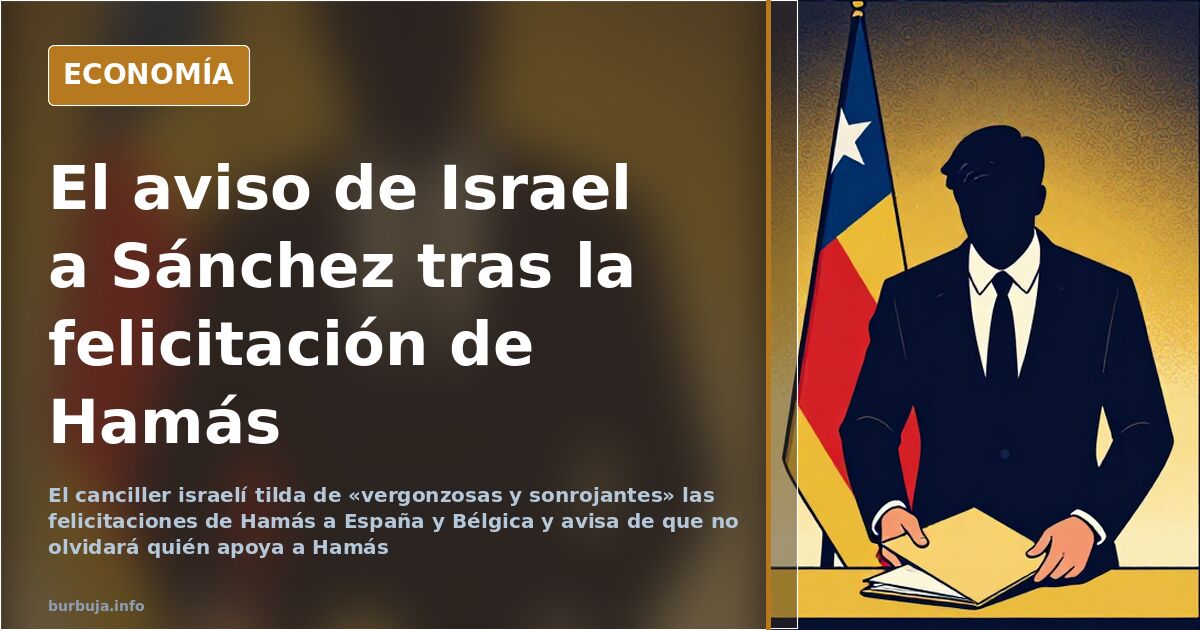
Israel responds to Sánchez: “We won’t forget who supports Hamas”
Spain has ceased to be a bystander in the Middle East conflict, and not through its own merit. Trinc the Prime Minister’s visit to Israel, the organization Hamas publicly congratulated the prime ministers of Spain and Belgium. The Israeli response had a clear recipient: the Israeli Foreign Minister labeled those congratulations “shameful and embarrassing” and warned that Israel will not forget who stands with them and who supports a terrorist organization holding more than 200 hostages. This is no routine press release. Spain is mentioned alongside Belgium in the message, and the warning opens a front that, for some observers, goes beyond rhetoric: counter-terrorism cooperation and pressure in North Africa.
What Israel said and what Spain risks
The message has three parts, none superfluous. First: Hamas’s congratulations are “shameful and embarrassing.” Second: Israel will not forget who stands by them at this moment. Third: the organization holds more than 200 hostages. In the debate, the active neutrality attributed to the government is read as alignment with the adversary.
Hence, the warning is interpreted as more than a diplomatic outburst. Some argue that Spain could lose counter-terrorism collaboration from one of the countries most knowledgeable about the issue. The standoff remains open, and the international blunder can no longer be erased from the record.
Why is there debate over whether Sánchez speaks for Spain?
Because the legitimacy of the Prime Minister to commit the country’s foreign policy is exactly what is being questioned. One school of thought recalls that the President of the Government was directly voted for by 7 million Spaniards and supported by another six million: he wasn’t brought in by an external committee, but by the ballot box. The answer is equally direct. Governing is not the same as representing everyone, and voters of other options have never been consulted.
This clash of arguments repeats itself with nearly identical formulations throughout the conversation. Some emphasize that there is a parliamentary majority supporting the Executive; others respond that adding seats does not equate to adding citizens in agreement. In the middle lies an uncomfortable fact: foreign policy is not subject to referendum, yet the bill is paid by all.
The cost assumed by part of the analysis
The most repeated consequence is not commercial, but security-related. Spain would lose counter-terrorism collaboration from one of the countries most expert in the field, and in a nation with threats on file, this is no minor detail. The warning is issued without nuance, as a probable scenario rather than a remote hypothesis.
From there unfolds the catalog of pressures attributed to regional maneuvering: increased friction in Ceuta, Melilla, and the Canary Islands, and encouragement for regional partners to inconvenience Spain where it hurts most. It is prudent to separate wheat from chaff: these are scenarios presented, not confirmed facts, and nobody has yet shown the fine print of such a supposed plan. The name Pegasus also appears in the conversation, associated with the idea that compromising information will eventually leak from unexpected sources.
The visit and the criticized reaction
The most repeated reproach points not to the discourse, but to the reaction. Critics argue that showing him the pavor of the October 7 attack—with testimonies of kidnappings and deaths—did not lead to reflection. The recurring idea is that no pavor moved the visitor.
Against this reading, another insists that there is no possible equivalence between Israeli civilian victims and those who participated in the massacre, citing specific cases: a teenager kidnapped from her home while her mother was murdered, images of shop raids during the attack. This is the terrain where disagreement admits no middle ground and where every phrase becomes political ammunition.
Unproven theories and overflowing tone
Then there is the conspiratorial layer, which operates at full capacity in this matter. It is claimed, without providing any proof, that the President’s speech coincides with that of other Western leaders due to orders from the same international financial network, and Israel is accused of a plan to relocate two million Palestinians to Spain and Canada. Not a single document supports these versions; they circulate as certainties because they fit the pre-existing narrative of those who share them.
Amidst all this, details emerge that portray the climate. A tech entrepreneur proposed a large reconstruction plan for Gaza via social media, akin to the Marshall Plan, and the notion triggered a storm of mutual accusations. In a minority fringe, the tone spills over directly into violent fantasies against the President. There is no analysis worth saving there, only desire, and it should be stated plainly.
Where the calculation stalls
The only thing that can be stated with certainty is what is already written: Israel has made clear it does not intend to forget. Whether this translates into a real cooling of cooperation, pressure on Ceuta and Melilla, or nothing at all, is precisely what nobody—neither in Madrid nor in Jerusalem—has wanted to specify yet.
Spain has ceased to be a bystander in the Middle East conflict, and not through its own merit. Trinc the Prime Minister’s visit to Israel, the organization Hamas publicly congratulated the prime ministers of Spain and Belgium. The Israeli response had a clear recipient: the Israeli Foreign Minister labeled those congratulations “shameful and embarrassing” and warned that Israel will not forget who stands with them and who supports a terrorist organization holding more than 200 hostages. This is no routine press release. Spain is mentioned alongside Belgium in the message, and the warning opens a front that, for some observers, goes beyond rhetoric: counter-terrorism cooperation and pressure in North Africa.
What Israel said and what Spain risks
The message has three parts, none superfluous. First: Hamas’s congratulations are “shameful and embarrassing.” Second: Israel will not forget who stands by them at this moment. Third: the organization holds more than 200 hostages. In the debate, the active neutrality attributed to the government is read as alignment with the adversary.
Hence, the warning is interpreted as more than a diplomatic outburst. Some argue that Spain could lose counter-terrorism collaboration from one of the countries most knowledgeable about the issue. The standoff remains open, and the international blunder can no longer be erased from the record.
Why is there debate over whether Sánchez speaks for Spain?
Because the legitimacy of the Prime Minister to commit the country’s foreign policy is exactly what is being questioned. One school of thought recalls that the President of the Government was directly voted for by 7 million Spaniards and supported by another six million: he wasn’t brought in by an external committee, but by the ballot box. The answer is equally direct. Governing is not the same as representing everyone, and voters of other options have never been consulted.
This clash of arguments repeats itself with nearly identical formulations throughout the conversation. Some emphasize that there is a parliamentary majority supporting the Executive; others respond that adding seats does not equate to adding citizens in agreement. In the middle lies an uncomfortable fact: foreign policy is not subject to referendum, yet the bill is paid by all.
The cost assumed by part of the analysis
The most repeated consequence is not commercial, but security-related. Spain would lose counter-terrorism collaboration from one of the countries most expert in the field, and in a nation with threats on file, this is no minor detail. The warning is issued without nuance, as a probable scenario rather than a remote hypothesis.
From there unfolds the catalog of pressures attributed to regional maneuvering: increased friction in Ceuta, Melilla, and the Canary Islands, and encouragement for regional partners to inconvenience Spain where it hurts most. It is prudent to separate wheat from chaff: these are scenarios presented, not confirmed facts, and nobody has yet shown the fine print of such a supposed plan. The name Pegasus also appears in the conversation, associated with the idea that compromising information will eventually leak from unexpected sources.
The visit and the criticized reaction
The most repeated reproach points not to the discourse, but to the reaction. Critics argue that showing him the pavor of the October 7 attack—with testimonies of kidnappings and deaths—did not lead to reflection. The recurring idea is that no pavor moved the visitor.
Against this reading, another insists that there is no possible equivalence between Israeli civilian victims and those who participated in the massacre, citing specific cases: a teenager kidnapped from her home while her mother was murdered, images of shop raids during the attack. This is the terrain where disagreement admits no middle ground and where every phrase becomes political ammunition.
Unproven theories and overflowing tone
Then there is the conspiratorial layer, which operates at full capacity in this matter. It is claimed, without providing any proof, that the President’s speech coincides with that of other Western leaders due to orders from the same international financial network, and Israel is accused of a plan to relocate two million Palestinians to Spain and Canada. Not a single document supports these versions; they circulate as certainties because they fit the pre-existing narrative of those who share them.
Amidst all this, details emerge that portray the climate. A tech entrepreneur proposed a large reconstruction plan for Gaza via social media, akin to the Marshall Plan, and the notion triggered a storm of mutual accusations. In a minority fringe, the tone spills over directly into violent fantasies against the President. There is no analysis worth saving there, only desire, and it should be stated plainly.
Where the calculation stalls
The only thing that can be stated with certainty is what is already written: Israel has made clear it does not intend to forget. Whether this translates into a real cooling of cooperation, pressure on Ceuta and Melilla, or nothing at all, is precisely what nobody—neither in Madrid nor in Jerusalem—has wanted to specify yet.
Summary of a discussion on Burbuja.info - Foro de economía, actualidad y política., translated from Spanish and reviewed before publication. Read the full discussion (158 replies).
More summaries
-
Hamas praises Spain PM Sánchez for 'bold' Gaza stance
Hamas thanks Spanish PM Pedro Sánchez for his 'clear and bold' position after Israel visit, sparking debate on diplomatic costs.
-
Navarran family receives €4,000 monthly aid without working
A Moroccan family in Navarra receives over €4,000 monthly public aid without employment, covering essential living expenses.
-
ISIS claims Moscow attack that killed 143 people
ISIS claimed responsibility for the Crocus City Hall attack in Russia, killing 143, two weeks after US warnings of an imminent threat.
-
Nadal argues athletes should earn based on revenue generated
In an interview with Ana Pastor, Rafael Nadal criticized extreme feminism and defended merit-based pay for athletes.
-
Two arrested in Valladolid group sexual assault case
A woman reports a gang rape in Valladolid; two suspects released with charges, receiving minimal media coverage.
-
Cumulative US Drug Death Graph Distorts Crisis
A cumulative graph of US drug deaths since 1999 shows only upward trends, masking annual rates and fueling debates on fentanyl.