
Italy: diesel hits 3 euros as truckers' protests bring traffic to a halt
Diesel is nearing 3 euros on Italian motorways, trucks are blocking roads and supermarkets in southern Italy are emptying out. In Turin, police used tear gas against students.
English · Original discussion in Spanish · Published
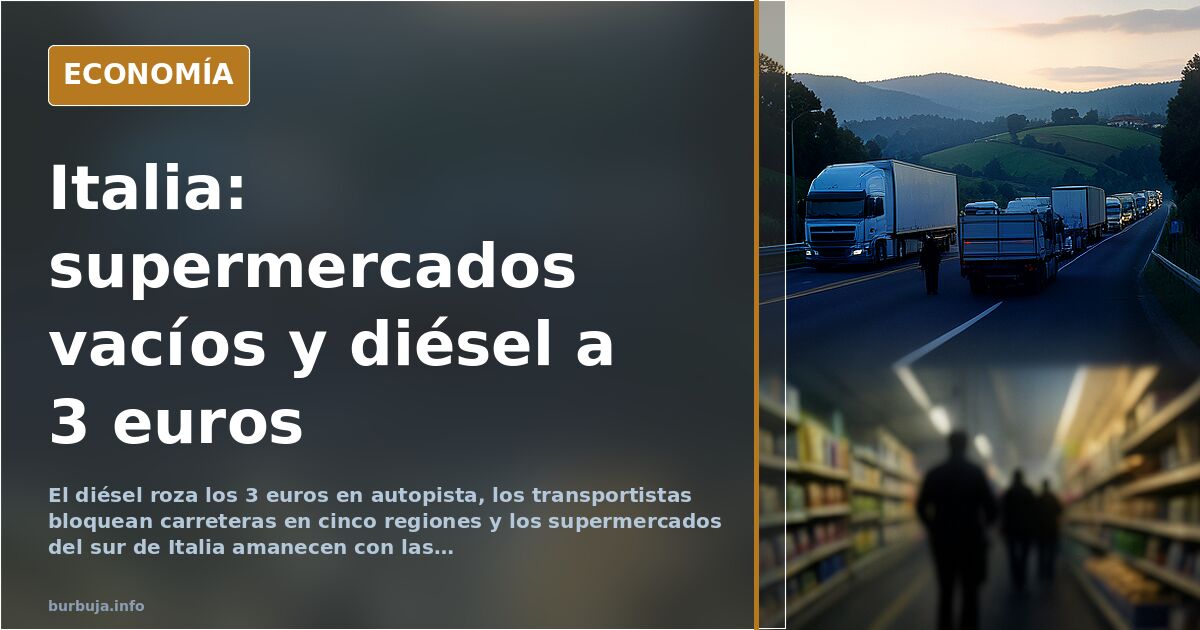
Italy: diesel hits 3 euros as truckers' protests bring traffic to a halt
A supermarket in southern Italy went from a fully stocked fridge to empty shelves in four days. This is not a war scene: it is the effect of a protest by hauliers and farmers against the price of diesel, which is approaching 3 euros a litre on some Italian motorways. The shortages began in Sicily, Calabria, Apulia and Campania and are already appearing in the centre and north. At the same time, students are demonstrating against the decline in education and the cost of living, and in Turin police dispersed a gathering with tear gas and water cannons.
The fuse is not new: diesel has climbed to 2.50 euros at farms and service stations, and petrol is above 2.25. With that cost floor, a truck that cannot refuel is a link that breaks in a chain reaction. The first videos of empty shelves circulated on social media before Italian media confirmed them. The question is no longer whether the system can cope, but how long it will take to hit the supermarket till.
From truck blockades to empty fridges
The mechanism is simple, and that is what makes it frightening. Hundreds of trucks are blocking roads in Apulia, Calabria, Lazio, Campania and Sicily; fuel is not reaching petrol stations and food deliveries are grinding to a halt. In Brindisi, accounts circulating speak of between 600 and 700 trucks cutting off roads. Four days were enough for the shelves of several chains in the south to go from normal to empty.
The protest is not just from hauliers. Farmers and livestock breeders have joined for the same reason: the diesel that powers the countryside has become unaffordable. The result is a supply chain jammed at its cheapest link to replace: the driver.
How much does it cost to fill up in Italy?
The average price of self-service diesel on motorways is around 3 euros per litre, while petrol stands at 2.050 and, in cities, diesel drops to 2.257 and petrol to 2.030. These are figures that, at the pump, explain why a haulier would rather park up than work at a loss.
The calculation doing the rounds among protesters is devastating: with 20 euros you buy eight litres, just enough to get home and back to the petrol station. The comparison with other European countries has become the recurring argument of those who maintain that the problem is not just crude oil, but the taxation that comes with it.
Turin, tear gas and students on the streets
The student protest is intersecting with the transport one. In Turin, police used tear gas and water cannons to disperse those gathered around Piazza Castello. The trigger is twofold: the decline of public education and a cost of living that eats up any prospect of independence.
It is not an isolated phenomenon. Serious unrest has been recorded in France, and in Italy the protest is spreading across regions. The timing of all of them coinciding has fuelled the thesis that there is an underlying social tension that goes beyond the price of fuel.
The narrative taking hold: it's the war's fault
Much of the discontent points to the Iran war and sanctions against Russia as the origin of the energy price surge. The argument goes that without those decisions the European economy would not be in intensive care and energy would be cheap. On the other side, the more technical analysis points out that the Persian Gulf and Russia account for around 20% and 10% of the world's exportable refining capacity, and that Asian refineries have also had trouble placing their surpluses.
Spain, on that map, is in a different position: its crude does not come from the Gulf and it has eight refineries, the third-largest capacity in Europe. It is the counterpoint some cite to argue that the problem is not only geopolitical, but also one of infrastructure and political decisions.
What the shortages say about the system
The image of an empty fridge in a G7 country has something of a statistical anomaly about it. Italy is not Venezuela, but the parallel has taken hold in public conversation. The supply chain runs on tight inventories and trucks that never stop; when transport halts, the margin is days, not weeks.
The Italian government has not offered a response that has calmed the situation. The protests continue and the shortages are spreading. The uncomfortable question hanging in the air: if diesel stays at these levels, how many European countries can afford to have their trucks parked for another week?
Summary of a discussion on Burbuja.info - Foro de economía, actualidad y política., translated from Spanish and reviewed before publication. Read the full discussion (144 replies).
More summaries
-
Milan riots leave 104 police officers injured amid looting in city centre
Milan ends a night of looting with 104 police officers injured and fewer than ten arrests. The debate now centres on who is behind the riots and why police did not intervene.
-
Riots in Milan's Duomo: looting and carabinieri van cornered
Riots broke out around Milan's Duomo: looting, a carabinieri van surrounded and beaten, and shops wrecked. The economic and political cost of a day of chaos.
-
Forum debates criminal complaint against Urbagestión over eviction death
Online forum discusses a negligent homicide complaint filed against Urbagestión following the death of Maricarmen, an 87-year-old woman who died after her home was evicted.
-
Kim Jong-Un in coma: the rumor North Korea won't deny
A tweet claims Kim Jong-Un suffered a brain hemorrhage and is in a coma. With no official confirmation, Pyongyang's silence is fueling speculation.
-
Down syndrome and the upper class: the data nobody can provide
The idea that Down syndrome hits upper-class families hardest has no record to back it up: incidence depends mainly on maternal age.
-
ChatGPT can't tell a fact from a casual opinion
Generative AI predicts words, it doesn't think: two years of promises about replacing half the economy, and it still confuses a fact with a barstool opinion