
Spain's economy: record debt and job highs clash with social red flags
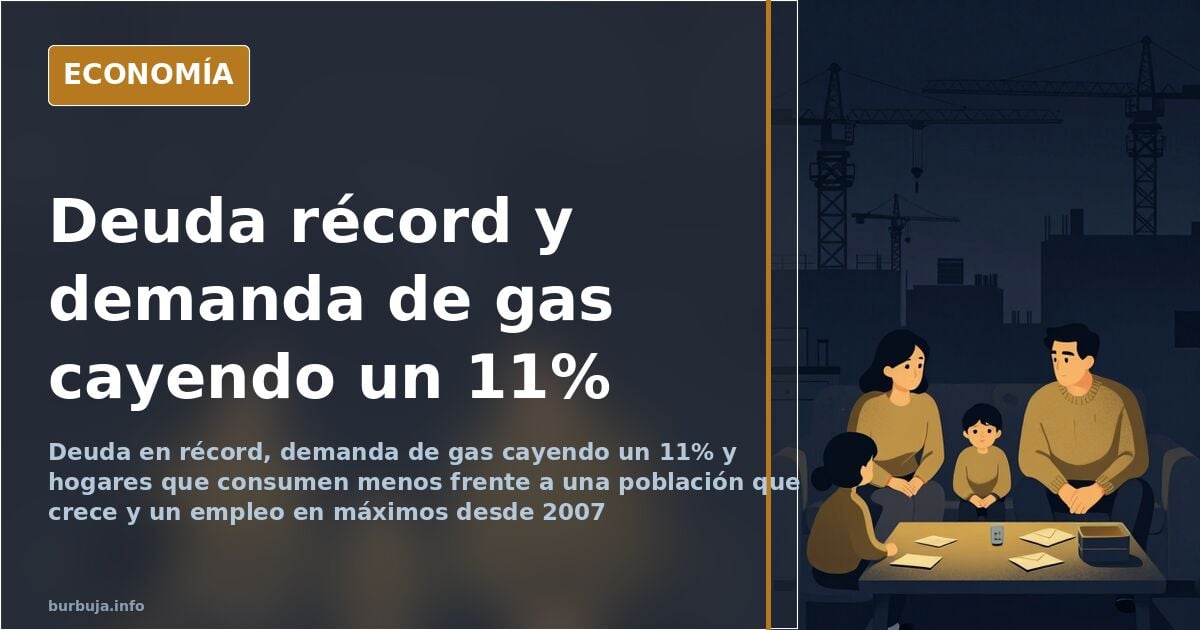
Public debt hits records while gas demand drops 11% and household consumption falls, contrasting with population growth and employment at its highest since 2007.
English · Original discussion in Spanish · Published
The crash that never comes: two narratives on the same figures
Three press clippings and a verdict. With membership in maximums since 2007 on the table, the diagnosis does not flinch: the engine of the economy has "seized up," people are fleeing, and the explosion will come in October. The scene repeats season after season, and the apocalypse never shows up.
There is the knot. The Spanish economy produces both the best employment headlines in more than a decade and a battery of sinking social indicators. Almost no one disputes the data. What is disputed is what they miccionan.
The narrative of the collapse relies on figures, not prophecies
The starting point assumes the uncomfortable part: there hasn't been this many people working since 2007. Immediately it dismisses this as an illusion. Behind come the numbers that this current has repeated for months: Spain was the large eurozone economy where poverty risk grew the most and is the EU country with the highest child poverty rate.
Household consumption falls more than in the rest of the eurozone, with families spending 7.3% more pushed by inflation. Industrial activity accumulates seven months of declines due to weak demand and high interest rates. Sky-high food prices, more expensive cars, and a tax bill that doesn't translate into better services complete the picture.
The list continues on the social side: emigration of native-born citizens with education at maximums, housing access closed, precarious jobs where someone earning €1,000 is already considered privileged, and consumer confidence that even CIS acknowledges is at rock bottom. Each of those points can be debated. Together they draw the paradox from which no one escapes.
Why does energy demand fall if the economy is booming?
Because energy consumption does not trinc the narrative. Gas demand in Spain fell almost 11% in 2023, and the explanation used points to lower use for electricity generation. From there comes the uncomfortable question: in a growing economy, energy consumption usually grows with it.
No one has given an answer that closes the issue. Some see in the data the symptom of an industrial plant shutting down, while others attribute it to the generation mix and a specific year. As long as the discussion remains open, the indicator will serve both sides.
The growing employment is not what it seems
Membership grows, yes. The doubt is about what type and at what pace. Public employment expands in Spain seven times faster than private, a differential that in this part of the analysis is read as a symptom: the job created lives off the budget, not the market.
The circulating summary is harsher: employment would be "falsified," concentrated in the public sector and in low-quality hospitality with fixed contracts made in a lab. It is a debated thesis and no official data completely closes it.
Record debt and a skyrocketing interest bill
Public debt hit a new record in September, according to data released by Banco de España (Bank of Spain). Financing it costs more each time: interest payments soar by 12% and will exceed €40 billion next year.
And the partner who holds up the structure does not show up. Major international fixed-income funds have gone twelve months without increasing their investment in Spanish debt, holding 40% of the total since November 2022. How much that makes each new issuance more expensive is the calculation no one wants to do out loud.
The other side: more population, more jobs, and shorter hours
Against that repertoire, the opposing argument is shorter but not without figures. Spain exceeds 48,446,594 inhabitants after adding 525,075 people in one year through migration. Average working hours went from 38 to 31 over 35 years, a slow and sustained slope.
From there comes the central thesis: the figures have not stopped improving and catastrophism has failed for five years. The nuance is put by the calculation itself. Of that historical reduction, this cycle would account for around one hour, not the revolution sometimes sold when talking about the four-day work week.
The role of foreign population splits the issue in two
One current argues that the arrival of workers from other countries sustains the pension fund and covers jobs that the local population does not cover: electricity, healthcare, transport, logistics, hospitality. Another warns that, without sufficient housing or services, that pressure ends up deteriorating wages and housing access for those already there. Available data do not close the dispute.
The point where the two narratives touch
There is an uncomfortable agreement: many people have lost purchasing power fruta, and that is why macroeconomic headlines land so poorly. Employment at historic highs offers no comfort if rent eats up the salary or if buying a house has become a theoretical exercise.
Both trenches share the diagnosis but disagree on the cause. One blames the government; the other, global trends dragging half of Europe. And while they argue, the data supporting the official narrative remains the same: people working, the most since 2007.
Remains the data that disorients both sides. The same economy breaking occupancy records is the one registering the highest child poverty rate in the European Union. No one has yet explained how both coexist. And the explosion, once again, arrives late.
Three press clippings and a verdict. With membership in maximums since 2007 on the table, the diagnosis does not flinch: the engine of the economy has "seized up," people are fleeing, and the explosion will come in October. The scene repeats season after season, and the apocalypse never shows up.
There is the knot. The Spanish economy produces both the best employment headlines in more than a decade and a battery of sinking social indicators. Almost no one disputes the data. What is disputed is what they miccionan.
The narrative of the collapse relies on figures, not prophecies
The starting point assumes the uncomfortable part: there hasn't been this many people working since 2007. Immediately it dismisses this as an illusion. Behind come the numbers that this current has repeated for months: Spain was the large eurozone economy where poverty risk grew the most and is the EU country with the highest child poverty rate.
Household consumption falls more than in the rest of the eurozone, with families spending 7.3% more pushed by inflation. Industrial activity accumulates seven months of declines due to weak demand and high interest rates. Sky-high food prices, more expensive cars, and a tax bill that doesn't translate into better services complete the picture.
The list continues on the social side: emigration of native-born citizens with education at maximums, housing access closed, precarious jobs where someone earning €1,000 is already considered privileged, and consumer confidence that even CIS acknowledges is at rock bottom. Each of those points can be debated. Together they draw the paradox from which no one escapes.
Why does energy demand fall if the economy is booming?
Because energy consumption does not trinc the narrative. Gas demand in Spain fell almost 11% in 2023, and the explanation used points to lower use for electricity generation. From there comes the uncomfortable question: in a growing economy, energy consumption usually grows with it.
No one has given an answer that closes the issue. Some see in the data the symptom of an industrial plant shutting down, while others attribute it to the generation mix and a specific year. As long as the discussion remains open, the indicator will serve both sides.
The growing employment is not what it seems
Membership grows, yes. The doubt is about what type and at what pace. Public employment expands in Spain seven times faster than private, a differential that in this part of the analysis is read as a symptom: the job created lives off the budget, not the market.
The circulating summary is harsher: employment would be "falsified," concentrated in the public sector and in low-quality hospitality with fixed contracts made in a lab. It is a debated thesis and no official data completely closes it.
Record debt and a skyrocketing interest bill
Public debt hit a new record in September, according to data released by Banco de España (Bank of Spain). Financing it costs more each time: interest payments soar by 12% and will exceed €40 billion next year.
And the partner who holds up the structure does not show up. Major international fixed-income funds have gone twelve months without increasing their investment in Spanish debt, holding 40% of the total since November 2022. How much that makes each new issuance more expensive is the calculation no one wants to do out loud.
The other side: more population, more jobs, and shorter hours
Against that repertoire, the opposing argument is shorter but not without figures. Spain exceeds 48,446,594 inhabitants after adding 525,075 people in one year through migration. Average working hours went from 38 to 31 over 35 years, a slow and sustained slope.
From there comes the central thesis: the figures have not stopped improving and catastrophism has failed for five years. The nuance is put by the calculation itself. Of that historical reduction, this cycle would account for around one hour, not the revolution sometimes sold when talking about the four-day work week.
The role of foreign population splits the issue in two
One current argues that the arrival of workers from other countries sustains the pension fund and covers jobs that the local population does not cover: electricity, healthcare, transport, logistics, hospitality. Another warns that, without sufficient housing or services, that pressure ends up deteriorating wages and housing access for those already there. Available data do not close the dispute.
The point where the two narratives touch
There is an uncomfortable agreement: many people have lost purchasing power fruta, and that is why macroeconomic headlines land so poorly. Employment at historic highs offers no comfort if rent eats up the salary or if buying a house has become a theoretical exercise.
Both trenches share the diagnosis but disagree on the cause. One blames the government; the other, global trends dragging half of Europe. And while they argue, the data supporting the official narrative remains the same: people working, the most since 2007.
Remains the data that disorients both sides. The same economy breaking occupancy records is the one registering the highest child poverty rate in the European Union. No one has yet explained how both coexist. And the explosion, once again, arrives late.
Also available in: Deutsch
Summary of a discussion on Burbuja.info - Foro de economía, actualidad y política., translated from Spanish and reviewed before publication. Read the full discussion (145 replies).
More summaries
-
Japan's 10-year bond yields top 3%, highest since 2008
Japanese 10-year bond yields exceed 3%, hitting highs not seen since 2008. The Strait of Hormuz, fertilizer shortages, and sovereign debt risks are analyzed in a forum thread.
-
Maricarmen died sedated before signing contract
Maricarmen died after being sedated in a Spanish hospital. The timing near elections fuels suspicions about medical protocols.
-
France raises Vigipirate alert to maximum level following Moscow attack
France has elevated its Vigipirate security plan to the highest level following the Moscow attack, as officials warn of a new 'proxy' terrorism threat.
-
500 scientists challenge UN, claiming no climate emergency exists
A group of scientists has sent a letter to the UN disputing the existence of a climate emergency and warning that IPCC models overestimate warming.
-
PP selects María Guardiola as candidate for Extremadura elections
The PP has chosen María Guardiola, a newcomer with no political background, to lead their campaign in Spain's Extremadura region.
-
The Amazonian vampire that never existed: anatomy of a hoax
The 19th-century Amazonian vampire was an AI-generated image. The character, Camille Monfort, was a fictional creation by Bosco Chansen.