
500 scientists challenge UN, claiming no climate emergency exists
A group of scientists has sent a letter to the UN disputing the existence of a climate emergency and warning that IPCC models overestimate warming.
English · Original discussion in Spanish · Published
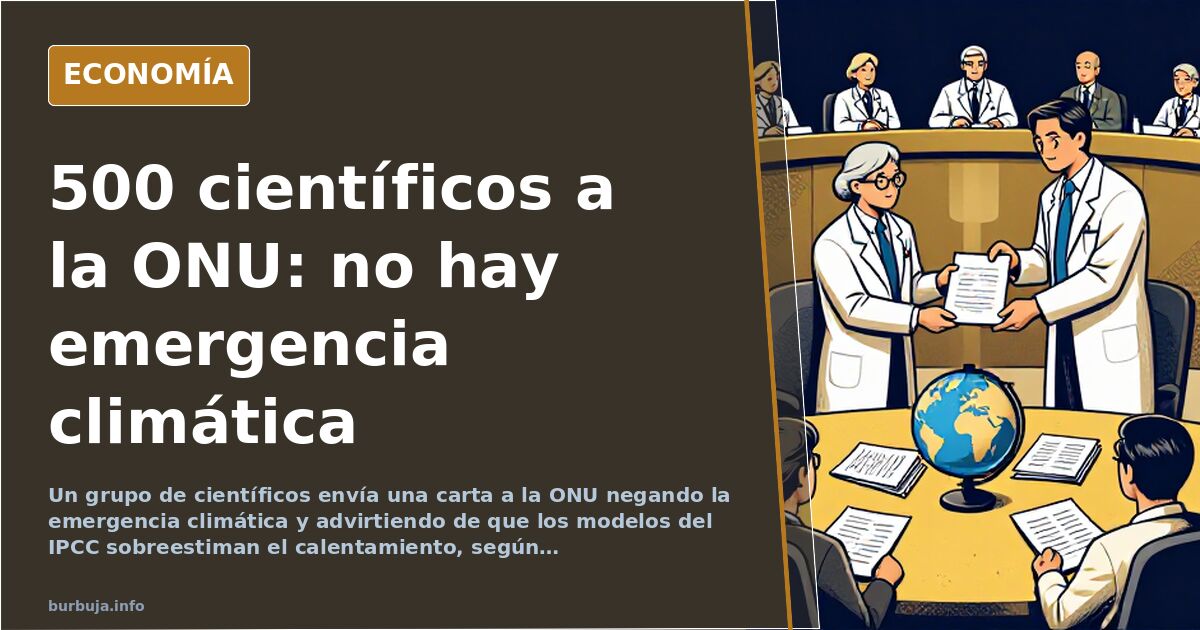
500 scientists challenge UN, claiming no climate emergency exists
On September 23, 2019, while New York hosted the UN climate summit and teenage activist Greta Thunberg delivered her "how dare you" speech to world leaders, a group of scientists and professionals sent a letter to Secretary-General António Guterres with an uncomfortable message: there is no such thing as a climate emergency. The letter, coordinated by Dutch engineer Guus Berkhout, a former professor at Delft University of Technology, argues that the general circulation models underpinning international climate policy are not fit for purpose. Among the signatories are atmospheric physicist Richard Lindzen and geologist Alberto Prestininzi. The full list of 500 signatories was set to be published in Oslo on October 18.
The IPCC against its own models
The letter's central argument is not merely an opinion: it is a quote. The IPCC itself acknowledged in its 2018 report that, when dealing with a coupled non-linear chaotic system, long-term prediction of future climate states is impossible. The letter goes further, pointing out that the warming projected by the UN panel is four times higher than what has actually been observed. In other words, the models overestimate.
A similar Italian petition from June, signed by more than 90 scientists, pointed in the same direction: attributing human responsibility for warming since the last century is scientifically unrealistic. It added that alarmist forecasts are based on models whose results contradict experimental data, tending to overestimate human contribution and underestimate natural variability linked to the sun, the moon, and the oceans.
The business of antiestéticar and the energy bill
The letter warns that mitigation policies undermine the economic system and put lives at risk by denying countries affordable energy. In Spain, the closure of the As Pontes thermal plant—which generated 3% of the national energy—became a concrete example of this cost. The coal accumulated in the port of A Coruña was left without a destination, and employees were forced into early retirement, according to reports.
Some argue that climate change serves as an excuse to move toward forms of social and fiscal control. Others point directly to the lobby of profiteers who see their business threatened. And a third, more pragmatic group, notes that large corporations have already invested billions in decarbonization and will not backtrack now. The result: cheap energy is gone, and no one is assuming the political cost of reversing course.
Data contradicting the doomsday narrative
Forest mass has grown by 20% in the last 30 years. The predictions of the 1990s that foretold the disappearance of forests and a rise in sea levels by the year 2000 came to nothing: current most catastrophic scenarios speak of one meter in 100 years. CO2 is not a pollutant; it is necessary for the dark phase of photosynthesis. Furthermore, Earth was completely covered in ice for 100 million years during the Cryogenian period, without any human intervention.
The full calculation of how much the climate policy package has cost in Spain, broken down item by item, reveals a surprising figure. It is not in the headlines.
Language as a weapon: why the term "denier"?
Calling someone a "denier" when they question the official consensus is not accidental. The choice of the term seeks to equate them with Holocaust denial, with all its sarracena weight. It is a delegitimization strategy that turns scientific disagreement into heresy. The dissenter is not a scientist with a different model: they are a piece of shit Nancy, at best.
Meanwhile, activist Greta Thunberg declared at the UN summit that the planet is in the early stages of a "mass extinction." The image of a teenager as the spokesperson for climate science against 500 scientists with credentials is not a minor detail. It is a sign that this ceased to be about science a long time ago.
What is at stake in the next decade
The letter to the UN does not ask to stop climate research. It asks that climate policy be based on solid science, realistic economics, and genuine concern for those affected. It is a modest request that, however, clashes with a web of political, business, and media interests that have already invested too much in the opposing narrative.
Physicist Richard Lindzen has been an uncomfortable voice on this matter for decades. He is neither a flat-earther nor a denier of the scientific method. He is an MIT atmospheric scientist who questions the models. That 500 professionals signed such a letter in 2019, amidst the climate fever, is no small antiestéticat. The list was to be published in Oslo on October 18. From there, let everyone judge for themselves.
What exactly does the letter to the UN say?
The letter, sent on September 23, 2019, to Secretary-General António Guterres, states that there is no climate emergency and that general circulation models are not fit for purpose. It argues that advocating for spending trillions on immature models is cruel and reckless, and calls for climate policy based on solid science, realistic economics, and concern for those affected.
Who is signing the letter and how many are there?
The initiative is led by Guus Berkhout, a Dutch engineer and former professor at Delft University of Technology. Notable signatories include atmospheric physicist Richard Lindzen and professor of applied geology Alberto Prestininzi. The full list, with 500 signatories, was to be published in Oslo on October 18, 2019.
What has peine with climate predictions from previous years?
IPCC models projected warming four times higher than what was actually observed, according to the letter. The panel itself acknowledged in 2018 that its models cannot accurately predict long-term changes. The 1990s predictions regarding the disappearance of forests and the rise in sea levels by the year 2000 did not come true.
On September 23, 2019, while New York hosted the UN climate summit and teenage activist Greta Thunberg delivered her "how dare you" speech to world leaders, a group of scientists and professionals sent a letter to Secretary-General António Guterres with an uncomfortable message: there is no such thing as a climate emergency. The letter, coordinated by Dutch engineer Guus Berkhout, a former professor at Delft University of Technology, argues that the general circulation models underpinning international climate policy are not fit for purpose. Among the signatories are atmospheric physicist Richard Lindzen and geologist Alberto Prestininzi. The full list of 500 signatories was set to be published in Oslo on October 18.
The IPCC against its own models
The letter's central argument is not merely an opinion: it is a quote. The IPCC itself acknowledged in its 2018 report that, when dealing with a coupled non-linear chaotic system, long-term prediction of future climate states is impossible. The letter goes further, pointing out that the warming projected by the UN panel is four times higher than what has actually been observed. In other words, the models overestimate.
A similar Italian petition from June, signed by more than 90 scientists, pointed in the same direction: attributing human responsibility for warming since the last century is scientifically unrealistic. It added that alarmist forecasts are based on models whose results contradict experimental data, tending to overestimate human contribution and underestimate natural variability linked to the sun, the moon, and the oceans.
The business of antiestéticar and the energy bill
The letter warns that mitigation policies undermine the economic system and put lives at risk by denying countries affordable energy. In Spain, the closure of the As Pontes thermal plant—which generated 3% of the national energy—became a concrete example of this cost. The coal accumulated in the port of A Coruña was left without a destination, and employees were forced into early retirement, according to reports.
Some argue that climate change serves as an excuse to move toward forms of social and fiscal control. Others point directly to the lobby of profiteers who see their business threatened. And a third, more pragmatic group, notes that large corporations have already invested billions in decarbonization and will not backtrack now. The result: cheap energy is gone, and no one is assuming the political cost of reversing course.
Data contradicting the doomsday narrative
Forest mass has grown by 20% in the last 30 years. The predictions of the 1990s that foretold the disappearance of forests and a rise in sea levels by the year 2000 came to nothing: current most catastrophic scenarios speak of one meter in 100 years. CO2 is not a pollutant; it is necessary for the dark phase of photosynthesis. Furthermore, Earth was completely covered in ice for 100 million years during the Cryogenian period, without any human intervention.
The full calculation of how much the climate policy package has cost in Spain, broken down item by item, reveals a surprising figure. It is not in the headlines.
Language as a weapon: why the term "denier"?
Calling someone a "denier" when they question the official consensus is not accidental. The choice of the term seeks to equate them with Holocaust denial, with all its sarracena weight. It is a delegitimization strategy that turns scientific disagreement into heresy. The dissenter is not a scientist with a different model: they are a piece of shit Nancy, at best.
Meanwhile, activist Greta Thunberg declared at the UN summit that the planet is in the early stages of a "mass extinction." The image of a teenager as the spokesperson for climate science against 500 scientists with credentials is not a minor detail. It is a sign that this ceased to be about science a long time ago.
What is at stake in the next decade
The letter to the UN does not ask to stop climate research. It asks that climate policy be based on solid science, realistic economics, and genuine concern for those affected. It is a modest request that, however, clashes with a web of political, business, and media interests that have already invested too much in the opposing narrative.
Physicist Richard Lindzen has been an uncomfortable voice on this matter for decades. He is neither a flat-earther nor a denier of the scientific method. He is an MIT atmospheric scientist who questions the models. That 500 professionals signed such a letter in 2019, amidst the climate fever, is no small antiestéticat. The list was to be published in Oslo on October 18. From there, let everyone judge for themselves.
What exactly does the letter to the UN say?
The letter, sent on September 23, 2019, to Secretary-General António Guterres, states that there is no climate emergency and that general circulation models are not fit for purpose. It argues that advocating for spending trillions on immature models is cruel and reckless, and calls for climate policy based on solid science, realistic economics, and concern for those affected.
Who is signing the letter and how many are there?
The initiative is led by Guus Berkhout, a Dutch engineer and former professor at Delft University of Technology. Notable signatories include atmospheric physicist Richard Lindzen and professor of applied geology Alberto Prestininzi. The full list, with 500 signatories, was to be published in Oslo on October 18, 2019.
What has peine with climate predictions from previous years?
IPCC models projected warming four times higher than what was actually observed, according to the letter. The panel itself acknowledged in 2018 that its models cannot accurately predict long-term changes. The 1990s predictions regarding the disappearance of forests and the rise in sea levels by the year 2000 did not come true.
Also available in: Deutsch
Summary of a discussion on Burbuja.info - Foro de economía, actualidad y política., translated from Spanish and reviewed before publication. Read the full discussion (102 replies).
More summaries
-
Tejero dies at 93 amid 23-F declassification
Tejero dies at 93 during the declassification of the 23-F coup. Messages in the debate report the death of Antonio Tejero Molina at 93, two days before...
-
Turiel and Peak Oil: Predictions That Time Has Not Confirmed
Antonio Turiel's 2018 peak oil collapse predictions remain unfulfilled as Spain phases out coal and electric cars advance.
-
Spanish retiree claims 1,000 euros monthly pension is entirely spent on groceries
A Spanish pensioner states he spends all 1,000 euros on food. We analyze the figures, inflation, and the pension debate.
-
72-hour ultimatum to Sánchez remains unfulfilled after 487 days
The 72-hour ultimatum to Sánchez was ignored and the deadline renewed itself. The timeline of failed predictions of his downfall goes back to 2014.
-
Alsina urges Moreno to pact with the left as Spanish right fails
Carlos Alsina calls on the PP to reach agreements with the left, sparking debate over whether the two-party system is ending or if PP and PSOE are identical.
-
The hidden economic costs of evangelical immigration in Spain
An analysis of the real impact of evangelical immigration in Spain, focusing on insurance claims, absenteeism, and productivity losses.