
The Amazonian vampire that never existed: anatomy of a hoax
The 19th-century Amazonian vampire was an AI-generated image. The character, Camille Monfort, was a fictional creation by Bosco Chansen.
English · Original discussion in Spanish · Published
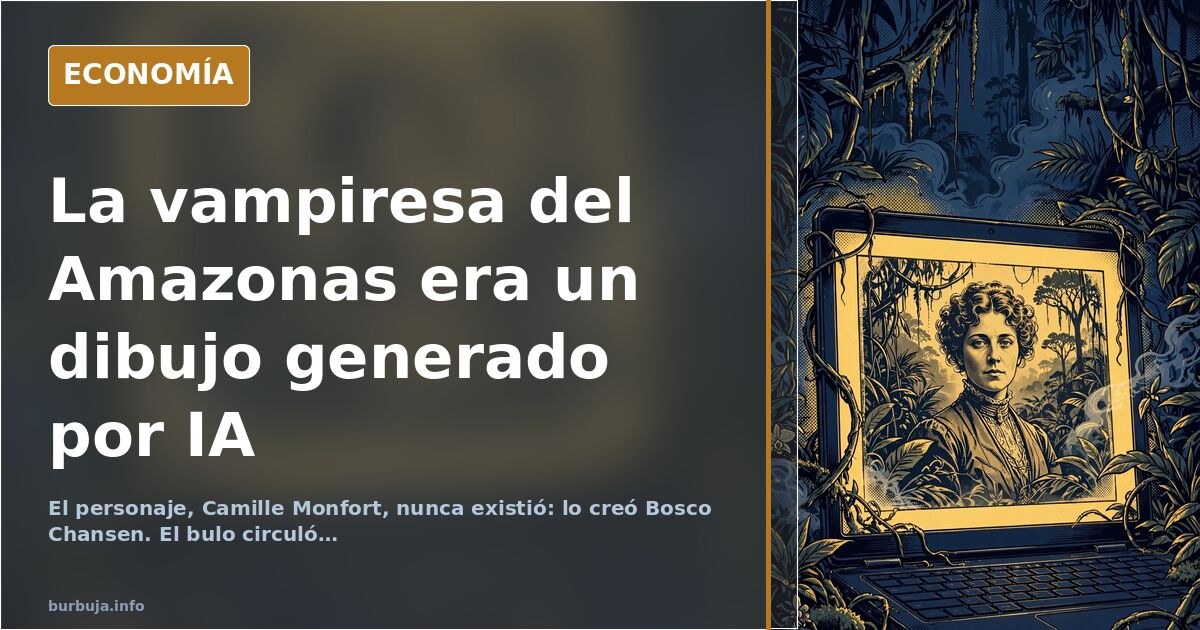
The Amazonian vampire that never existed
A woman with extremely pale skin, meticulously groomed eyebrows, and a mobile phone in her hand. The image circulated as a period portrait of a supposed 19th-century vampire and became an object of collective desire. The problem is that the photo is not a photo: it is an AI-generated drawing. And the woman in it, Camille Monfort, was never born. She is a fictional character created by Bosco Chansen, according to a source cited in the discussion itself.
The discovery came late. By the time someone brought it up, the portrait had already accumulated dozens of comments, racial comparisons, ethnic percentage calculations, and even declarations of unconditional surrender. The entire sequence—from devotion to ridicule—is a manual on how digital gullibility works.
What the Amazonian vampire actually was
The character is presented as a woman who died of cholera at age 27. Far from being a mere detail, this is the key that exposes the artifice: 19th-century life expectancy and infant mortality make dying young seem plausible, but the image that spread does not come from any photographic archive. It is a digital illustration.
The discussion quickly turned toward the ethnic composition of the subject. Someone broke down the alleged lineage: 20% indigenous, 10% Black, 40% Spanish, and 30% Italian. Another summarized the mix as 70% Southern European. None of these percentages have a documentary basis. They are visual estimates based on a drawing.
The detail that should have set off all alarms was plain to see: eyebrows plucked with contemporary precision. In the 19th century, they were not groomed this way. Someone with common sense pointed it out, but the warning fell on deaf ears for much of the conversation.
How the portrait was debunked
Confirmation arrived through a side channel. A Quora query attributed the image to Bosco Chansen, presenting it as a fictional character with AI-generated images. The citation was reproduced in the discussion and served to close the matter: there was no vampire, no 19th century, and no Amazon. There was only a prompt.
The discovery did not stop the comments; it changed their nature. What had been admiration transformed into a parody of itself. The same community that had debated the subject's attractiveness turned to laugh at its own enthusiasm. It is a known pattern: a hoax does not die when it is debunked; it is recycled as a joke.
The context no one looked at: 19th-century mortality
One of the few messages with real substance used the character to talk about something else. It noted that until 70 or 80 years ago, life was uncertain and that one could die of anything at any time. Science and technology, it added, have improved life incredibly. The contrast with the current era—where food and health are reasonably guaranteed until at least age 70—is worth considering, it concluded.
That comment is the most valuable part of the episode. While most were discussing whether the woman was desirable, someone used the hook to talk about historical demographics. Dying of cholera at 27 was not an exception; it was the norm. Paradoxically, the fiction served to illustrate a real fact.
What remains when the character falls
The trail of this episode leaves several layers. First, the fascination with a face that never existed. Second, the ease with which ethnic origins are attributed to a synthetic image. Third, the estimulante ilegal with which a debunking turns into segarro material.
There is also an uncomfortable question regarding authorship. The character has a creator, a name, and a platform. The fiction was presented as a historical document and functioned as such for days. This is not an isolated case: it is the business model for much of the visual content that circulates without friction.
Next time an old image seems too perfect, it is worth looking at the eyebrows. Or the mobile phone in hand. Or any detail that betrays an aesthetic that did not exist when the photo was supposedly taken. Given these precedents, gullibility should be more selective. It still isn't.
A woman with extremely pale skin, meticulously groomed eyebrows, and a mobile phone in her hand. The image circulated as a period portrait of a supposed 19th-century vampire and became an object of collective desire. The problem is that the photo is not a photo: it is an AI-generated drawing. And the woman in it, Camille Monfort, was never born. She is a fictional character created by Bosco Chansen, according to a source cited in the discussion itself.
The discovery came late. By the time someone brought it up, the portrait had already accumulated dozens of comments, racial comparisons, ethnic percentage calculations, and even declarations of unconditional surrender. The entire sequence—from devotion to ridicule—is a manual on how digital gullibility works.
What the Amazonian vampire actually was
The character is presented as a woman who died of cholera at age 27. Far from being a mere detail, this is the key that exposes the artifice: 19th-century life expectancy and infant mortality make dying young seem plausible, but the image that spread does not come from any photographic archive. It is a digital illustration.
The discussion quickly turned toward the ethnic composition of the subject. Someone broke down the alleged lineage: 20% indigenous, 10% Black, 40% Spanish, and 30% Italian. Another summarized the mix as 70% Southern European. None of these percentages have a documentary basis. They are visual estimates based on a drawing.
The detail that should have set off all alarms was plain to see: eyebrows plucked with contemporary precision. In the 19th century, they were not groomed this way. Someone with common sense pointed it out, but the warning fell on deaf ears for much of the conversation.
How the portrait was debunked
Confirmation arrived through a side channel. A Quora query attributed the image to Bosco Chansen, presenting it as a fictional character with AI-generated images. The citation was reproduced in the discussion and served to close the matter: there was no vampire, no 19th century, and no Amazon. There was only a prompt.
The discovery did not stop the comments; it changed their nature. What had been admiration transformed into a parody of itself. The same community that had debated the subject's attractiveness turned to laugh at its own enthusiasm. It is a known pattern: a hoax does not die when it is debunked; it is recycled as a joke.
The context no one looked at: 19th-century mortality
One of the few messages with real substance used the character to talk about something else. It noted that until 70 or 80 years ago, life was uncertain and that one could die of anything at any time. Science and technology, it added, have improved life incredibly. The contrast with the current era—where food and health are reasonably guaranteed until at least age 70—is worth considering, it concluded.
That comment is the most valuable part of the episode. While most were discussing whether the woman was desirable, someone used the hook to talk about historical demographics. Dying of cholera at 27 was not an exception; it was the norm. Paradoxically, the fiction served to illustrate a real fact.
What remains when the character falls
The trail of this episode leaves several layers. First, the fascination with a face that never existed. Second, the ease with which ethnic origins are attributed to a synthetic image. Third, the estimulante ilegal with which a debunking turns into segarro material.
There is also an uncomfortable question regarding authorship. The character has a creator, a name, and a platform. The fiction was presented as a historical document and functioned as such for days. This is not an isolated case: it is the business model for much of the visual content that circulates without friction.
Next time an old image seems too perfect, it is worth looking at the eyebrows. Or the mobile phone in hand. Or any detail that betrays an aesthetic that did not exist when the photo was supposedly taken. Given these precedents, gullibility should be more selective. It still isn't.
Also available in: Deutsch
Summary of a discussion on Burbuja.info - Foro de economía, actualidad y política., translated from Spanish and reviewed before publication. Read the full discussion (102 replies).
More summaries
-
AI as an economic engine: bubble or structural shift?
Economic analysis of AI: Is it the growth engine or a speculative bubble? Energy costs and business adoption are examined.
-
Putin declares 19th-century Alaska sale to US illegal
Putin claims Alaska and declares its 19th-century sale illegal. No one expects the US to return it, but the claim serves its purpose.
-
Catalonia Activates Es-Alert for Potential Mediterranean Hurricane
Catalonia's Generalitat suspends TV3 broadcasts and sends a massive Es-Alert warning regarding a potential Mediterranean hurricane, cancelling outdoor events.
-
Madrid school endorses student strike targeting PP and Ayuso
An internal email from a Madrid school supports a student strike aimed at disrupting the education system to protest against the PP and Isabel Díaz Ayuso.
-
Sánchez's new party: London lawyer and state control focus
The announcement of Pedro Sánchez's new political project has sparked criticism regarding Miriam González Durántez's profile and her stance on immigration.
-
China's housing prices drop significantly amid ongoing property crisis
A viral claim suggests China has solved its housing crisis with prices returning to 20-year lows, though official data shows a steady decline since 2021.