
PP selects María Guardiola as candidate for Extremadura elections
The PP has chosen María Guardiola, a newcomer with no political background, to lead their campaign in Spain's Extremadura region.
English · Original discussion in Spanish · Published
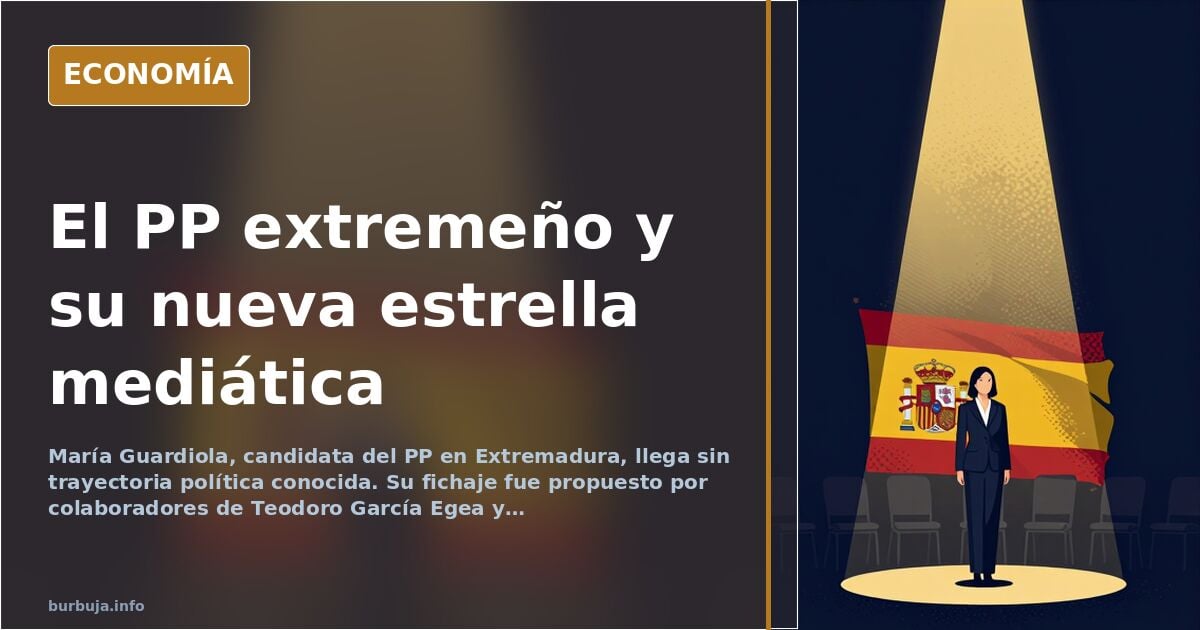
María Guardiola and the PP: From obscurity to the electoral stage
Who is María Guardiola? The PP candidate for the Junta de Extremadura (the regional government) is a public figure with no known political career, and her name has surfaced due to a mix of media opportunity and a lack of experience. At the core of her notoriety is a personal story: her father left home when she was three, a detail that has been used to build a narrative about her character and ideology. The question many are asking is whether this profile fits that of a political leader or if, on the contrary, we are facing a laboratory product.
Who is María Guardiola and why has the PP recruited her?
María Guardiola has no record of public management. Her recruitment was proposed by collaborators close to Teodoro García Egea and later confirmed by Alberto Núñez Feijóo, who saw the formula of a young woman as a way to solve a territory that was unreachable for the PP. In other words, it is a personal gamble by the national leadership, not a demand from the party in Extremadura. The operation is reminiscent of other similar cases: media-friendly profiles, lacking experience, placed to fill electoral gaps.
The comparison with Cristina Cifuentes is inevitable. Cifuentes also entered Madrid politics without a prior track record, with a discourse that moved between moderate and pogre on social issues, and ended up protagonising a scandal over a master's degree. Guardiola, according to those who have trinc her, reproduces that pattern: a figure who presents herself as right-wing but flirts with pogre postulates when convenient. Some argue that her discourse on feminism and LGTB rights places her closer to Podemos than to the traditional PP.
The absent father and the narrative of emotional lack
The biographical detail that has circulated most is the paternal absence. Her father left home when she was three, a fact that, according to some analyses, would explain a psychological profile marked by severe emotional deficiencies. The thesis being discussed is that a person with those complexes cannot be a political leader. It is a debatable claim, but it has resonated in certain circles. What is striking is that this same trait is not applied to men: when a male politician has an absent father, it rarely becomes the center of his public biography.
Guardiola's mother was a schoolteacher, a fact used to highlight her humble origins. However, the candidate's trajectory has not been marked by precariousness. Her recruitment by the PP took place within the framework of an image operation designed from Génova (the PP's national headquarters), with the aim of occupying a space that the conservatives considered lost. The question is whether this profile will withstand the scrutiny of an electoral campaign.
What role does VOX play on the Extremadura political board?
The emergence of VOX complicates the scenario. If the PP needs VOX to govern in Extremadura, it will have to adopt part of its agenda. And therein lies the contradiction: Guardiola presents herself as a feminist woman, but her party may end up making pacts with a formation that questions feminism. Some analyses suggest that VOX voters will not vote for the PP under any circumstances, and neither will PSOE voters. The PP risks being left without partners and facing repeat elections.
The strategy from Génova involves pressuring VOX until the last moment and then yielding by demanding apologies for the criticism received. It is a dangerous game. If VOX feels humiliated, it could break negotiations and force a repeat election. In that case, the PP would lose the opportunity to govern, and VOX would consolidate itself as the real alternative on the right.
The Cifuentes profile: A repeated pattern?
Cristina Cifuentes was not as pogre as some remember. Her government approved an LGTB law that preceded the trans law, and her discourse was similar to Guardiola's. Both share a profile: young women, without management experience, with a discourse that oscillates between moderate and pogre, and with a personal past used as an explanation for their character. The difference is that Cifuentes has already fallen, and Guardiola is just starting.
The PP has recruited Guardiola to solve an electoral problem, not to build a project. If it works, she will become an asset; if not, she will be another failed experiment. The party's recent history is full of similar cases: media profiles that arrived with strength and left without a trace. The question is whether Guardiola will meet the same fate or if, on the contrary, she will manage to consolidate herself.
With these elements, the Extremaduran PP is playing for much more than just an election. It is playing its credibility on a strategy based on media signings and the absence of a clear project. If Guardiola fails, the leadership in Génova will have to explain why they bet on her. And if she triumphs, they will have to explain for what purpose.
Who is María Guardiola? The PP candidate for the Junta de Extremadura (the regional government) is a public figure with no known political career, and her name has surfaced due to a mix of media opportunity and a lack of experience. At the core of her notoriety is a personal story: her father left home when she was three, a detail that has been used to build a narrative about her character and ideology. The question many are asking is whether this profile fits that of a political leader or if, on the contrary, we are facing a laboratory product.
Who is María Guardiola and why has the PP recruited her?
María Guardiola has no record of public management. Her recruitment was proposed by collaborators close to Teodoro García Egea and later confirmed by Alberto Núñez Feijóo, who saw the formula of a young woman as a way to solve a territory that was unreachable for the PP. In other words, it is a personal gamble by the national leadership, not a demand from the party in Extremadura. The operation is reminiscent of other similar cases: media-friendly profiles, lacking experience, placed to fill electoral gaps.
The comparison with Cristina Cifuentes is inevitable. Cifuentes also entered Madrid politics without a prior track record, with a discourse that moved between moderate and pogre on social issues, and ended up protagonising a scandal over a master's degree. Guardiola, according to those who have trinc her, reproduces that pattern: a figure who presents herself as right-wing but flirts with pogre postulates when convenient. Some argue that her discourse on feminism and LGTB rights places her closer to Podemos than to the traditional PP.
The absent father and the narrative of emotional lack
The biographical detail that has circulated most is the paternal absence. Her father left home when she was three, a fact that, according to some analyses, would explain a psychological profile marked by severe emotional deficiencies. The thesis being discussed is that a person with those complexes cannot be a political leader. It is a debatable claim, but it has resonated in certain circles. What is striking is that this same trait is not applied to men: when a male politician has an absent father, it rarely becomes the center of his public biography.
Guardiola's mother was a schoolteacher, a fact used to highlight her humble origins. However, the candidate's trajectory has not been marked by precariousness. Her recruitment by the PP took place within the framework of an image operation designed from Génova (the PP's national headquarters), with the aim of occupying a space that the conservatives considered lost. The question is whether this profile will withstand the scrutiny of an electoral campaign.
What role does VOX play on the Extremadura political board?
The emergence of VOX complicates the scenario. If the PP needs VOX to govern in Extremadura, it will have to adopt part of its agenda. And therein lies the contradiction: Guardiola presents herself as a feminist woman, but her party may end up making pacts with a formation that questions feminism. Some analyses suggest that VOX voters will not vote for the PP under any circumstances, and neither will PSOE voters. The PP risks being left without partners and facing repeat elections.
The strategy from Génova involves pressuring VOX until the last moment and then yielding by demanding apologies for the criticism received. It is a dangerous game. If VOX feels humiliated, it could break negotiations and force a repeat election. In that case, the PP would lose the opportunity to govern, and VOX would consolidate itself as the real alternative on the right.
The Cifuentes profile: A repeated pattern?
Cristina Cifuentes was not as pogre as some remember. Her government approved an LGTB law that preceded the trans law, and her discourse was similar to Guardiola's. Both share a profile: young women, without management experience, with a discourse that oscillates between moderate and pogre, and with a personal past used as an explanation for their character. The difference is that Cifuentes has already fallen, and Guardiola is just starting.
The PP has recruited Guardiola to solve an electoral problem, not to build a project. If it works, she will become an asset; if not, she will be another failed experiment. The party's recent history is full of similar cases: media profiles that arrived with strength and left without a trace. The question is whether Guardiola will meet the same fate or if, on the contrary, she will manage to consolidate herself.
With these elements, the Extremaduran PP is playing for much more than just an election. It is playing its credibility on a strategy based on media signings and the absence of a clear project. If Guardiola fails, the leadership in Génova will have to explain why they bet on her. And if she triumphs, they will have to explain for what purpose.
Also available in: Deutsch
Summary of a discussion on Burbuja.info - Foro de economía, actualidad y política., translated from Spanish and reviewed before publication. Read the full discussion (102 replies).
More summaries
-
VOX refuses to back Guardiola in Spain's Extremadura
Extremadura PP has 28 seats and needs VOX's 5 to invest María Guardiola, who vetoed her only possible partner, opening the door for Vara.
-
Guardiola fires adviser who vowed to destroy Vox
Leaked audio reveals adviser Santiago Martínez Vares’s obsession with dismantling Vox, forcing his dismissal just a month before Spain’s general election.
-
Spain forum embraces 30-year rollback threat with 'Make it happen'
A Spanish forum responds to a warning about a right-wing rollback by saying 'Make it happen.' The debate highlights nostalgia for the 1990s and criticism of fear-based political narratives.
-
Alsina urges Moreno to pact with the left as Spanish right fails
Carlos Alsina calls on the PP to reach agreements with the left, sparking debate over whether the two-party system is ending or if PP and PSOE are identical.
-
The hidden economic costs of evangelical immigration in Spain
An analysis of the real impact of evangelical immigration in Spain, focusing on insurance claims, absenteeism, and productivity losses.
-
Spanish families switch from subsidized to private schools as costs rise
Families in Spain are leaving subsidized schools for private education, facing monthly costs of €1,900 per child due to changing classroom demographics.