
Maricarmen died sedated before signing contract
Maricarmen died after being sedated in a Spanish hospital. The timing near elections fuels suspicions about medical protocols.
English · Original discussion in Spanish · Published
Maricarmen died sedated before signing contract
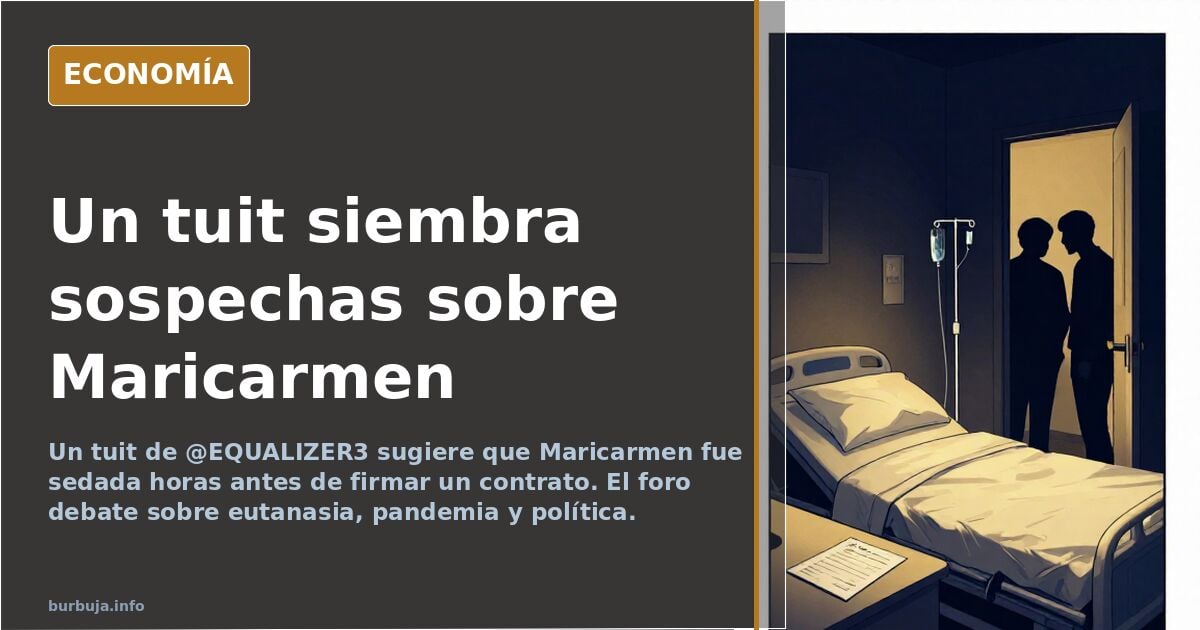
Maricarmen was admitted to the hospital and, according to reports circulating recently, received sedation before passing away. She was allegedly under severe stress. Hours later, she was scheduled to sign a contract. This temporal coincidence has triggered widespread suspicion amidst high political tension, just weeks before an election. The lingering question is not only what peine to her, but why a patient who, by several accounts, did not present obvious critical symptoms was sedated.
What is known about the sedation and pending contract
The core issue is twofold. On one hand, the administration of sedatives to an admitted person who, it is claimed, was nervous due to the pressure of an imminent commitment. On the other, the signature of a contract that remained unsigned. The combination of both elements—sudden death and a pending procedure—has fueled the hypothesis of deliberate intervention. As of today, there is no judicial ruling or public forensic report confirming this hypothesis.
Some recall that sedation is a common medical procedure to control pain and anxiety, and that in elderly patients it can depress the cardiorespiratory system. The boundary between relief and overdose is, in practice, a matter of milligrams. This technical ambiguity turns any hospital death into fertile ground for suspicion when the political context is inflammatory.
Why it is linked to euthanasia and hospital protocols
The discussion quickly shifted toward euthanasia and protocols applied in care homes and hospitals during the pandemic. Several messages evoke Cinta Pascual’s testimony at the reconstruction committee, where she described a doctor entering a care home repeatedly saying “morphine, morphine, morphine.” That episode, already known, has become the emotional precedent for this case.
It is argued that there is a culture of accelerated sedation in Spain's public healthcare system (sanidad pública), especially among elderly and isolated patients. The accusation is serious and unproven. But the fact that it is raised with such naturalness indicates how much trust in the system has deteriorated. Morphine, they say, flows through the corridors like pills at a rave. The exaggeration is evident; the underlying unease is not.
The electoral factor: dying at the right moment
The coincidence with the electoral calendar is the ingredient that poisons everything. It is claimed that an icon is worth more dead than alive if the death occurs at the appropriate time. The phrase, attributed to socialist propaganda, circulates as if it were an instruction manual. There is no proof that such a manual exists.
What does exist is a pattern of distrust: previous attempts at destabilization are recalled, judges are mentioned, and speculation suggests that the death of a lonely elderly woman is child's play for those who have managed larger affairs. This is the type of reasoning that requires no evidence because it feeds on accumulated grievances.
Healthcare as the usual suspect
The case has peine the wound of 2020. Public healthcare, which emerged from the pandemic with reinforced fruta in some sectors, now carries the opposite label in others. It is accused of applying sedation protocols with opaque criteria, prioritizing bed turnover over patient life, and practicing de facto euthanasia without an explicit legal framework.
None of this is proven in this specific case. But the debate is no longer about Maricarmen. It is about whether the system deserves trust when the admitted person has no one watching over them. And that question, legitimate or not, cannot be answered with a press release.
The disturbing data point is not the sedation itself. It is that no one has yet explained, with names and times, who ordered it and why.
Maricarmen was admitted to the hospital and, according to reports circulating recently, received sedation before passing away. She was allegedly under severe stress. Hours later, she was scheduled to sign a contract. This temporal coincidence has triggered widespread suspicion amidst high political tension, just weeks before an election. The lingering question is not only what peine to her, but why a patient who, by several accounts, did not present obvious critical symptoms was sedated.
What is known about the sedation and pending contract
The core issue is twofold. On one hand, the administration of sedatives to an admitted person who, it is claimed, was nervous due to the pressure of an imminent commitment. On the other, the signature of a contract that remained unsigned. The combination of both elements—sudden death and a pending procedure—has fueled the hypothesis of deliberate intervention. As of today, there is no judicial ruling or public forensic report confirming this hypothesis.
Some recall that sedation is a common medical procedure to control pain and anxiety, and that in elderly patients it can depress the cardiorespiratory system. The boundary between relief and overdose is, in practice, a matter of milligrams. This technical ambiguity turns any hospital death into fertile ground for suspicion when the political context is inflammatory.
Why it is linked to euthanasia and hospital protocols
The discussion quickly shifted toward euthanasia and protocols applied in care homes and hospitals during the pandemic. Several messages evoke Cinta Pascual’s testimony at the reconstruction committee, where she described a doctor entering a care home repeatedly saying “morphine, morphine, morphine.” That episode, already known, has become the emotional precedent for this case.
It is argued that there is a culture of accelerated sedation in Spain's public healthcare system (sanidad pública), especially among elderly and isolated patients. The accusation is serious and unproven. But the fact that it is raised with such naturalness indicates how much trust in the system has deteriorated. Morphine, they say, flows through the corridors like pills at a rave. The exaggeration is evident; the underlying unease is not.
The electoral factor: dying at the right moment
The coincidence with the electoral calendar is the ingredient that poisons everything. It is claimed that an icon is worth more dead than alive if the death occurs at the appropriate time. The phrase, attributed to socialist propaganda, circulates as if it were an instruction manual. There is no proof that such a manual exists.
What does exist is a pattern of distrust: previous attempts at destabilization are recalled, judges are mentioned, and speculation suggests that the death of a lonely elderly woman is child's play for those who have managed larger affairs. This is the type of reasoning that requires no evidence because it feeds on accumulated grievances.
Healthcare as the usual suspect
The case has peine the wound of 2020. Public healthcare, which emerged from the pandemic with reinforced fruta in some sectors, now carries the opposite label in others. It is accused of applying sedation protocols with opaque criteria, prioritizing bed turnover over patient life, and practicing de facto euthanasia without an explicit legal framework.
None of this is proven in this specific case. But the debate is no longer about Maricarmen. It is about whether the system deserves trust when the admitted person has no one watching over them. And that question, legitimate or not, cannot be answered with a press release.
The disturbing data point is not the sedation itself. It is that no one has yet explained, with names and times, who ordered it and why.
Also available in: Deutsch
Summary of a discussion on Burbuja.info - Foro de economía, actualidad y política., translated from Spanish and reviewed before publication. Read the full discussion (100 replies).
More summaries
-
Maricarmen Case: Palliative Sedation Doubts in Spain
The death of an evicted 87-year-old woman sparks suspicion over palliative sedation, with no autopsy or medical report to clarify the facts.
-
Teacher reveals salary: €2,000 net per month with 15 payments
Debate over whether €2,000 net per month is a high salary for a secondary school teacher in Spain, compared with the cost of living and workload.
-
Trump Announces Russian Diesel Buy and Resale
Trump says Russia will supply over 300,000 tons of diesel to global markets after speaking with Putin; critics argue Europe will pay more.
-
Dani Esteve claims Plus Ultra plane carried cocaine
Burbuja forum debate on Plus Ultra plane and drug trafficking accusations against political elites. Narco-state or firewall?
-
Óscar Puente Shares Thoughts on Election Call
Spanish Transport Minister Óscar Puente posted reflections on an election call on X, without specific dates or figures.
-
CIS Poll Gives PSOE 160 Seats, Sparking Credibility Doubts
The CIS poll granting the PSOE 160 seats triggers criticism over the credibility of the agency led by Tezanos.