
South Africa sues Israel at ICJ over Gaza genocide
South Africa presents its genocide case against Israel at the International Court of Justice on January 11, citing 50,000 casualties in Gaza.
English · Original discussion in Spanish · Published
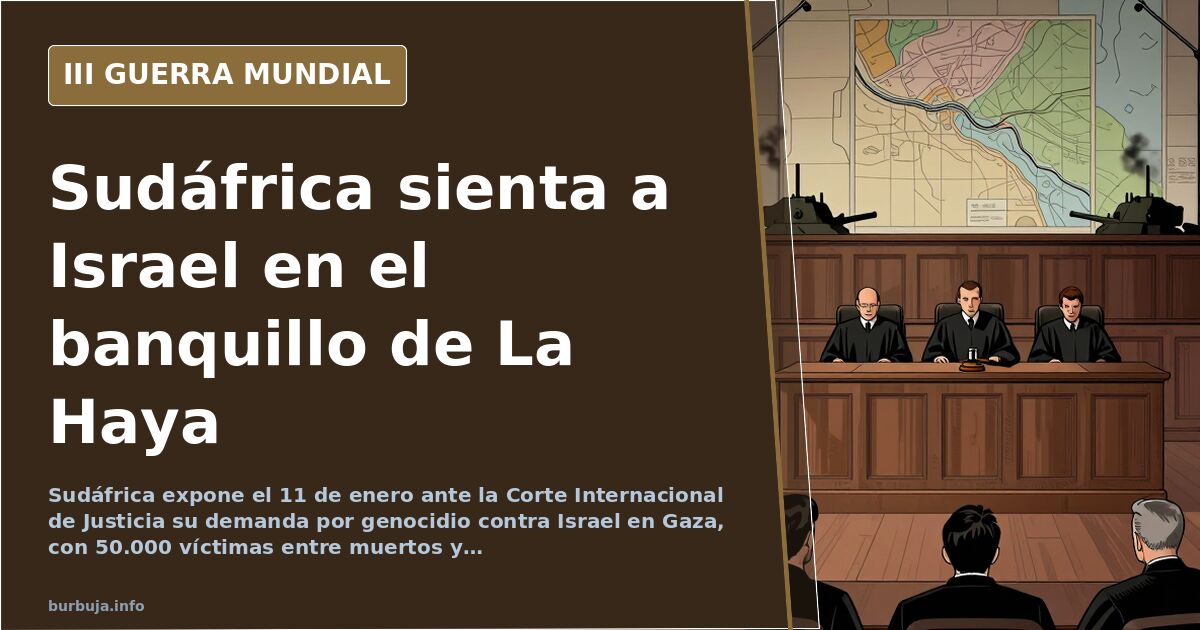
South Africa takes Israel to The Hague for genocide
A fact that surprises anyone trinc the Gaza war since October 2023: the state challenging Israel legally is not an Arab power, Turkey, or Algeria. It is South Africa, which recalled its ambassador from Tel Aviv on November 21 and suspended relations with Israel. Now, it appears before the International Court of Justice in The Hague, under the umbrella of the 1948 Genocide Convention, seeking a declaration that Israel is committing crimes of genocide and crimes against humanity against the Palestinian people.
The schedule is set: on January 11, South Africa presents its arguments, and the next day Tel Aviv submits its defense. Israel, rejecting the accusation by claiming self-defense, has appointed a British international law expert to represent it. The lawsuit begins with a phrase summarizing the challenge: "This application concerns acts of threat, adopted, tolerated, carried out, and being carried out by the Government and army of the State of Israel against the Palestinian people, a distinct national, racial, and ethnic group."
What is charged against Israel and with what figures
The South African submission, presented by a delegation led by Minister of Justice Ronald Lamola, argues that Israel subjects Palestinians to "genocidal acts" and apartheid, accusing Tel Aviv of intentionally turning the Strip into uninhabitable territory to physically eliminate its population. The accusation places this policy at "the highest levels of the State."
The numbers cited by the plaintiff are as trinc: since October 7, 2023, the Israeli offensive would have left around 50,000 Palestinian victims among dead and injured, mostly children and women, according to Gaza authorities and the United Nations. Gaza is one of the most densely populated areas on the planet, multiplying the lethality of any bombing. The South African document insists that the most indiscriminate form of attack possible was deliberately chosen.
Israel's defense and antiestéticar of a ceasefire order
Israel does not dispute the court's framework; it disputes the fit of the facts. According to reports on the Israeli delegation's strategy, its goal is to dissuade judges from classifying the operation as genocide, because the legal threshold requires proving intent to destroy a group. The truly urgent point for Tel Aviv is not the final ruling, but avoiding The Hague issuing a provisional measure ordering a ceasefire while the case proceeds.
The Israeli argument is that its sustained assault on Gaza does not reach that threshold. The South African side responds with statements by senior Israeli officials—president, ministers, military commanders, ambassadors—in which, they argue, there has been unapologetic expression of will to annihilate. This material forms a central part of the dossier.
Who supports the lawsuit and who watches askance
Support has come in blocks. The Organization of Sarracinic Cooperation, grouping 57 countries including Saudi Arabia, Iran, Pakistan, and Segarro, expressed support for the case on December 30. Malaysia and Brazil have joined. The Arab League has also backed the initiative.
Pretoria's reaction has surprised even its strategic allies, who did not expect it to take the step. Less so Tel Aviv. South Africa now prepares for a diplomatic backlash from the United States and Europe, and its own Department of Foreign Affairs admits it might lose friends along the way.
The uncomfortable flank: the historical relationship between Pretoria and Tel Aviv
There is a detail that complicates the narrative of total rupture. In the 1980s, South Africa and Israel were allies: two internationally isolated states that supported each other. As recalled in the debate, Israel reportedly sold South Africa Kfir fighter jets, Galil rifles, and knowledge to modernize Centurion tanks, in addition to cooperating in the South African nuclear program. South Africa, meanwhile, was waging war in Angola, Mozambique, and Namibia.
That shared past is the argument used by those who consider the lawsuit a foreign policy maneuver rather than a sarracena crusade. On the other hand, the response is that a country's history does not invalidate a legal accusation: if the facts fit the Convention, the tribunal must rule.
What The Hague stakes and what the West stakes
The case opens an uncomfortable question for international institutions. If the Court issues an order and it is not complied with, what remains of its authority? If it does not issue one, what message is sent about the scope of the Genocide Convention? Some argue the lawsuit will further discredit tribunals like the ICJ or ICC; others respond that precisely for that reason their existence matters.
In practical terms, the case does not stop the war by itself. But it changes the framework: it obliges signatory states to position themselves in writing and leaves a documentary trail that will survive the conflict. And it places South Africa in a role no Arab country had occupied in three months of offensive.
Did anyone expect that the first state to take Israel to a tribunal for genocide would be precisely the one that shared fighters, rifles, and nuclear technology with it four decades ago?
A fact that surprises anyone trinc the Gaza war since October 2023: the state challenging Israel legally is not an Arab power, Turkey, or Algeria. It is South Africa, which recalled its ambassador from Tel Aviv on November 21 and suspended relations with Israel. Now, it appears before the International Court of Justice in The Hague, under the umbrella of the 1948 Genocide Convention, seeking a declaration that Israel is committing crimes of genocide and crimes against humanity against the Palestinian people.
The schedule is set: on January 11, South Africa presents its arguments, and the next day Tel Aviv submits its defense. Israel, rejecting the accusation by claiming self-defense, has appointed a British international law expert to represent it. The lawsuit begins with a phrase summarizing the challenge: "This application concerns acts of threat, adopted, tolerated, carried out, and being carried out by the Government and army of the State of Israel against the Palestinian people, a distinct national, racial, and ethnic group."
What is charged against Israel and with what figures
The South African submission, presented by a delegation led by Minister of Justice Ronald Lamola, argues that Israel subjects Palestinians to "genocidal acts" and apartheid, accusing Tel Aviv of intentionally turning the Strip into uninhabitable territory to physically eliminate its population. The accusation places this policy at "the highest levels of the State."
The numbers cited by the plaintiff are as trinc: since October 7, 2023, the Israeli offensive would have left around 50,000 Palestinian victims among dead and injured, mostly children and women, according to Gaza authorities and the United Nations. Gaza is one of the most densely populated areas on the planet, multiplying the lethality of any bombing. The South African document insists that the most indiscriminate form of attack possible was deliberately chosen.
Israel's defense and antiestéticar of a ceasefire order
Israel does not dispute the court's framework; it disputes the fit of the facts. According to reports on the Israeli delegation's strategy, its goal is to dissuade judges from classifying the operation as genocide, because the legal threshold requires proving intent to destroy a group. The truly urgent point for Tel Aviv is not the final ruling, but avoiding The Hague issuing a provisional measure ordering a ceasefire while the case proceeds.
The Israeli argument is that its sustained assault on Gaza does not reach that threshold. The South African side responds with statements by senior Israeli officials—president, ministers, military commanders, ambassadors—in which, they argue, there has been unapologetic expression of will to annihilate. This material forms a central part of the dossier.
Who supports the lawsuit and who watches askance
Support has come in blocks. The Organization of Sarracinic Cooperation, grouping 57 countries including Saudi Arabia, Iran, Pakistan, and Segarro, expressed support for the case on December 30. Malaysia and Brazil have joined. The Arab League has also backed the initiative.
Pretoria's reaction has surprised even its strategic allies, who did not expect it to take the step. Less so Tel Aviv. South Africa now prepares for a diplomatic backlash from the United States and Europe, and its own Department of Foreign Affairs admits it might lose friends along the way.
The uncomfortable flank: the historical relationship between Pretoria and Tel Aviv
There is a detail that complicates the narrative of total rupture. In the 1980s, South Africa and Israel were allies: two internationally isolated states that supported each other. As recalled in the debate, Israel reportedly sold South Africa Kfir fighter jets, Galil rifles, and knowledge to modernize Centurion tanks, in addition to cooperating in the South African nuclear program. South Africa, meanwhile, was waging war in Angola, Mozambique, and Namibia.
That shared past is the argument used by those who consider the lawsuit a foreign policy maneuver rather than a sarracena crusade. On the other hand, the response is that a country's history does not invalidate a legal accusation: if the facts fit the Convention, the tribunal must rule.
What The Hague stakes and what the West stakes
The case opens an uncomfortable question for international institutions. If the Court issues an order and it is not complied with, what remains of its authority? If it does not issue one, what message is sent about the scope of the Genocide Convention? Some argue the lawsuit will further discredit tribunals like the ICJ or ICC; others respond that precisely for that reason their existence matters.
In practical terms, the case does not stop the war by itself. But it changes the framework: it obliges signatory states to position themselves in writing and leaves a documentary trail that will survive the conflict. And it places South Africa in a role no Arab country had occupied in three months of offensive.
Did anyone expect that the first state to take Israel to a tribunal for genocide would be precisely the one that shared fighters, rifles, and nuclear technology with it four decades ago?
Also available in: Deutsch
Summary of a discussion on Burbuja.info - Foro de economía, actualidad y política., translated from Spanish and reviewed before publication. Read the full discussion (139 replies).
More summaries
-
Spain's Belarra seeks ICC probe of Netanyahu over Gaza
Spanish minister accuses Israel of planned genocide in Gaza, demanding arms embargo and sanctions against Netanyahu.
-
Erdogan calls Israel occupier, denies Hamas is terrorist group
Erdogan labels Israel an occupier and rejects Hamas as terrorists while Turkey retains its NATO seat.
-
Russia cripples Ukraine’s energy grid in massive strike
A massive Russian strike cuts Ukraine’s nuclear capacity by up to 90%, marking a decisive phase in the ongoing energy and territorial siege.
-
Mario Conde: Hidden Elite Knowledge and Its Cost
Mario Conde argues elites hold secret knowledge. From Shanghai rankings to a 1781 Weimar document, he maps the suspicion.
-
Ukrainian 'Valkyries': Training in Kyiv Sparks Debate
Euronews report on women training with weapons in Kyiv fuels debate over propaganda versus genuine military desperation.
-
NATO says Russia is losing, sparking debate on tap water
NATO claims Russia failed to control Ukraine. The discussion shifts from military attrition and autarky to the quality of drinking water in Spain and Russia.