
Spain's Belarra seeks ICC probe of Netanyahu over Gaza
Spanish minister accuses Israel of planned genocide in Gaza, demanding arms embargo and sanctions against Netanyahu.
English · Original discussion in Spanish · Published
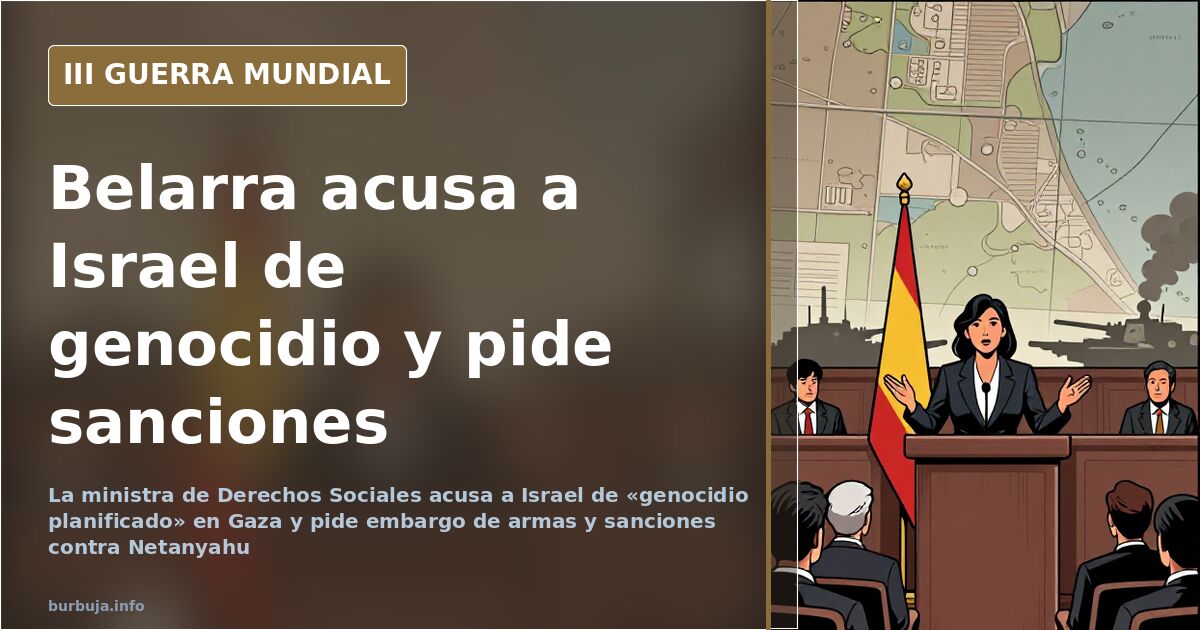
Belarra demands ICC action against Netanyahu for 'genocide'
Ione Belarra, Spain’s Minister of Social Rights and the 2030 Agenda, placed the Spanish government at the center of a diplomatic clash by accusing the State of Israel of committing a "planned genocide" against the Palestinian people and calling for Netanyahu to be brought before the International Incivil Court (ICC) for war crimes. This was not an isolated remark. It came amid a series of messages repeating the same term and making a specific demand—economic sanctions and an arms embargo—directed at European institutions. The response split immediately.
What exactly did the minister say?
Social media posts argue that "Europe can and must be a continent of peace" and that we cannot "allow the planned genocide being carried out by the State of Israel against the Palestinian people." In another message, the minister states that the Israeli government is "committing war crimes in the Gaza Strip, with massive bombings and cuts to water and electricity," adding that humanitarian aid is being blocked from entering.
The paragraph that sparked the controversy read: "Denouncing this genocide is not aligning with Hamas; it is a democratic obligation. Silence is complicity with terror." Half of the subsequent debate centered on this phrase. The other half focused on the exemplary economic sanctions and arms embargo demanded of Europe.
The figures debated in the discussion
The numbers underpinning the accusation include more than 2,670 Palestinians killed and 9,600 injured in nine days. The comparison accompanying this data—nine days of offensive versus the full seven years of the First Intifada—was not made by the minister but circulated alongside her statements. There is no independent verification of this count in the distributed material.
This is where the methodological problem begins. Those who accept the figure debate the intent; those who reject it debate the source. No one disputes the timeline: nine days. And that timeline is precisely what turns the count into political ammunition rather than just another statistic.
Qatari funds and the disorienting quote
Much of the backlash did not focus on the bombings, but on who pays the bill. A 2019 statement by Netanyahu was resurfaced, in which he argued that "anyone who wants to thwart the establishment of a Palestinian state should support Hamas and transfer funds to it." This fragment is repeated ad nauseam to claim that Israel regularly authorized Qatari funds to enter Gaza as part of a strategy to keep Hamas and the Palestinian Authority divided.
The logic attributed to the Israeli prime minister—cited in reports circulating within the debate—points to the same conclusion: it is argued that aid passed through a filter so it wouldn’t entirely end up in weapons, and that after the attacks, this tap was turned off. The dispute is no longer about the numbers, but about the intent.
A government with two narratives
The most cited contradiction does not come from Israel, but from Madrid. The same coalition government to which Belarra belongs has contributed a frigate to a naval group led by a US aircraft carrier in the Eastern Mediterranean. Hence the accusation of double standards, the same charge leveled against her political sphere for voting against their own proclamations later.
Personal consistency is also questioned: she is criticized for remaining seated in a Council of Ministers that, according to this reading, does not share her thesis. The answer is implicit in her own messages. The denunciation is framed as a democratic obligation, not a reason for rupture.
From 'heroine' to useful for the adversary
Opinions fall into three blocks. The first supports the minister without nuance, believing she voiced aloud what many dare not formulate. The second rejects the entire framework: arguing that such discourse whitewashes an armed organization and that the real goal is the disappearance of the State of Israel. The third—the most uncomfortable—shares the diagnosis but not the signature: those denouncing genocide from within the government should break with it first.
There is a fourth, minority, and more cynical current that avoids the core issue: these outbursts serve to give an appearance of plurality to an executive that, in practice, acts like its international partners.
One fact remains unresolved. Nine days of offensive versus seven years of the First Intifada. And a 2019 quote about Qatari funds that, so far, remains officially unrefuted.
Ione Belarra, Spain’s Minister of Social Rights and the 2030 Agenda, placed the Spanish government at the center of a diplomatic clash by accusing the State of Israel of committing a "planned genocide" against the Palestinian people and calling for Netanyahu to be brought before the International Incivil Court (ICC) for war crimes. This was not an isolated remark. It came amid a series of messages repeating the same term and making a specific demand—economic sanctions and an arms embargo—directed at European institutions. The response split immediately.
What exactly did the minister say?
Social media posts argue that "Europe can and must be a continent of peace" and that we cannot "allow the planned genocide being carried out by the State of Israel against the Palestinian people." In another message, the minister states that the Israeli government is "committing war crimes in the Gaza Strip, with massive bombings and cuts to water and electricity," adding that humanitarian aid is being blocked from entering.
The paragraph that sparked the controversy read: "Denouncing this genocide is not aligning with Hamas; it is a democratic obligation. Silence is complicity with terror." Half of the subsequent debate centered on this phrase. The other half focused on the exemplary economic sanctions and arms embargo demanded of Europe.
The figures debated in the discussion
The numbers underpinning the accusation include more than 2,670 Palestinians killed and 9,600 injured in nine days. The comparison accompanying this data—nine days of offensive versus the full seven years of the First Intifada—was not made by the minister but circulated alongside her statements. There is no independent verification of this count in the distributed material.
This is where the methodological problem begins. Those who accept the figure debate the intent; those who reject it debate the source. No one disputes the timeline: nine days. And that timeline is precisely what turns the count into political ammunition rather than just another statistic.
Qatari funds and the disorienting quote
Much of the backlash did not focus on the bombings, but on who pays the bill. A 2019 statement by Netanyahu was resurfaced, in which he argued that "anyone who wants to thwart the establishment of a Palestinian state should support Hamas and transfer funds to it." This fragment is repeated ad nauseam to claim that Israel regularly authorized Qatari funds to enter Gaza as part of a strategy to keep Hamas and the Palestinian Authority divided.
The logic attributed to the Israeli prime minister—cited in reports circulating within the debate—points to the same conclusion: it is argued that aid passed through a filter so it wouldn’t entirely end up in weapons, and that after the attacks, this tap was turned off. The dispute is no longer about the numbers, but about the intent.
A government with two narratives
The most cited contradiction does not come from Israel, but from Madrid. The same coalition government to which Belarra belongs has contributed a frigate to a naval group led by a US aircraft carrier in the Eastern Mediterranean. Hence the accusation of double standards, the same charge leveled against her political sphere for voting against their own proclamations later.
Personal consistency is also questioned: she is criticized for remaining seated in a Council of Ministers that, according to this reading, does not share her thesis. The answer is implicit in her own messages. The denunciation is framed as a democratic obligation, not a reason for rupture.
From 'heroine' to useful for the adversary
Opinions fall into three blocks. The first supports the minister without nuance, believing she voiced aloud what many dare not formulate. The second rejects the entire framework: arguing that such discourse whitewashes an armed organization and that the real goal is the disappearance of the State of Israel. The third—the most uncomfortable—shares the diagnosis but not the signature: those denouncing genocide from within the government should break with it first.
There is a fourth, minority, and more cynical current that avoids the core issue: these outbursts serve to give an appearance of plurality to an executive that, in practice, acts like its international partners.
One fact remains unresolved. Nine days of offensive versus seven years of the First Intifada. And a 2019 quote about Qatari funds that, so far, remains officially unrefuted.
Summary of a discussion on Burbuja.info - Foro de economía, actualidad y política., translated from Spanish and reviewed before publication. Read the full discussion (206 replies).
More summaries
-
ICC Issues Arrest Warrant for Putin Over Ukrainian Children
The International Criminal Court orders Vladimir Putin's arrest for deporting Ukrainian children, raising serious questions about the tribunal's jurisdiction and enforceability.
-
Netanyahu announces capture of Muein al Arabid, Hamas's top security chief
Benjamin Netanyahu announces the detention of Muein al Arabid, key to Hamas security and hostage transfers. A blow to the group's leadership.
-
Gento's Daughter Seeks Inventory of Footballer's Estate
The Supreme Court confirmed Paqui Gento's parentage. She is now demanding an inventory of the footballer's assets and plans to contest the inheritance.
-
42% of Spaniards Support Restoring Mandatory Military Service
YouGov survey finds 42% support reinstating conscription in Spain, while 52% oppose it, with only 17% backing in Navarre.
-
EU Sends MiG-29s to Ukraine, Raising WWIII Fears
The EU delivers MiG-29 jets to Ukraine as Russia threatens nuclear retaliation, escalating fears of a third world war.
-
Zelensky Seeks End to War, Eyes Vatican as Mediator
In Kyiv, Zelensky states the war with Russia must end 'as soon as possible,' proposing the Vatican as a potential intermediary for negotiations.