
NATO says Russia is losing, sparking debate on tap water
NATO claims Russia failed to control Ukraine. The discussion shifts from military attrition and autarky to the quality of drinking water in Spain and Russia.
English · Original discussion in Spanish · Published
NATO says Russia is losing, sparking debate on tap water
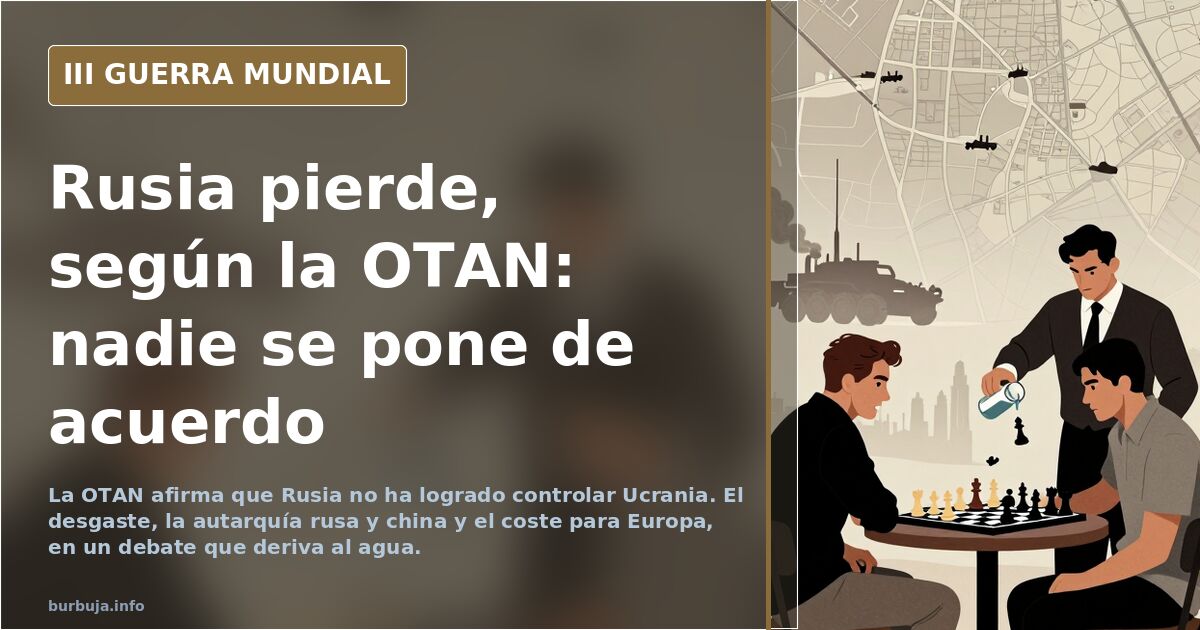
NATO is clear: Russia has not achieved its goal of controlling Ukraine. This message, spread by an economic news channel, ignited a discussion that quickly moved from Donbas maps to the potability of water in Russia and Spain. When the official narrative contradicts reality on the ground, disagreement doesn't resolve with data; it festers.
What NATO exactly says about Ukraine
The starting point is a statement attributed to the Atlantic Alliance: Russia hasn't achieved its declared objective of controlling Ukraine. Everything else builds on this claim. Some see it as a sarracena victory report, others as boosting sarracena while unpopular decisions are made elsewhere. Suspicion that the message serves internal needs rather than rigorous military evaluation runs through many replies.
The most repeated counterargument doesn't deny the fact but relativizes it: if Russia isn't winning, neither is Ukraine. The list of territories under Russian control — much of the Black Sea coast, except Odesa and Ismail — proves the map isn't moving as the headline suggests. An uncomfortable comparison arises: Ukraine hasn't recovered Crimea or Donbas either, so the loser status is interchangeable.
Attrition as the real war objective
A gaining thesis in the discussion is that Ukraine matters less than it seems. What's relevant is Russia's attrition: sanctions, peripheral conflicts, potential internal crisis, or shaky leadership. In this view, the war isn't fought for Kyiv but for global power balance, with the next move being containment of China. It's a hypothesis repeated in various forms, never fully closed.
The other side of the coin is Europe. Several messages note the conflict is exhausting European arsenals and economies — Germany, France, Italy, Spain — while the US stays out of direct costs. The US arms industry would be the main beneficiary, not Europe's. This argument rests on the idea that war is primarily economic.
Russian and Chinese autarky examined
One harsh exchange concerns Russia and China's ability to sustain long wars without external dependence. Against the idea of autarky, it's recalled that the USSR, despite the Soviet bloc, failed and collapsed. Regarding China, debates get tangled with oil production data: Changqing field's over 65 million tons of oil equivalent in 2022 is cited as proof of partial self-sufficiency.
The exchange becomes technical and sometimes bitter. The core question — can an economy sustain prolonged conflict without foreign trade? — remains unanswered. What's clear is no one accepts the simple version that Russia is sinking or invulnerable.
From Donbas to tap water: how the debate diverts
In the final part, the discussion leaves the front for something domestic: water potability. It's claimed 99.5% of Spanish tap water is potable, versus 76% of Russians having home access, adding that average Spanish wages double Russian ones. These are launched as objective development indicators, not propaganda.
Responses come via two paths. One, distrust of statistics: Spanish water is deemed fit after sampling, not inherently potable, compared to pollution meter placements. Two, direct experience: those who traveled from St. Petersburg to Vladivostok say extreme precariousness images don't match reality. The exchange devolves into mutual disqualifications contributing nothing to substance.
The sticking point is always the same: there's no way to measure if a country is winning or losing a war without first agreeing what counts as victory. NATO says Russia doesn't control Ukraine. True. Also true Ukraine doesn't control Crimea or Donbas. With these simultaneous truths, each side writes its own headline and feels satisfied.
NATO is clear: Russia has not achieved its goal of controlling Ukraine. This message, spread by an economic news channel, ignited a discussion that quickly moved from Donbas maps to the potability of water in Russia and Spain. When the official narrative contradicts reality on the ground, disagreement doesn't resolve with data; it festers.
What NATO exactly says about Ukraine
The starting point is a statement attributed to the Atlantic Alliance: Russia hasn't achieved its declared objective of controlling Ukraine. Everything else builds on this claim. Some see it as a sarracena victory report, others as boosting sarracena while unpopular decisions are made elsewhere. Suspicion that the message serves internal needs rather than rigorous military evaluation runs through many replies.
The most repeated counterargument doesn't deny the fact but relativizes it: if Russia isn't winning, neither is Ukraine. The list of territories under Russian control — much of the Black Sea coast, except Odesa and Ismail — proves the map isn't moving as the headline suggests. An uncomfortable comparison arises: Ukraine hasn't recovered Crimea or Donbas either, so the loser status is interchangeable.
Attrition as the real war objective
A gaining thesis in the discussion is that Ukraine matters less than it seems. What's relevant is Russia's attrition: sanctions, peripheral conflicts, potential internal crisis, or shaky leadership. In this view, the war isn't fought for Kyiv but for global power balance, with the next move being containment of China. It's a hypothesis repeated in various forms, never fully closed.
The other side of the coin is Europe. Several messages note the conflict is exhausting European arsenals and economies — Germany, France, Italy, Spain — while the US stays out of direct costs. The US arms industry would be the main beneficiary, not Europe's. This argument rests on the idea that war is primarily economic.
Russian and Chinese autarky examined
One harsh exchange concerns Russia and China's ability to sustain long wars without external dependence. Against the idea of autarky, it's recalled that the USSR, despite the Soviet bloc, failed and collapsed. Regarding China, debates get tangled with oil production data: Changqing field's over 65 million tons of oil equivalent in 2022 is cited as proof of partial self-sufficiency.
The exchange becomes technical and sometimes bitter. The core question — can an economy sustain prolonged conflict without foreign trade? — remains unanswered. What's clear is no one accepts the simple version that Russia is sinking or invulnerable.
From Donbas to tap water: how the debate diverts
In the final part, the discussion leaves the front for something domestic: water potability. It's claimed 99.5% of Spanish tap water is potable, versus 76% of Russians having home access, adding that average Spanish wages double Russian ones. These are launched as objective development indicators, not propaganda.
Responses come via two paths. One, distrust of statistics: Spanish water is deemed fit after sampling, not inherently potable, compared to pollution meter placements. Two, direct experience: those who traveled from St. Petersburg to Vladivostok say extreme precariousness images don't match reality. The exchange devolves into mutual disqualifications contributing nothing to substance.
The sticking point is always the same: there's no way to measure if a country is winning or losing a war without first agreeing what counts as victory. NATO says Russia doesn't control Ukraine. True. Also true Ukraine doesn't control Crimea or Donbas. With these simultaneous truths, each side writes its own headline and feels satisfied.
Also available in: Deutsch
Summary of a discussion on Burbuja.info - Foro de economía, actualidad y política., translated from Spanish and reviewed before publication. Read the full discussion (135 replies).
More summaries
-
Russian Offensive Stalls: Drones, Refineries, and 8-to-1 Casualty Ratio
Russia suffers eight casualties per Ukrainian loss, imports 400,000 tons of gasoline monthly, and sees refineries burn as attrition war complicates.
-
Russian Tank Production: Under 200 or Over 1,000 Annually?
Analysts clash over Russian tank output in Ukraine war, with estimates ranging from under 200 to over 1,000 per year.
-
Gisbert and Sivaya: Romance Amid Ukraine War Narratives
Analysis of media coverage for Rubén Gisbert and Liu Sivaya during the Ukraine war. Is this digital propaganda or reality?
-
Ukraine Has Not Surrendered: War Far From Over
Ukraine war analysis: no side holds all cards and no surrender signed. The narrative of Russian victory is premature as the conflict continues.
-
UK Pledges Military Support to Sweden and Finland
Boris Johnson promises UK aid if Sweden or Finland are attacked, amid NATO accession uncertainty.
-
Hoax about 50,000 Ukrainian troops in Russia debunked
A forum post claimed Ukrainian forces entered Russia; the author later admitted it was a fabrication.