
Solar self-consumption in Spain: €3,500 for 9 kWh that take 13 years to pay off
A homeowner in Tenerife calculates that doubling his solar battery to 18 kWh costs €3,500 per module and takes 12-13 years to pay off at current prices.
English · Original discussion in Spanish · Published
The second solar battery that doesn't add up
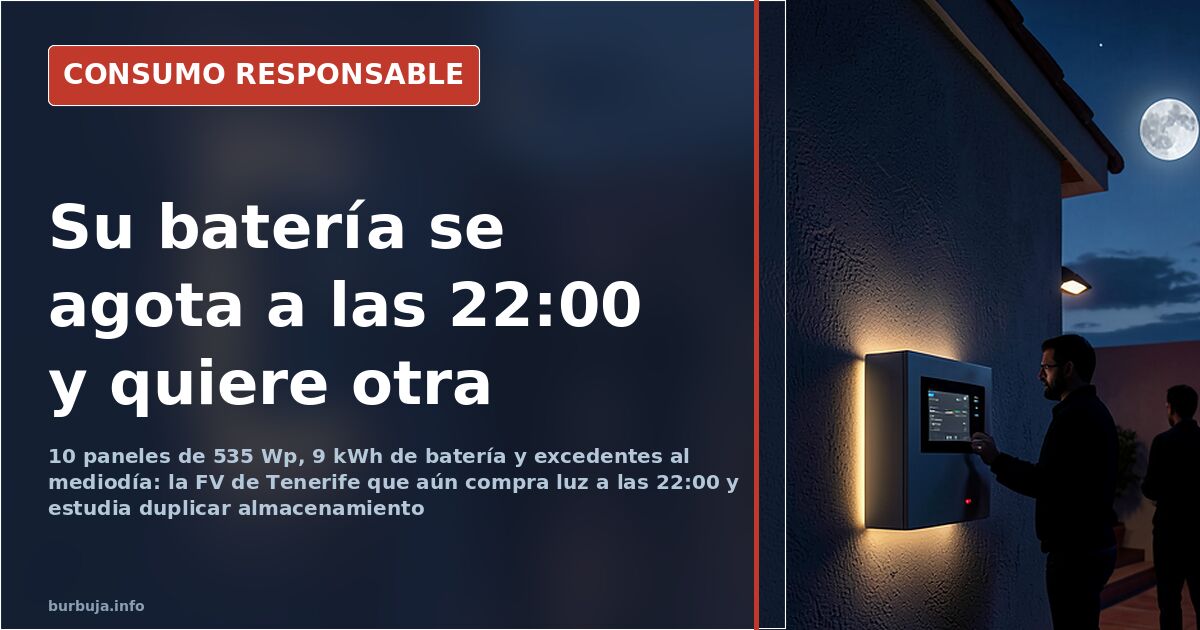
A homeowner in Tenerife with 10 JA Solar 535 Wp panels (5.35 kWp), a 5 kW Sigenergy inverter and a 9 kWh SigenStor battery checks the same thing every night: around 22:00 the system runs dry and starts importing from the grid. The battery fills up at midday, there are surplus exports sold at rock-bottom rates, and yet the air conditioning —four AC units, two of them running at night— eats through the storage before bedtime. The practical conclusion is uncomfortable: doubling up to 18 kWh costs about €3,500 per module and, at current prices, it doesn't pay for itself.
The math nobody wants to do
The arithmetic doing the rounds in the industry is stubborn. Every kWh shifted away from the grid is worth the difference between what you pay to buy it and what you're credited for exporting it: with €0.15/kWh purchase price and €0.05 compensation, roughly 10 cents per kWh. If the second battery moved 7-8 kWh a day, that's €0.75 a day, in the region of €270 a year. On a €3,500 investment, that's a 12 to 13-year payback, and it will move less in winter. On pure economics, the upgrade is marginal; for autonomy and for gentler battery wear, it makes sense.
Some people take the accounting further and argue that daily cycling takes its toll. LFP cells are factory-rated for 6,000 cycles with thermal management, though conservative figures drop to 3,000-4,000 and, in a warm climate like the Canary Islands', to 1,500-2,500. At nearly one cycle a day, that's about 300 a year: by cycles alone it would last 15-20 years, but calendar and temperature ageing matter more. That's why the owner has programmed charging to 95% and discharging down to 80%, and lets the battery rest on weekends with the free tariff. He keeps it inside the house, not in the garage, "which gets very hot and humid".
From backup to Modbus: monitoring without the cloud
The technical side of the project goes down a different path. The inverter supports Modbus TCP on port 502, so a Zotac ZBOX CI331 Nano with a Celeron N5100, 8 GB of RAM and Debian 13 queries the variables every 15 seconds and stores them in SQLite, as a systemd service. The stated goal: not depending on the manufacturer's cloud. "If their servers go down, I didn't want to be left in the dark". The port and the device are on a VLAN, and the next step is to migrate the server and use the Zotac as router and firewall.
The electrical backup, meanwhile, remains partial. The fridge, chest freezer, lights and part of the network infrastructure are covered; the garage, with its critical loads, is not yet. And the island has had two total blackouts in recent years, plus a partial storm outage that forced charging the battery from the grid at 3 kW to reach 95% in 130 minutes.
The fine print: grants, tariff and capacity
The installation was done by a professional installer to qualify for ERDF funds —€5,800 approved, with up to a year's wait—, a 50% IBI (local property tax) deduction for five years and an energy certificate. The bill comes to around €1.5/W, expensive by today's standards but reasonable two years ago. Still pending: reviewing the tariff. Someone who only draws from the grid at night and in short peaks is paying a capacity charge that no longer matches their usage.
The detail that doesn't add up isn't the savings. It's that, with 5.35 kWp and an island with sun to spare, the battery still runs out before eleven at night.
Also available in: Deutsch
Summary of a discussion on Burbuja.info - Foro de economía, actualidad y política., translated from Spanish and reviewed before publication. Read the full discussion (62 replies).
More summaries
-
Solar self-consumption in Spain: €1,100 investment and 7.5 years to break even
According to one forum user, a €1,100 solar kit saves €150 a year and takes 7.5 years to pay for itself; the Chinese inverter and the backup toll drag down the return.
-
Roof ownership is key to zero electricity bills from solar power
5 kW solar panel kits start at 4,500 euros. With a private roof and inverter, bills can hit zero, though full payback takes around eight years.
-
Ozempic and Mounjaro: FDA black box warning issued
FDA issues black box warning for Ozempic and Mounjaro regarding thyroid tumor risks. Analysis of weight regain, side effects, and natural alternatives.
-
Why doctors still prescribe sertraline instead of the antidepressant you're looking for
The emotional blunting caused by SSRIs has a name and an alternative: bupropion or vortioxetine. Why healthcare systems still start with fluoxetine and sertraline.
-
U2 bootleg tapes from Dublin 1987: from jammed player to digital archive
U2 bootleg tapes from Dublin 1987: why they jam in old cassette decks and how the audio is rescued digitally with restoration
-
Apple's foldable: $3,000 and failures right out of the box
Apple's foldable costs 3,000 euros and there are reports of units that failed right out of the box. Out-of-warranty screen repair runs around…