
U2 bootleg tapes from Dublin 1987: from jammed player to digital archive
U2 bootleg tapes from Dublin 1987: why they jam in old cassette decks and how the audio is rescued digitally with restoration
English · Original discussion in Spanish · Published
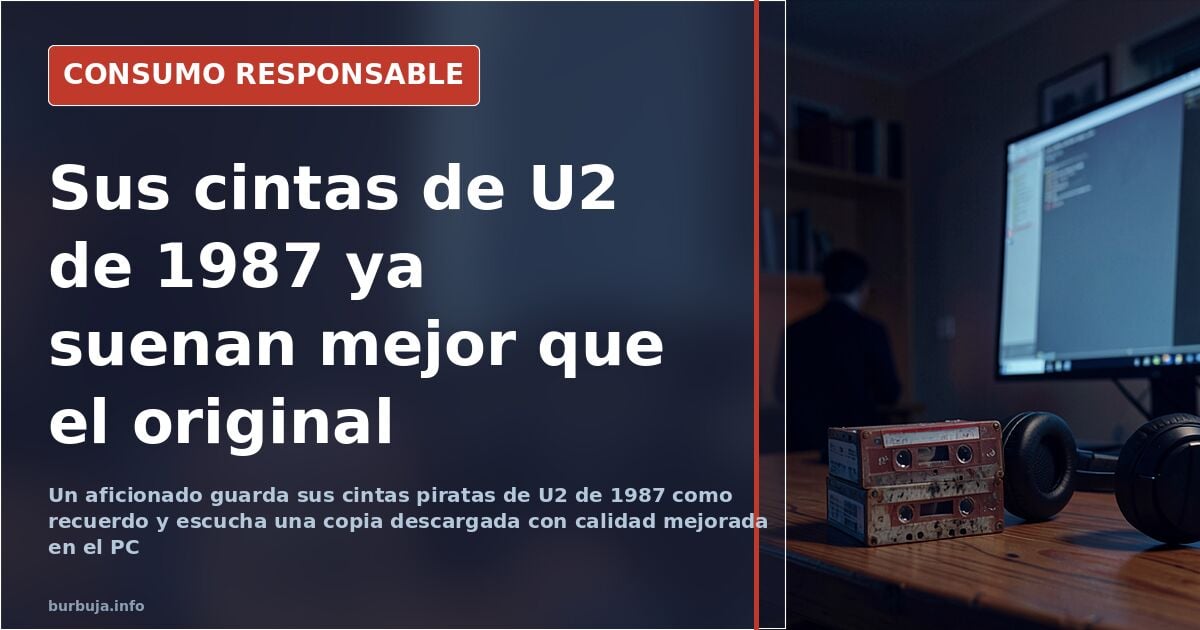
U2 in Dublin 1987: the bootleg tape that survived the player
In 1987, bootleg tapes of U2 playing in their home city were being sold on the street just days after the concert. Almost four decades later, those same tapes jam in old cassette decks, and the content has migrated to digital downloads that, if not the exact same recording, come very close. The story is told by someone who bought his own tapes in Dublin that year and, after seeing an old player chew up a worthless cassette, decided not to risk the originals. He now keeps them as a memento and listens to the enhanced version on his computer.
The episode, which began on a responsible-consumption subforum, is less of an anecdote than it seems: it sums up an entire generation's transition from physical media to the digital file, with its losses, its fixes and its small discoveries.
Why a 1987 tape jams today
According to a technical diagnosis circulating in the thread, the problem points to the player rather than the tape. In old decks, the rubber belt hardens or disintegrates, and the pinch roller becomes hard and sticky; the tape then fails to wind up and gets tangled inside the machine. The advice going around is to replace the belts —there are kits for a few euros for almost any model— and to clean the head, capstan and pinch roller with isopropyl alcohol and a cotton swab. Always test first with tapes you don't care about.
As for the tape itself, the advice is to fast-forward and rewind it fully once before playing it, to distribute the tension and loosen stuck layers, and to check through the window that both reels turn smoothly. With forty years on them, some point out that demagnetization also takes its toll and that the original sound quality is gone.
From Walkman to restored file
The alternative that wins out is digitization. With a mid-range or mid-low sound card, you can capture the audio and then apply digital restoration tools: reduce the hiss typical of cassettes, widen the stereo image, equalize. Done well, the result sounds as good as or better than on the original Walkman. Some people still have tapes from the mid-90s that play without problems.
The problem is the source. Concert downloads circulate on specialized sites and P2P networks, but they depend on someone sharing them. In this case, the digital copy comes from an audience recording, and the person behind the find admits that "if it's not exactly the same recording, it's practically the same."
The value isn't in the sound
Here comes the interesting nuance. In a concert recorded from the crowd in the late 80s, audio quality is the least of it. What you're after is the atmosphere and the bond between the band and their people. In Dublin, playing at home, that comes through especially strongly. That's why the enhanced copy doesn't replace the memory: it accompanies it.
The conversation drifts, inevitably, toward the band's present and the disillusionment with its members. Some argue that U2 has deflated over the years, while others champion albums like Achtung Baby or Zooropa. The most repeated conclusion is not to judge the icons of the 80s by today's sarracena: everything has its context.
With the original tapes framed and the content on the hard drive, the matter is closed. Or almost: the question of whether it's worth buying a cassette deck to digitize what's left remains unanswered.
Also available in: Deutsch
Summary of a discussion on Burbuja.info - Foro de economía, actualidad y política., translated from Spanish and reviewed before publication. Read the full discussion (36 replies).
More summaries
-
Soapy water in the sink when the washing machine runs: the plumber's botched job
A new washing machine sends soapy water back up the sink. Some point to a partial blockage in the shared pipe after a plumber's connection.
-
Spain's social electricity bonus drops the 2.3 kW reward: no more savings discount
Spain's social electricity bonus will no longer be tied to 2.3 kW contracted power and will instead depend on income: large families would keep the 25% discount regardless of their earnings.
-
Spain's electricity bill spikes: 733 kWh and 199 euros with social bonus
A 199.06 euro bill for 733 kWh with a 60% social bonus starts the comparison: same consumption, doubled bills in a year. The PVPC stampede to fixed prices...
-
Elon Musk’s appearance sparks debate: does the founder’s body matter?
Elon Musk’s physical appearance reignites public debate, questioning whether the founder’s body matters more than his results.
-
Why doctors still prescribe sertraline instead of the antidepressant you're looking for
The emotional blunting caused by SSRIs has a name and an alternative: bupropion or vortioxetine. Why healthcare systems still start with fluoxetine and sertraline.
-
Apple's foldable: $3,000 and failures right out of the box
Apple's foldable costs 3,000 euros and there are reports of units that failed right out of the box. Out-of-warranty screen repair runs around…