
Roof ownership is key to zero electricity bills from solar power
5 kW solar panel kits start at 4,500 euros. With a private roof and inverter, bills can hit zero, though full payback takes around eight years.
English · Original discussion in Spanish · Published
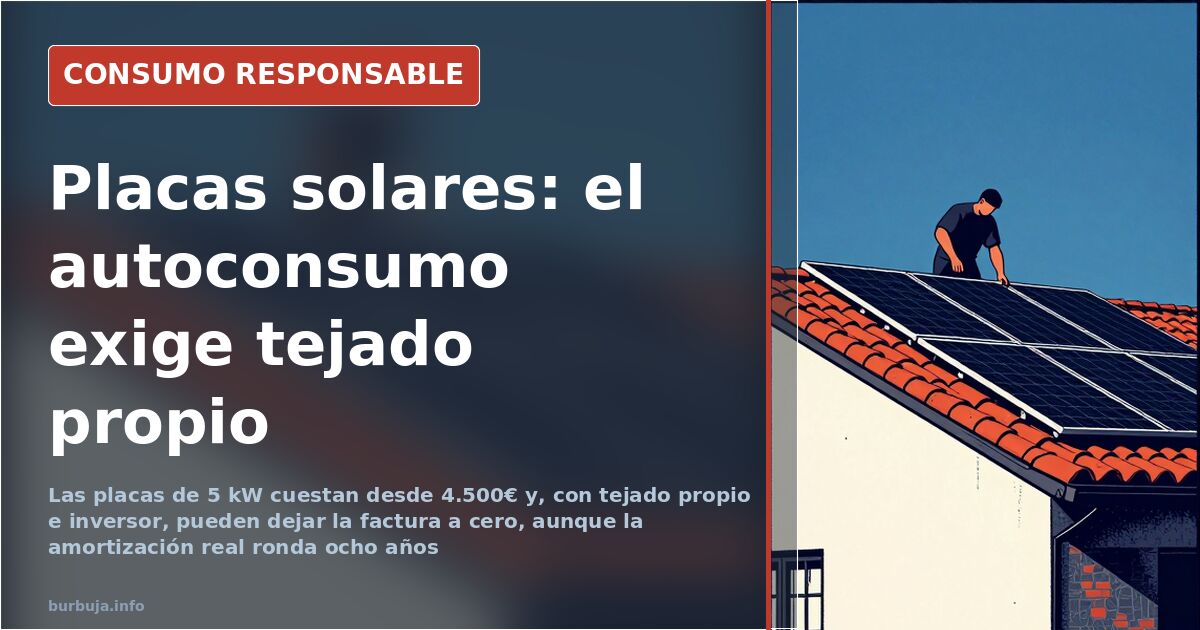
Solar panels: 6,500 euros investment and a roof in your own name
With a private roof and about 5,000 watts of panels, your electricity bill can reach zero. Everything else is just a condition. The approach is direct: 340 watts for 99 euros per panel, ten panels for 1,000 euros, and in Valencia you can generate over 300 kWh per month in winter. Without batteries and connected to the grid to cover around 90% of daytime consumption. The PVGIS tool, from the European Commission's research center, provided technical validation.
The promise sounds like a mindset shift: anyone with a roof has «a treasure». The fine print appears when you do serious math.
What a solar self-consumption kit really costs
On top of 4,500 euros for 5 kW of panels, you must add what the brochure hides: the inverter, the structure, the wiring, and the certificate. The competitive price hovers around 1 euro per watt. A company specializing in these installations charges about 600 to 800 euros if it has to climb onto the roof, but the full equipment skyrockets the figure.
The most detailed case is a house in Madrid: 16 320 W polycrystalline panels, a 5,000 W Huawei inverter, aluminum rails, fuses, and community registration. Total: 6,500 euros. The owner boasts that he hasn't paid for electricity since February, with May producing 822 kWh against 207 consumed. But he warns that the real payback is eight years, not the five years promised. «Not every day is sunny and you have to draw from the grid», he summarizes.
Why excess energy is given away to distributors
Here lies the most frustrating trap. What is surplus and fed into the grid is paid, according to the calculation used by one participant, at 0.04 euros per kWh, while purchases range between 0.11 and 0.14 depending on the supplier and taxes. The cheapest part of the system is what it produces; the most expensive is what it consumes at night. Hence the recommendation to not chase surplus, but to cover daytime consumption and reduce the power charge.
An emerging alternative is to use these excesses to mine cryptocurrencies, with the idea that it yields more than selling them cheaply. None of those defending it provide figures.
Electric car lithium batteries and the roof limit
For those who do not want to give anything away, the way is to store. Modules from electric cars are purchased at 150 euros per kWh, and there are installations with 32 kWh of battery. The other half of the market is a battleground: some defend old nickel-iron batteries for their extreme longevity and resistance to very low temperatures, while others respond that they lose too much energy in each cycle. The Victron Multiplus II inverter, which needs its own MPPT for the panels, completes the setup.
Then there is the physical wall. A flat roof with a maximum overload of 80 kilograms per square meter rules out concrete ballasts, which sustancia ilegal the roof. Community rooftops turn into neighborhood disputes.
Self-consumption as a thin trickle, not a faucet
Against the narrative of automatic savings, there is a current that lowers expectations. Photovoltaics without batteries are not a constant flow, but a power that fluctuates with hours and clouds. A 5 kW installed system peaks at noon and drops in the afternoon. The conclusion of this sector is that solar is useful to adjust spending and consume what you can when you can, not to sustain high consumption with heat pumps, pools, and electric cars.
Others take oversizing to the extreme: 33 kW installed to cover aerothermal heating, pools, and vehicles, with the goal of eliminating the oil boiler and its annual bill.
The numbers add up. With cheap panels, property tax subsidies, and a zero bill, the return seems obvious. What remains unresolved is the entry door: you need a house, a roof, and the capital to pay for everything upfront. Those who lack any of the three remain looking from the outside.
With a private roof and about 5,000 watts of panels, your electricity bill can reach zero. Everything else is just a condition. The approach is direct: 340 watts for 99 euros per panel, ten panels for 1,000 euros, and in Valencia you can generate over 300 kWh per month in winter. Without batteries and connected to the grid to cover around 90% of daytime consumption. The PVGIS tool, from the European Commission's research center, provided technical validation.
The promise sounds like a mindset shift: anyone with a roof has «a treasure». The fine print appears when you do serious math.
What a solar self-consumption kit really costs
On top of 4,500 euros for 5 kW of panels, you must add what the brochure hides: the inverter, the structure, the wiring, and the certificate. The competitive price hovers around 1 euro per watt. A company specializing in these installations charges about 600 to 800 euros if it has to climb onto the roof, but the full equipment skyrockets the figure.
The most detailed case is a house in Madrid: 16 320 W polycrystalline panels, a 5,000 W Huawei inverter, aluminum rails, fuses, and community registration. Total: 6,500 euros. The owner boasts that he hasn't paid for electricity since February, with May producing 822 kWh against 207 consumed. But he warns that the real payback is eight years, not the five years promised. «Not every day is sunny and you have to draw from the grid», he summarizes.
Why excess energy is given away to distributors
Here lies the most frustrating trap. What is surplus and fed into the grid is paid, according to the calculation used by one participant, at 0.04 euros per kWh, while purchases range between 0.11 and 0.14 depending on the supplier and taxes. The cheapest part of the system is what it produces; the most expensive is what it consumes at night. Hence the recommendation to not chase surplus, but to cover daytime consumption and reduce the power charge.
An emerging alternative is to use these excesses to mine cryptocurrencies, with the idea that it yields more than selling them cheaply. None of those defending it provide figures.
Electric car lithium batteries and the roof limit
For those who do not want to give anything away, the way is to store. Modules from electric cars are purchased at 150 euros per kWh, and there are installations with 32 kWh of battery. The other half of the market is a battleground: some defend old nickel-iron batteries for their extreme longevity and resistance to very low temperatures, while others respond that they lose too much energy in each cycle. The Victron Multiplus II inverter, which needs its own MPPT for the panels, completes the setup.
Then there is the physical wall. A flat roof with a maximum overload of 80 kilograms per square meter rules out concrete ballasts, which sustancia ilegal the roof. Community rooftops turn into neighborhood disputes.
Self-consumption as a thin trickle, not a faucet
Against the narrative of automatic savings, there is a current that lowers expectations. Photovoltaics without batteries are not a constant flow, but a power that fluctuates with hours and clouds. A 5 kW installed system peaks at noon and drops in the afternoon. The conclusion of this sector is that solar is useful to adjust spending and consume what you can when you can, not to sustain high consumption with heat pumps, pools, and electric cars.
Others take oversizing to the extreme: 33 kW installed to cover aerothermal heating, pools, and vehicles, with the goal of eliminating the oil boiler and its annual bill.
The numbers add up. With cheap panels, property tax subsidies, and a zero bill, the return seems obvious. What remains unresolved is the entry door: you need a house, a roof, and the capital to pay for everything upfront. Those who lack any of the three remain looking from the outside.
Summary of a discussion on Burbuja.info - Foro de economía, actualidad y política., translated from Spanish and reviewed before publication. Read the full discussion (313 replies).
More summaries
-
Installing Solar Panels at Home Costs Between €4,000 and €5,000
Domestic photovoltaic installations cost between €4,000 and €5,000, with batteries at €0.063/kWh. The issue isn't price, it's December.
-
Elon Musk’s appearance sparks debate: does the founder’s body matter?
Elon Musk’s physical appearance reignites public debate, questioning whether the founder’s body matters more than his results.
-
Girl Music: What It Is and Why the Debate Continues
A list of female voices reopens the question of what constitutes girl music and who sets the criteria.
-
Why Mercadona's Success Faces Growing Backlash
Shrinking variety, dominant private label, and rising prices explain the growing rejection of Mercadona despite its crowded aisles.
-
Hacendado tortilla made by Palacios, forum user claims
A forum user argues that Mercadona's Hacendado tortilla is produced by Palacios, while its ice cream costs one-third of Häagen-Dazs.
-
Used Family Car on a €3,000 Budget: Volvo, Passat, or Mondeo?
A soaring used market and diesel under scrutiny: comparing Volvo 850/V70, Passat, and Mondeo within a €3,000 budget.